Introduction
Neonatal intensive care requires specialized equipment that can support the monitoring and treatment needs of newborn patients. Hospitals evaluating NICU Manufacturers should look at more than product availability and compare equipment specifications, safety features, reliability, installation support, maintenance, and user training. National Health Mission resources provide technical specifications for neonatal and pediatric care equipment, covering areas such as respiratory support, thermal management, monitoring, phototherapy, infusion, and suction.
Specialized Neonatal Equipment
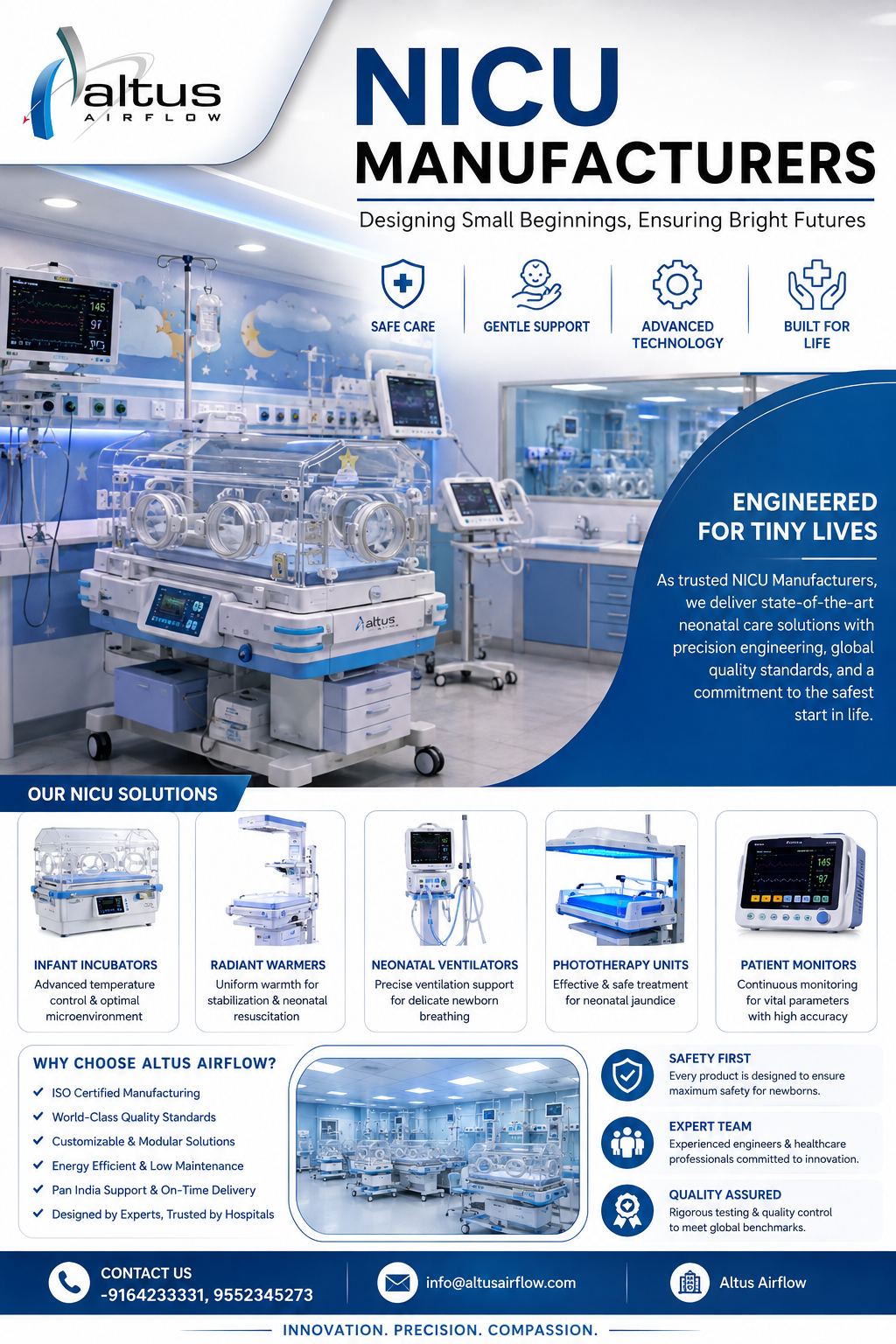
A reliable supplier should understand the different equipment requirements of neonatal care. Depending on the level of service, hospitals may need radiant warmers, incubators, phototherapy units, neonatal ventilators, CPAP systems, pulse oximeters, multiparameter monitors, infusion pumps, syringe pumps, suction systems, and transport incubators.
Patient Monitoring
Continuous observation is an important part of neonatal care. Hospitals should evaluate monitoring equipment based on the parameters required by their clinical teams, display clarity, alarm functions, ease of use, and compatibility with the planned care environment.
Thermal Management
Newborns require appropriate temperature management, particularly when specialized care is needed. Radiant warmers and incubators can provide controlled thermal support, while transport incubators can help maintain an appropriate environment when infants need to be moved between clinical areas.
Respiratory Support
Respiratory equipment is another important consideration. Depending on clinical requirements, neonatal units may use CPAP systems, ventilators, oxygen-delivery equipment, and related accessories. Equipment should be selected according to the unit's patient population, infrastructure, and clinical protocols.
Safety and Quality
Hospitals should review applicable standards, certifications, testing information, technical documentation, and safety requirements before procurement. Equipment should also be suitable for routine cleaning and disinfection. National technical specifications include requirements covering safety, environmental conditions, cleaning, installation, and documentation.
Installation and Staff Training
Correct installation and staff familiarity can significantly affect the practical use of medical equipment. Hospitals should assess whether suppliers provide installation, safety and operational checks, user training, maintenance instructions, and appropriate technical documentation.
Maintenance and Service Support
Long-term reliability requires planned maintenance rather than relying only on repairs after breakdowns. The National Health Mission's biomedical equipment programme highlights preventive maintenance, corrective maintenance, calibration, and user training as important elements of equipment management.
Power and Infrastructure Compatibility
Neonatal equipment may operate continuously, making dependable electrical infrastructure an important consideration. Hospitals should check power requirements, backup provisions, electrical protection, oxygen availability, and compatibility with the clinical environment before installation. Research involving neonatal-care facilities in India has also identified power quality and delayed repairs as equipment-related challenges.
Long-Term Reliability
Hospitals should consider warranty provisions, availability of spare parts, service responsiveness, maintenance schedules, calibration support, and technical assistance. Choosing equipment with appropriate lifecycle support can help reduce avoidable downtime and support consistent unit operations.
Conclusion
Choosing dependable NICU Manufacturers involves evaluating specialized equipment, monitoring capabilities, thermal and respiratory support, safety documentation, installation, training, maintenance, power compatibility, and long-term technical service. A structured evaluation helps hospitals select neonatal-care solutions that are appropriate for their clinical requirements and operational environment.
FAQs
1. What equipment is commonly used in neonatal intensive care?
Common equipment can include incubators, radiant warmers, neonatal ventilators, CPAP systems, monitors, pulse oximeters, phototherapy units, infusion pumps, suction systems, and transport incubators.
2. Why is thermal management important for newborns?
Thermal-management equipment helps provide an appropriately controlled environment for newborn patients according to their clinical needs.
3. What should hospitals check when selecting neonatal equipment?
Hospitals should review technical specifications, safety documentation, clinical suitability, usability, installation requirements, maintenance provisions, training, and spare-parts support.
4. How important is equipment maintenance?
Regular preventive maintenance, corrective servicing, calibration where applicable, and user training can support equipment functionality and operational reliability.
5. Why should hospitals consider technical support?
Installation assistance, staff training, troubleshooting, maintenance, calibration, and spare-parts support can help hospitals manage equipment throughout its operational lifecycle.
Read Our Previous Blog----------->Who Are the Best ICU Manufacturers for Modern Hospitals?




 English
 Arabic
 French
 Spanish
 Portuguese
 Deutsch
 Dutch
Dutch
 Italiano
 Russian
 Romaian
 Portuguese (Brazil)
 Greek
Greek
