Introduction
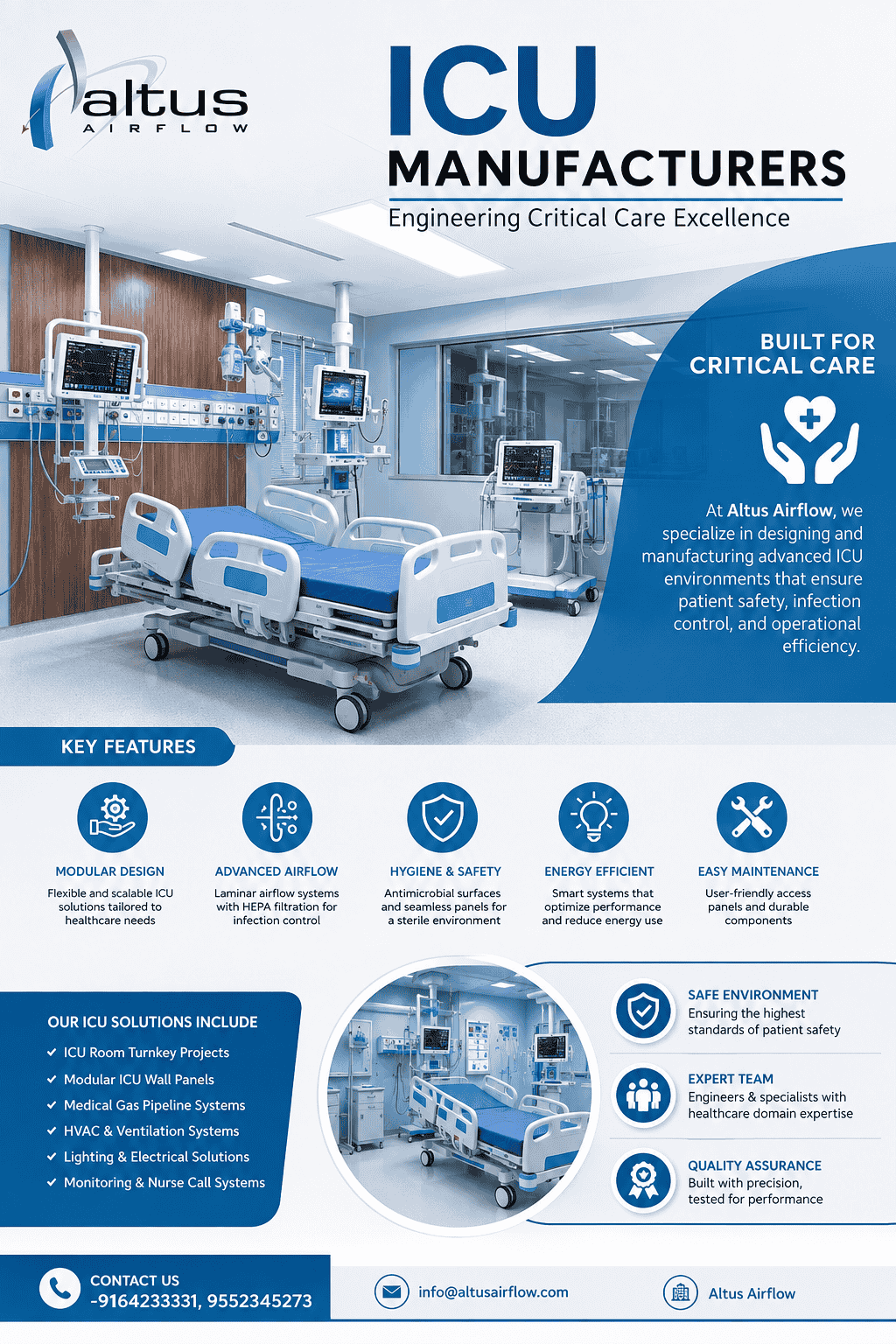
Modern intensive care units require highly coordinated clinical and technical infrastructure. ICU Manufacturers can support hospitals by developing solutions that accommodate critical-care equipment, patient monitoring, medical gases, electrical services, infection-control requirements, environmental management, emergency access, and efficient staff workflows. The appropriate approach depends on the hospital's clinical specialties, bed capacity, equipment selection, available space, and applicable healthcare standards.
Critical Care Bedspace Planning
Each ICU bedspace needs sufficient room for the patient, healthcare professionals, monitoring equipment, ventilators, infusion pumps, and emergency devices.
Well-planned bedspaces allow staff to approach patients from appropriate directions and perform procedures efficiently.
Advanced Patient Monitoring
Critical-care patients often require continuous monitoring.
Infrastructure should accommodate equipment for parameters such as ECG, blood pressure, oxygen saturation, respiratory rate, temperature, and other clinically relevant measurements.
Central Monitoring
Central monitoring facilities can provide clinical teams with information from multiple beds.
The monitoring station should complement bedside observation and support staff awareness of changing patient conditions.
Medical Gas Infrastructure
ICU beds commonly require access to essential medical gases.
Depending on clinical requirements, this can include oxygen, medical air, and vacuum. Outlet locations should provide convenient access while keeping the patient area organized.
Respiratory Support
Ventilators and other respiratory-support devices are central to many critical-care environments.
ICU infrastructure should provide suitable medical gas connections, electrical capacity, equipment-support arrangements, and monitoring connections for the devices selected by the hospital.
Reliable Electrical Systems
Critical-care units operate numerous electrically powered devices simultaneously.
Planning should account for sufficient outlets, grounding, essential circuits, equipment connections, cable management, and appropriate backup power arrangements.
Emergency Power
Power interruptions can affect critical equipment.
Hospitals should consider emergency generators, UPS systems, and designated essential circuits based on clinical priorities and applicable electrical requirements.
Emergency Equipment Access
Critical-care environments need rapid access to emergency resources.
Crash carts, defibrillators, airway equipment, emergency medications, oxygen, suction, and other required resources should be positioned so they remain readily accessible.
Infection-Control Infrastructure
ICU patients can be particularly vulnerable to healthcare-associated infections.
Infrastructure can support infection prevention through suitable hand hygiene facilities, cleanable surfaces, appropriate patient spacing, organized equipment, isolation provisions, and controlled circulation.
Isolation Rooms
Modern ICUs may require dedicated isolation facilities.
These rooms can incorporate appropriate ventilation, medical gases, electrical infrastructure, monitoring systems, communication facilities, and controlled access.
HVAC and Environmental Management
Environmental control is an important component of critical-care planning.
HVAC systems should address ventilation, filtration, temperature, humidity, airflow, and applicable pressure relationships according to the unit's clinical function.
Lighting Design
Critical-care lighting should support clinical observation and procedures.
Adjustable lighting can help provide appropriate illumination for examinations while allowing more comfortable conditions when intense lighting is unnecessary.
Noise Management
ICUs contain numerous alarms, monitors, ventilators, and other devices.
Acoustic planning and appropriate alarm-management practices can help manage unnecessary noise while preserving clinically significant alerts.
Equipment Integration
Critical-care beds can require many devices within a limited area.
Equipment-support solutions can help organize monitors, ventilators, infusion pumps, dialysis equipment, and other technologies while preserving staff access to the patient.
Wall- and Ceiling-Mounted Systems
Selected medical equipment and utilities can be incorporated into wall- or ceiling-mounted solutions.
These systems can help reduce floor congestion and provide convenient access to medical gases and electrical connections.
Storage Solutions
ICUs require organized storage for medications, consumables, respiratory supplies, protective equipment, monitoring accessories, and emergency resources.
Storage should be accessible without obstructing staff movement or emergency routes.
Communication Infrastructure
Critical-care teams coordinate with operating theatres, emergency departments, laboratories, imaging departments, wards, and specialist services.
Nurse call, telephone, intercom, and approved digital communication systems can support this coordination.
Digital Connectivity
Modern ICUs increasingly use electronic records and connected clinical technologies.
Suitable network infrastructure can support approved monitoring systems, electronic documentation, communication platforms, and other digital clinical applications.
Staff Workflow
ICU infrastructure should support efficient movement between patient beds, nursing stations, storage, medication areas, monitoring systems, and emergency resources.
Understanding actual clinical workflows can help manufacturers develop more practical solutions.
Patient and Family Support
Where hospital policies permit, ICU planning can include suitable family waiting, communication, privacy, and controlled-access provisions.
These features should be integrated without compromising clinical access or infection-control practices.
Safe Patient Transfers
Critical-care patients may require transportation to operating theatres, imaging departments, procedure rooms, or other units.
Routes should accommodate ICU beds, monitoring equipment, ventilators, oxygen supplies, staff, and emergency resources.
Modular Infrastructure
Modular solutions can help coordinate medical gases, electrical services, equipment supports, wall systems, and other technical infrastructure.
They can also provide flexibility when hospitals need to modify or upgrade selected parts of the ICU.
Maintenance Access
ICU infrastructure should be designed with maintenance requirements in mind.
Medical gas systems, electrical services, HVAC components, communication infrastructure, and equipment-support systems need appropriate access for inspection and servicing.
Testing and Commissioning
Relevant systems should be tested and commissioned before the ICU becomes operational.
Depending on project scope, this can include medical gases, electrical systems, emergency power, HVAC, monitoring interfaces, communication systems, and equipment supports.
Future-Ready Planning
Critical-care technology evolves continuously.
Flexible infrastructure can allow hospitals to introduce new monitoring devices, modify equipment arrangements, upgrade utilities, and adapt bedspaces as clinical requirements change.
Multidisciplinary Coordination
ICU projects require collaboration among intensivists, nurses, architects, biomedical engineers, MEP consultants, infection-control professionals, manufacturers, contractors, and facility managers.
This coordination helps ensure that clinical requirements and technical infrastructure are addressed together.
Conclusion
ICU Manufacturers can meet the needs of modern critical-care facilities by supporting integrated solutions for patient bedspaces, monitoring, respiratory care, medical gases, electrical infrastructure, emergency preparedness, infection control, HVAC, equipment integration, storage, communication, and flexible infrastructure. Hospitals should evaluate solutions based on clinical requirements, patient capacity, equipment needs, staff workflow, available space, maintenance considerations, and applicable healthcare standards. A coordinated approach can help create critical-care environments that are functional, adaptable, and suitable for demanding clinical operations.
FAQs
1. How can ICU Manufacturers support modern critical-care facilities?
They can provide solutions for critical-care bedspaces, monitoring infrastructure, medical gases, electrical services, equipment integration, infection control, HVAC, emergency support, communication, storage, and modular infrastructure.
2. Why is medical gas planning important in an ICU?
Critical-care patients may require oxygen, medical air, and vacuum. Properly positioned outlets can support respiratory equipment and suction while maintaining organized patient areas.
3. How can ICU infrastructure support infection control?
Cleanable surfaces, hand hygiene facilities, suitable bed spacing, isolation rooms, organized equipment, and controlled circulation can support established infection-prevention practices.
4. Why is flexible infrastructure valuable in an ICU?
Flexible infrastructure can help hospitals adapt to new medical technologies, upgraded monitoring systems, changing equipment arrangements, and evolving clinical workflows.
5. What should hospitals evaluate when selecting ICU solutions?
Hospitals should consider clinical suitability, quality, technical compatibility, customization, project experience, documentation, installation, commissioning, maintenance support, future flexibility, and applicable standards.
Read Our Previous Blog----------->What elements contribute to an efficient Recovery Room Setup?




 English
 Arabic
 French
 Spanish
 Portuguese
 Deutsch
 Turkish
 Dutch
Dutch
 Italiano
 Russian
 Romaian
 Greek
Greek
