


Who are the leading Laminar Airflow System Manufacturers in India?
INTRODUCTION
Choosing among Laminar Airflow System Manufacturers in India requires more than comparing product prices. Hospitals, pharmaceutical facilities, IVF laboratories, research centres, and other controlled environments need airflow systems that are appropriately designed, manufactured, installed, tested, and maintained for their intended application. India has several established manufacturers and cleanroom engineering companies offering laminar airflow units, HEPA filtration systems, modular operation theatre solutions, and integrated HVAC systems. The right supplier depends on the application, required airflow pattern, filtration efficiency, room configuration, customization requirements, documentation, and after-sales support.
It is important to note that there is no single official national ranking of the "leading" manufacturers. Companies specialize in different segments, ranging from laboratory laminar airflow workstations to healthcare operating-theatre systems and complete cleanroom projects. Therefore, hospitals and organizations should evaluate manufacturers based on technical capabilities and project experience rather than rankings alone.
What Is a Laminar Airflow System?
A laminar airflow system is an engineered air-management solution designed to provide a controlled, uniform airflow pattern through high-efficiency filtration.
Depending on the application, airflow may be configured as:
- Vertical laminar airflow
- Horizontal laminar airflow
- Ceiling-mounted airflow
- Surgical-zone laminar airflow
- Localized clean-air workstations
The system generally combines components such as:
- Air-handling equipment
- HEPA filtration
- Fans or blowers
- Filter housings
- Air distribution sections
- Control panels
- Sensors
- Diffusers or airflow modules
The design should be selected according to the intended application rather than using the same configuration for every facility.
Why Is Manufacturer Selection Important?
The manufacturer influences the system's performance throughout its operating life.
A technically capable supplier should be able to address:
- Airflow requirements
- Filtration
- Pressure relationships
- Noise
- Energy consumption
- Equipment integration
- Maintenance access
- Testing
- Documentation
- Future servicing
A low-cost system that is poorly matched to the application may result in unstable airflow, excessive maintenance, inadequate filtration performance, or difficult servicing.
Notable Laminar Airflow Manufacturers and Providers in India
Several Indian companies publicly identify themselves as manufacturers or providers of laminar airflow and related cleanroom systems. The following are examples of notable companies based on their published product and service capabilities, not a definitive ranking.
1. Microflow Devices India Private Limited
Microflow Devices India Private Limited, based in Chennai, offers a broad range of cleanroom equipment, including laminar airflow systems, operation-theatre laminar flow, horizontal laminar airflow, biosafety cabinets, pass boxes, air showers, and cleanroom systems.
The company states that it designs, constructs, equips, installs, commissions, and maintains modular operation theatres and associated cleanroom systems across India.
Its portfolio makes it relevant for organizations looking for a combination of cleanroom equipment and healthcare-oriented controlled environments.
2. Filtotech Air Control System Pvt. Ltd.
Filtotech, based in Kolkata, operates in cleanroom engineering and HVAC. The company describes its experience in designing and installing pharmaceutical and healthcare cleanrooms and also manufactures laminar-flow-type movable cleanrooms for manufacturing, laboratory, technical, and healthcare applications.
This type of expertise can be valuable when laminar airflow needs to be integrated with broader HVAC and cleanroom infrastructure rather than treated as an isolated unit.
3. Care Equipment
Care Equipment is another Indian manufacturer focused on cleanroom equipment. Its published portfolio includes:
- Horizontal laminar airflow units
- Vertical laminar airflow units
- Ceiling-mounted LAF systems
- Mobile laminar airflow units
- Biosafety cabinets
- Pass boxes
- Air showers
- Cleanroom furniture
The company also states that its systems can be manufactured according to customer requirements and provides documentation such as HEPA filter test certificates and qualification-related documents.
This makes customization and documentation important evaluation points for buyers.
4. Pillar 9 TAE India Pvt. Ltd.
Pillar 9 TAE India presents itself as a provider of modular operation rooms and cleanroom solutions. Its published portfolio includes customized modular operation-room systems, hygienic wall and ceiling panels, medical infrastructure, and high-efficiency laminar airflow systems.
For hospitals, this integrated approach can be useful when airflow systems need to work together with modular OT construction and other healthcare infrastructure.
5. VayuClean Technologies
VayuClean Technologies, based in Vasai, Maharashtra, describes itself as an ISO 9001:2015-certified cleanroom equipment manufacturer. Its published product portfolio includes laminar air flow systems, air showers, pass boxes, biosafety cabinets, and HEPA systems for pharmaceutical, biotechnology, and healthcare applications.
This type of supplier may be considered when the project requires cleanroom equipment beyond a single laminar airflow unit.
6. Medi Clean India
Medi Clean India describes its specialization as precision airflow-control and pressurization systems for critical environments. Its published applications include laboratories, hospitals, pharmaceutical process areas, cleanrooms, and containment facilities.
This broader airflow-control expertise can be relevant for projects where laminar airflow forms part of a larger environmental-control strategy.
7. Other Manufacturers and Suppliers
Industry directories also list several Indian manufacturers and suppliers operating in this segment. These include companies associated with locations such as Hyderabad, Delhi, Chennai, Mumbai, Kolkata, Ahmedabad, Vadodara, and other manufacturing centres. Directory listings should be treated as a starting point rather than an independent certification of quality or project capability.
Organizations should independently verify technical credentials, references, manufacturing capability, certifications, and completed projects before selecting a supplier.
How Should Hospitals Evaluate Laminar Airflow Manufacturers?
A manufacturer should be evaluated according to the actual application.
1. Healthcare Experience
Hospitals should look for experience with:
- Operation theatres
- Modular OTs
- Orthopaedic OTs
- Cardiac OTs
- Ophthalmic OTs
- Gynaecological OTs
- IVF facilities
- Critical healthcare environments
Healthcare airflow requirements can differ considerably from laboratory or industrial applications.
2. Engineering Capability
Manufacturing alone is not enough for complex projects.
A capable provider should understand:
- Airflow calculations
- HEPA filtration
- HVAC integration
- Pressure control
- Air distribution
- Heat loads
- Room volume
- Equipment positioning
- Maintenance access
Engineering should begin before equipment manufacturing.
3. Customization
Different facilities have different requirements.
A manufacturer should be able to consider:
- Room dimensions
- Ceiling height
- Surgical area
- Equipment configuration
- Existing HVAC
- Required airflow pattern
- Filter arrangement
- Access requirements
Customization is particularly important for modular operation theatres and healthcare renovations.
4. HEPA Filtration
The filtration system is a major component of laminar airflow.
Buyers should verify:
- Filter specifications
- Filter efficiency
- Filter certification
- Housing design
- Sealing
- Filter replacement procedure
- Integrity-testing capability
The appropriate filter selection should be based on the application and project specifications.
5. HVAC Integration
A laminar airflow system should work properly with the room's HVAC system.
The design should consider:
- Air-handling capacity
- Supply-air volume
- Return-air volume
- Temperature
- Humidity
- Pressure
- Fresh air
- Filtration stages
Poor integration can compromise overall system performance.
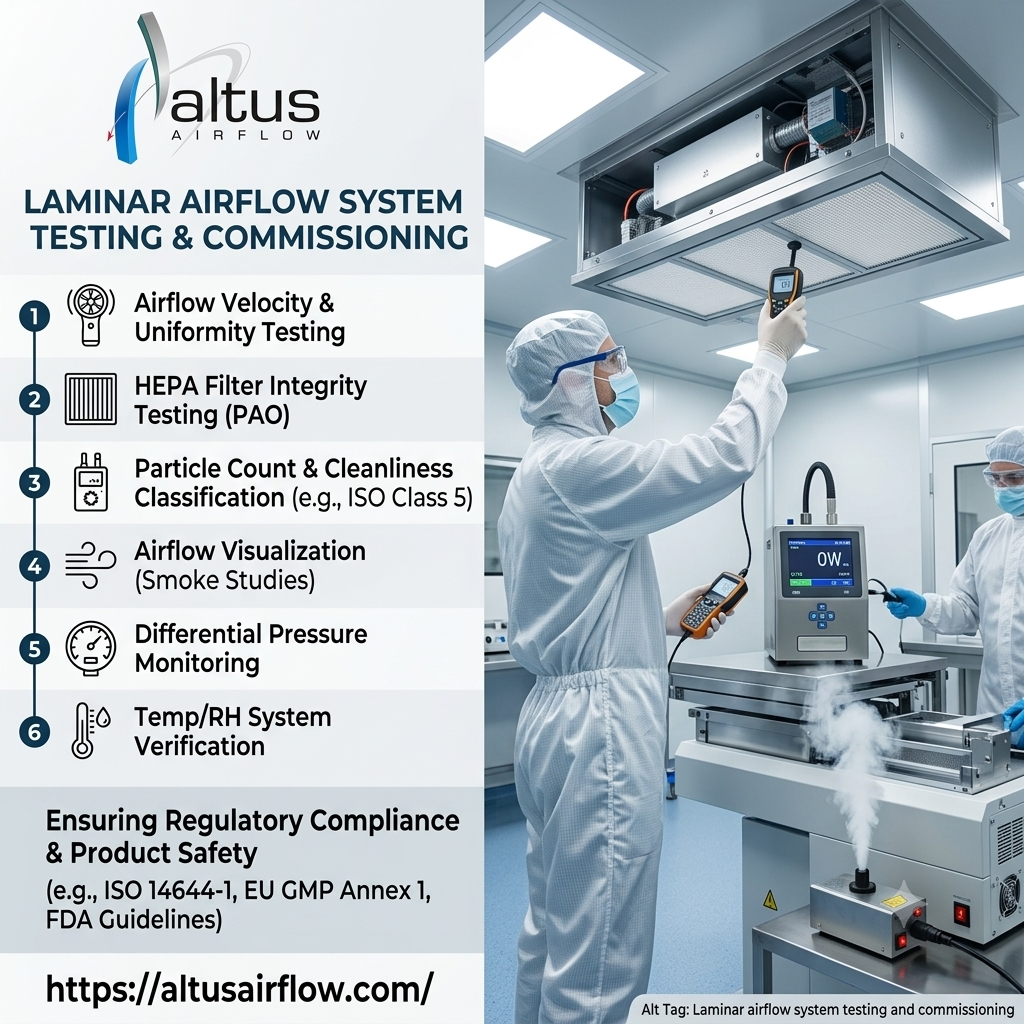
Why Testing and Commissioning Matter
A manufacturer should provide or coordinate appropriate testing after installation.
Depending on the project, this may include:
- Airflow measurement
- Air velocity testing
- HEPA filter integrity testing
- Pressure differential testing
- Particle testing where specified
- Temperature measurement
- Humidity measurement
- System functionality checks
Testing establishes whether the installed system meets the approved project requirements.
Importance of Documentation
Professional manufacturers should provide appropriate technical documentation.
This can include:
- Product specifications
- Drawings
- Operation manuals
- Maintenance instructions
- Filter certificates
- Test reports
- Calibration documentation
- Commissioning records
- Warranty information
Documentation becomes particularly important when the system is installed in a regulated healthcare or pharmaceutical environment.
Laminar Airflow for Modular Operation Theatres
Operating theatres represent one of the more specialized applications.
In a surgical environment, the airflow design must be coordinated with:
- Surgical table
- Operating lights
- Ceiling services
- Surgical equipment
- HVAC
- Return-air arrangement
- Room pressure
A manufacturer with experience in modular OTs can better understand these interactions.
The airflow system should not be selected only on the basis of fan capacity or filter efficiency. Its integration with the complete OT environment is equally important.
Laminar Airflow for IVF Laboratories
IVF laboratories have different requirements from operating theatres.
Laboratory design may require attention to:
- Temperature stability
- Humidity
- Airborne particles
- VOC control
- Pressure relationships
- Filtration
- Equipment heat loads
- Low-vibration conditions
Therefore, an organization choosing a supplier for an IVF facility should look for experience in controlled laboratory environments.
Laminar Airflow for Pharmaceutical Facilities
Pharmaceutical manufacturing and research environments may require specialized cleanroom configurations.
Potential applications include:
- Sterile manufacturing
- Aseptic processing
- Dispensing
- Sampling
- Research
- Quality-control laboratories
The system should be designed according to the facility's process, cleanroom classification, applicable quality requirements, and validated operating conditions.
Maintenance Support
The relationship with the manufacturer should continue after installation.
Important services can include:
- Preventive maintenance
- Filter inspection
- HEPA filter replacement
- Fan servicing
- Airflow balancing
- Sensor checks
- Control-system maintenance
- Periodic testing
A manufacturer with local service capability can help reduce downtime.
Questions to Ask Before Selecting a Manufacturer
Organizations should ask potential suppliers:
- How many similar projects have you completed?
- Do you manufacture systems in-house?
- Can the airflow design be customized?
- What HEPA filters are used?
- How is airflow calculated?
- How is the system integrated with HVAC?
- What testing is included?
- Is HEPA integrity testing available?
- What documentation is supplied?
- What warranty is provided?
- Is preventive maintenance available?
- Can replacement filters be supplied?
- What is the expected lead time?
- Can you provide references for similar projects?
- What qualifications and certifications does the company maintain?
These questions help separate a complete engineering provider from a basic equipment reseller.
Manufacturer vs. Equipment Supplier
There is an important difference between purchasing from a manufacturer and purchasing through a general supplier.
A manufacturer may provide:
- Product customization
- Engineering support
- Manufacturing control
- Technical documentation
- Direct service
- Spare parts
- Product modifications
A supplier may primarily handle:
- Procurement
- Distribution
- Installation coordination
Neither model is automatically better. The correct choice depends on the complexity of the project.
Why Local Service Capability Matters
Laminar airflow systems require periodic maintenance and performance verification.
A manufacturer or engineering partner with accessible service teams can help with:
- Emergency repairs
- Filter replacement
- Airflow testing
- Preventive maintenance
- Spare parts
- System upgrades
This is especially important for hospitals and pharmaceutical facilities where prolonged downtime can disrupt operations.
How to Compare Quotes
The lowest quotation should not automatically be considered the best option.
Compare quotations based on:
| Evaluation Area | What to Check |
|---|---|
| Engineering | Design and airflow calculations |
| Filtration | HEPA specifications and certification |
| Manufacturing | Construction quality and materials |
| Customization | Ability to meet site requirements |
| Installation | Skilled installation team |
| Testing | Airflow and filter testing |
| Documentation | Drawings, reports, manuals |
| Warranty | Coverage and duration |
| Maintenance | AMC and service support |
| Experience | Similar completed projects |
A technically complete quotation can provide better long-term value than a cheaper quotation with limited scope.
Emerging Technologies
Modern airflow systems are increasingly incorporating:
- Digital monitoring
- Variable-speed drives
- Energy-efficient fans
- Differential-pressure monitoring
- Smart controls
- Remote alarms
- Automated environmental monitoring
- Improved filter monitoring
These technologies can help facilities improve energy efficiency, monitoring, and preventive maintenance when appropriately specified.
Choosing the Right Manufacturer for Your Application
The best manufacturer is not necessarily the largest company or the one with the lowest price.
The right provider should demonstrate:
- Relevant application experience
- Strong engineering capabilities
- Quality manufacturing
- Appropriate filtration
- Customization
- Testing and commissioning
- Documentation
- Reliable after-sales support
- Maintenance capability
For healthcare projects, particular attention should be given to experience with modular operation theatres and integrated HVAC systems.
Conclusion
India has a diverse market of manufacturers and engineering companies offering laminar airflow systems for healthcare, pharmaceutical, laboratory, biotechnology, and industrial applications. Companies such as Microflow Devices, Filtotech, Care Equipment, Pillar 9 TAE, VayuClean Technologies, and Medi Clean India are examples of organizations with publicly documented capabilities in laminar airflow or associated cleanroom and airflow-control solutions. The right choice should ultimately be based on application-specific engineering, filtration, customization, testing, documentation, installation quality, and long-term service rather than an assumed ranking. For hospitals and healthcare institutions seeking integrated laminar airflow, modular OT, HVAC, cleanroom, and contamination-control solutions, Altus Airflow offers project-focused engineering and turnkey support for specialized healthcare environments.
Frequently Asked Questions
1. Who are the leading Laminar Airflow System Manufacturers in India?
Several companies operate in India's laminar airflow and cleanroom sector. Examples include Microflow Devices, Filtotech, Care Equipment, Pillar 9 TAE, VayuClean Technologies, and Medi Clean India. Organizations should evaluate Laminar Airflow System Manufacturers according to their specific application, engineering capabilities, certifications, testing, and service support rather than relying only on rankings.
2. What industries use laminar airflow systems?
Laminar Airflow System Manufacturers serve industries including healthcare, pharmaceuticals, biotechnology, research laboratories, electronics, food processing, and other controlled environments. The system configuration should be selected according to the specific process and environmental requirements.
3. Can Laminar Airflow System Manufacturers provide customized systems?
Yes. Many Laminar Airflow System Manufacturers offer customized dimensions, airflow configurations, filter arrangements, controls, and construction materials according to project requirements. Customization should be based on airflow calculations and the intended application.
4. What should hospitals check before selecting a manufacturer?
Hospitals should evaluate Laminar Airflow System Manufacturers based on healthcare experience, engineering capability, HEPA filtration, HVAC integration, customization, testing, documentation, warranty, and after-sales service.
5. Do Laminar Airflow System Manufacturers provide installation services?
Many Laminar Airflow System Manufacturers and cleanroom engineering companies provide installation, commissioning, and maintenance services. The scope should be clearly specified in the project quotation.
Read Our Previous Blog------>What zoning and workflow considerations are important in IVF Lab Design?

 English
 Arabic
 Spanish
 Portuguese
 Deutsch
 Turkish
 Dutch
Dutch
 Italiano
 Russian
 Romaian
 Portuguese (Brazil)
 Greek
Greek
