Introduction
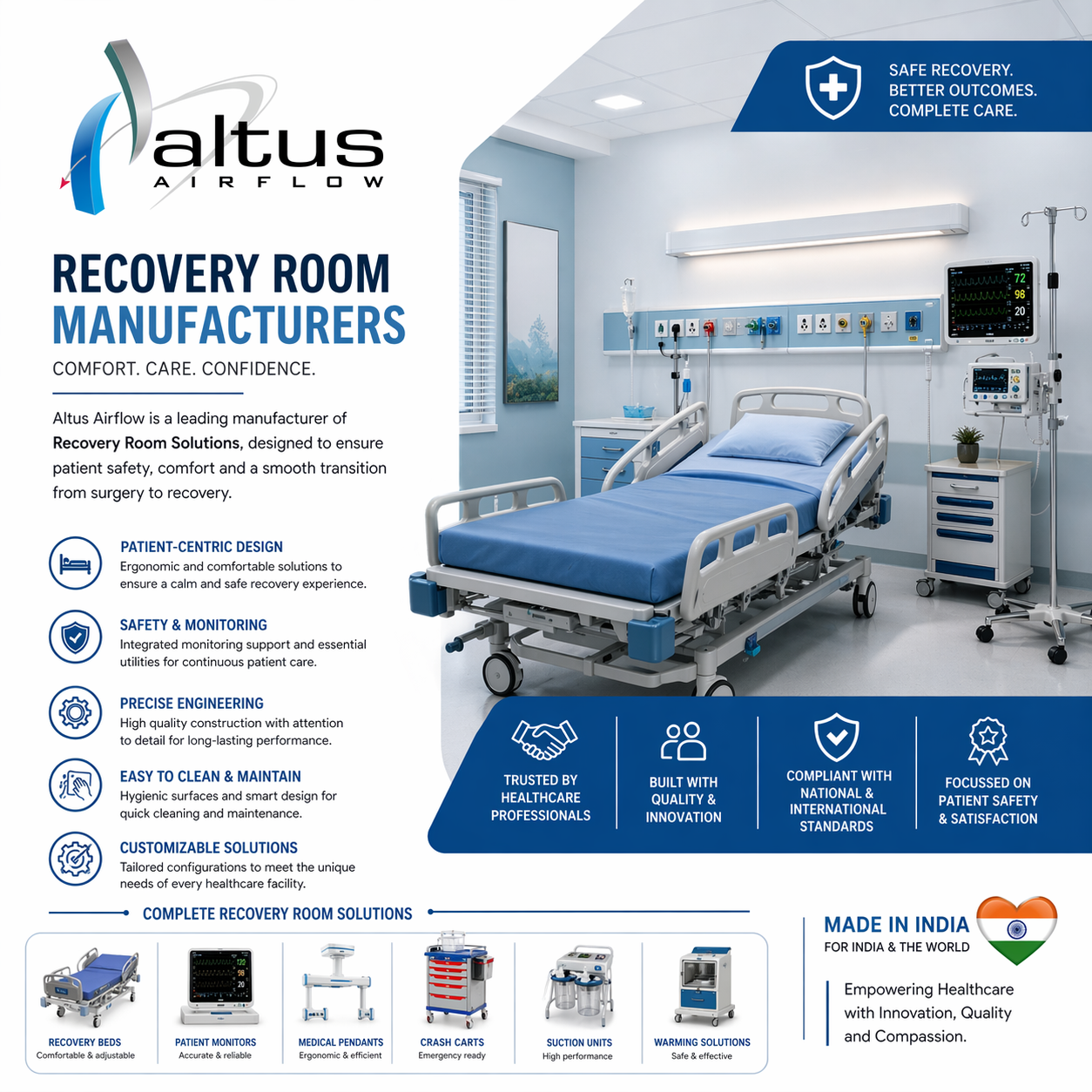
Choosing Recovery Room Manufacturers is an important part of developing a safe and efficient post-operative care environment. Hospitals should evaluate not only the products offered but also the manufacturer's ability to understand clinical workflows, integrate medical infrastructure, customize solutions, support installation, and provide ongoing technical assistance. A well-planned recovery area should support patient monitoring, staff access, emergency response, equipment organization, infection control, and future operational requirements.
Understanding Hospital Requirements
Before selecting a manufacturer, hospitals should clearly define their requirements.
Important considerations may include patient capacity, number of recovery beds, types of surgical procedures, monitoring requirements, available space, staffing patterns, and connections with operating theatres and other departments.
Experience in Healthcare Infrastructure
Hospitals can assess the manufacturer's experience with healthcare projects.
Experience in recovery rooms, critical care areas, operating environments, and related clinical spaces may help the manufacturer understand the infrastructure and workflow requirements of the project.
Product Range
A manufacturer should be able to support the required components of the recovery environment.
Depending on the project, this may include modular wall systems, bed head units, medical gas panels, electrical infrastructure, equipment supports, monitoring infrastructure, nursing stations, storage, and communication systems.
Customization Capabilities
Every hospital has different space and clinical requirements.
Manufacturers should be able to adapt infrastructure according to room dimensions, bed capacity, equipment selection, patient-care needs, workflow, and future expansion plans.
Clinical Workflow Understanding
The recovery area should allow healthcare professionals to move efficiently between patient beds, nursing stations, emergency equipment, storage areas, and other clinical spaces.
Hospitals should consider whether the manufacturer can coordinate solutions that support practical clinical workflow.
Patient Bedspace Planning
Each recovery bed requires sufficient space for patient care.
The selected solution should accommodate monitoring equipment, infusion devices, oxygen, suction, staff access, and emergency intervention without unnecessary congestion.
Medical Gas Infrastructure
Recovery patients may require access to medical gases.
Hospitals should evaluate whether the manufacturer can support suitable infrastructure for oxygen, medical air, vacuum, and other required services in coordination with qualified engineering teams.
Electrical Infrastructure
Recovery rooms operate multiple electrically powered devices.
The manufacturer should be able to coordinate appropriate electrical infrastructure, including medical-grade outlets, equipment connections, essential circuits, grounding, and cable-management arrangements according to project requirements.
Equipment Integration
Hospitals should consider how monitoring and treatment devices will be positioned around each patient.
A suitable manufacturer can help coordinate infrastructure for patient monitors, infusion pumps, respiratory equipment, suction devices, and other medical technologies.
Wall and Ceiling-Mounted Systems
Equipment-support systems can improve organization and preserve valuable floor space.
Wall-mounted and ceiling-mounted solutions can help keep devices accessible while reducing unnecessary congestion around patient-care areas.
Patient Monitoring Infrastructure
Recovery rooms may require continuous or regular patient monitoring.
Hospitals should consider whether the proposed infrastructure supports bedside monitoring and, where required, connections to central monitoring systems.
Emergency Preparedness
The recovery environment should support rapid access to emergency resources.
Planning may include appropriate locations for emergency carts, defibrillators, airway equipment, oxygen, suction, and other resources determined by hospital protocols.
Infection-Control Considerations
Materials and infrastructure should support appropriate cleaning and infection-prevention practices.
Hospitals can evaluate surface finishes, equipment placement, hand hygiene provisions, storage arrangements, and the overall ability of the design to support a hygienic environment.
HVAC and Environmental Coordination
Environmental conditions can influence patient comfort and clinical operations.
Manufacturers may need to coordinate with qualified HVAC and engineering professionals regarding ventilation, temperature, humidity, airflow, filtration, and other project-specific requirements.
Nursing Station and Workstation Planning
The nursing station should support observation, documentation, communication, and staff coordination.
Hospitals should consider how the manufacturer's solution integrates workstations, monitoring displays, communication systems, and access to frequently used supplies.
Communication and Data Infrastructure
Modern recovery areas may require communication and digital connectivity.
Nurse call systems, telephones, intercoms, data points, and network infrastructure should be considered where required.
Storage Solutions
Adequate storage helps maintain an organized clinical environment.
Hospitals should assess whether the manufacturer can provide practical solutions for medical supplies, consumables, monitoring accessories, protective equipment, respiratory supplies, and emergency resources.
Installation Capabilities
Product quality alone is not sufficient if installation is poorly coordinated.
Hospitals should understand the manufacturer's installation process, project coordination capabilities, technical expertise, testing procedures, and responsibilities during implementation.
Testing and Commissioning
Relevant systems should be appropriately inspected and tested before clinical operation.
Hospitals can ask about commissioning procedures for infrastructure such as medical gases, electrical services, communication systems, equipment supports, and other supplied components.
Maintenance and Technical Support
Recovery infrastructure requires periodic inspection and maintenance.
Hospitals should consider the availability of technical support, preventive maintenance, repair services, replacement components, and assistance with future upgrades.
Compliance With Project Requirements
Healthcare projects may need to meet specific clinical, engineering, electrical, fire-safety, accessibility, and building requirements.
Hospitals should ensure that the selected manufacturer can coordinate with qualified project professionals and work according to applicable requirements.
Product Quality and Durability
Recovery room infrastructure is used continuously and should withstand routine clinical operations and cleaning.
Hospitals can evaluate the quality of materials, finishes, construction, equipment supports, and the suitability of products for healthcare environments.
Project Coordination
Recovery room development often involves several stakeholders.
A capable manufacturer should be able to coordinate with hospital management, clinical teams, architects, consultants, biomedical engineers, facility engineers, contractors, and other project professionals.
Scalability and Future Expansion
Hospital requirements can change over time.
Flexible infrastructure can make it easier to add new equipment, modify patient positions, upgrade monitoring systems, or expand the recovery area.
Budget and Lifecycle Considerations
Hospitals should consider more than the initial product cost.
Installation, maintenance, service availability, replacement requirements, durability, upgrade options, and long-term operational needs can all influence the overall value of a solution.
Project Timeline
Hospitals may have specific construction or commissioning schedules.
The manufacturer's production capacity, delivery planning, installation timeline, and ability to coordinate with other project activities should be considered.
Training and Handover Support
Hospital technical and operational teams may require information about installed systems.
Clear documentation, system handover, operational guidance, and technical support can help ensure a smoother transition into clinical use.
Reputation and Project References
Hospitals can review previous healthcare projects and relevant experience.
Project references, technical capabilities, quality processes, and the manufacturer's ability to complete similar installations can provide useful information during the selection process.
Customized Recovery Solutions
The best solution should reflect the specific needs of the hospital rather than relying entirely on a standard layout.
Recovery room infrastructure can be customized according to bed capacity, available space, clinical services, equipment requirements, workflow, and future development plans.
Conclusion
Hospitals should evaluate Recovery Room Manufacturers based on their ability to provide suitable products, technical expertise, customization, installation support, equipment integration, maintenance, and long-term project coordination. Important factors include clinical workflow, patient bedspace planning, medical gases, electrical infrastructure, monitoring support, emergency preparedness, infection control, storage, communication, environmental coordination, product durability, and future scalability. A coordinated selection process involving clinical, architectural, engineering, biomedical, infection-control, and facility professionals can help hospitals develop an efficient recovery environment suited to their operational needs.
FAQs
1. What should hospitals consider when choosing Recovery Room Manufacturers?
Hospitals should consider experience, product quality, customization capabilities, clinical workflow understanding, medical gas and electrical infrastructure, equipment integration, installation, maintenance, technical support, and future expansion options.
2. Can recovery room infrastructure be customized?
Yes. Recovery room solutions can be adapted according to available space, patient capacity, clinical services, equipment selection, staff workflow, and future development requirements.
3. Why is installation support important?
Proper installation helps ensure that infrastructure, utilities, equipment supports, and other systems are coordinated correctly and tested before the recovery area becomes operational.
4. Should hospitals consider maintenance services?
Yes. Maintenance and technical support can help maintain infrastructure, address repairs, support replacement needs, and assist with future upgrades.
5. Who should participate in the manufacturer selection process?
Hospital management, clinical teams, architects, biomedical engineers, facility engineers, infection-control professionals, procurement teams, and other qualified project stakeholders can contribute to the evaluation process.
Read Our Previous Blog----------->Which solutions are provided by PICU Manufacturers In India?




 English
 Arabic
 French
 Portuguese
 Deutsch
 Turkish
 Dutch
Dutch
 Italiano
 Russian
 Romaian
 Portuguese (Brazil)
 Greek
Greek
