Introduction
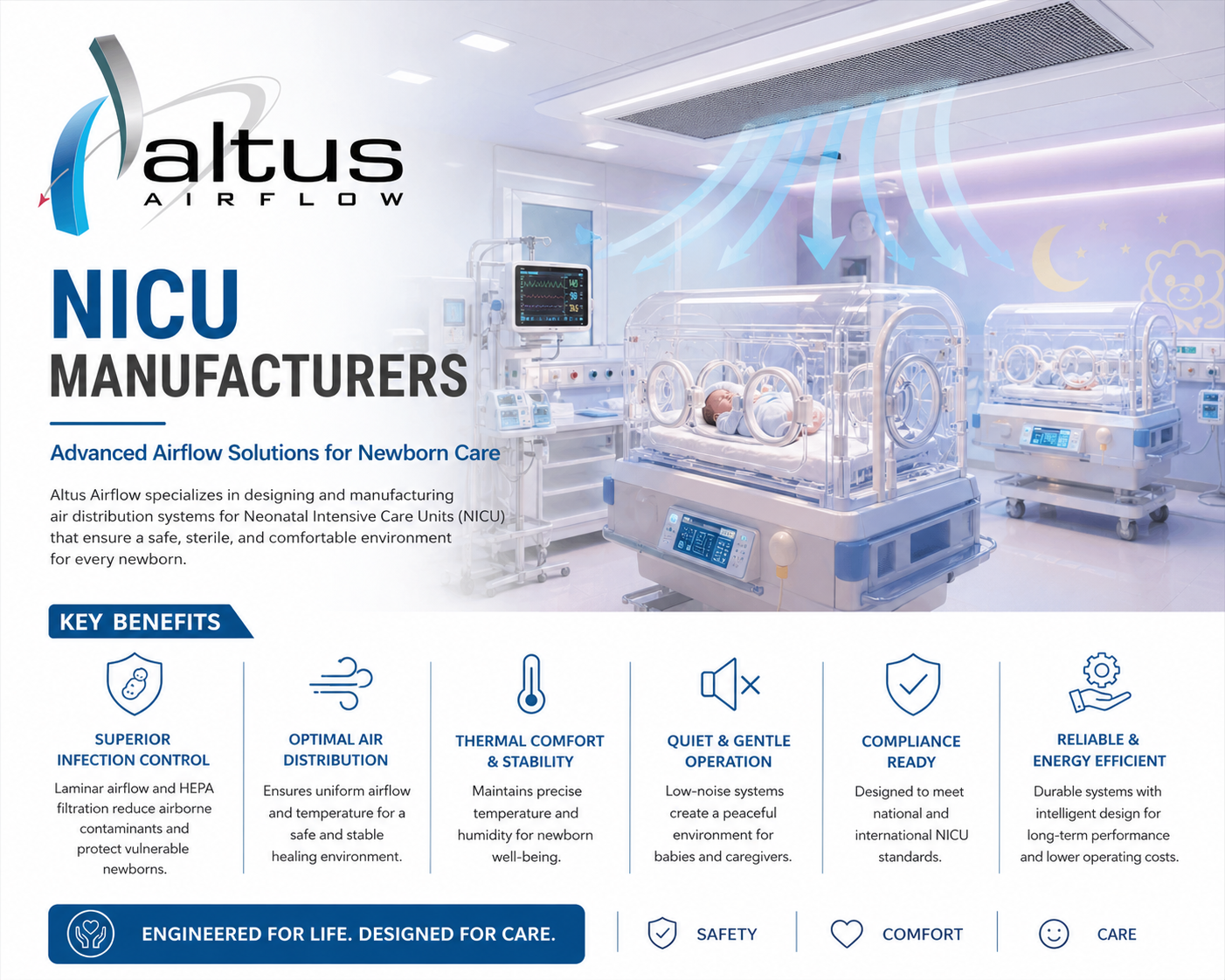
NICU Manufacturers play an important role in supporting neonatal care by providing specialized healthcare solutions for premature babies, newborns with medical complications, and infants requiring intensive monitoring. They help hospitals develop advanced Neonatal Intensive Care Units equipped with essential medical infrastructure, safety systems, and modern technology. Their services include NICU planning, customized design, medical equipment integration, infection control solutions, medical gas systems, installation, and maintenance support. These solutions help healthcare professionals provide effective and safe care for newborn patients.
Advanced NICU Planning and Design
Proper planning is essential for creating a safe neonatal care environment.
Manufacturers analyze hospital requirements, available space, patient capacity, workflow patterns, and clinical needs before designing NICU layouts. They plan patient areas, nursing stations, equipment zones, and support spaces to ensure smooth operations.
A well-planned NICU improves workflow efficiency and supports better newborn care.
Customized Neonatal Care Solutions
Every hospital requires a NICU based on its specific healthcare needs.
Manufacturers provide customized solutions that include patient bed arrangements, monitoring areas, storage spaces, and treatment zones. These designs focus on maintaining a controlled environment suitable for premature and critically ill newborns.
Customized planning helps hospitals provide specialized neonatal care effectively.
Medical Equipment Integration
Advanced medical devices are essential for neonatal treatment.
NICU Manufacturers integrate important equipment such as neonatal incubators, radiant warmers, patient monitors, ventilators, infusion pumps, syringe pumps, phototherapy units, and emergency care devices.
Proper equipment installation and placement allow healthcare professionals to monitor newborns and provide timely treatment.
Infection Control Systems
Newborns require a highly controlled and hygienic environment.
Manufacturers incorporate infection control solutions such as HEPA filtration systems, controlled airflow, advanced ventilation, antimicrobial surfaces, and easy-to-clean materials.
These measures help reduce infection risks and maintain a safer environment for vulnerable newborn patients.
Temperature and Environmental Control
Maintaining stable environmental conditions is important in neonatal care.
Manufacturers design NICU environments with temperature regulation, humidity control, proper lighting, and noise reduction systems. These features help create a comfortable and controlled atmosphere for newborns.
A stable environment supports infant comfort and recovery.
Medical Gas Infrastructure
Reliable medical gas systems are essential for newborn respiratory support.
Manufacturers install oxygen pipelines, vacuum systems, compressed air outlets, medical gas panels, and alarm systems to ensure continuous access to required medical gases.
Proper infrastructure supports respiratory care and emergency treatment.
Electrical Safety and Backup Power
NICU equipment requires continuous power availability.
Manufacturers provide medical-grade electrical systems, UPS solutions, emergency lighting, grounding protection, and backup power arrangements to ensure critical devices continue functioning during power interruptions.
Reliable power systems support uninterrupted neonatal care.
Installation and Project Management Services
Professional installation ensures that NICU systems operate correctly.
Manufacturers manage the installation of medical equipment, electrical systems, medical gas pipelines, and healthcare utilities. They coordinate project execution according to hospital requirements.
Effective project management helps establish fully functional neonatal care units.
Testing and Commissioning Support
Before NICU operations begin, all systems require proper evaluation.
Manufacturers conduct equipment testing, safety inspections, calibration, system verification, and commissioning to confirm that all components function properly.
Testing ensures reliable performance and improves operational readiness.
Maintenance and Technical Support
Regular maintenance helps maintain NICU efficiency.
Manufacturers provide preventive maintenance, equipment servicing, repairs, calibration, and technical assistance to ensure medical devices and infrastructure continue working effectively.
Continuous support helps hospitals provide uninterrupted newborn care.
NICU Expansion and Modernization
Hospitals may require upgrades as neonatal care demands increase.
Manufacturers provide expansion and modernization solutions, including layout improvements, technology upgrades, equipment replacement, and infrastructure enhancements.
Modernization helps hospitals improve their neonatal care capabilities.
Compliance and Quality Standards
Safety and quality standards are important in neonatal care development.
Manufacturers follow healthcare guidelines, engineering practices, quality procedures, and safety requirements while designing and implementing NICU solutions.
Compliance helps hospitals create dependable and efficient newborn care environments.
Conclusion
Supporting neonatal care requires advanced planning, specialized infrastructure, medical equipment integration, infection control systems, environmental management, reliable utilities, and continuous maintenance. These solutions help hospitals create safe and efficient neonatal environments where healthcare professionals can provide specialized care for newborn patients.
FAQs
1. How do NICU Manufacturers support neonatal care?
NICU Manufacturers support neonatal care through NICU planning, customized designs, medical equipment integration, infection control solutions, medical gas systems, installation services, maintenance support, and healthcare infrastructure development.
2. Why is NICU design important for newborn care?
NICU design helps maintain a controlled environment, improves workflow, and supports safe treatment for premature and critically ill newborns.
3. What equipment is used in neonatal intensive care units?
NICUs commonly use incubators, radiant warmers, patient monitors, ventilators, infusion pumps, syringe pumps, phototherapy units, and emergency care equipment.
4. How do NICU manufacturers help prevent infections?
They use advanced ventilation, HEPA filtration, controlled airflow, hygienic materials, and infection control systems to reduce contamination risks.
5. Why is NICU maintenance important?
Regular maintenance ensures equipment reliability, reduces downtime, and supports continuous neonatal care operations.
Read Our Previous Blog----------->What services are offered by ICU Manufacturers?




 English
 Arabic
 French
 Spanish
 Portuguese
 Deutsch
 Turkish
 Dutch
Dutch
 Italiano
 Russian
 Romaian
 Greek
Greek
