


What equipment is installed in a Modular Ophthalmic Operation Theatre?
INTRODUCTION
A Modular Ophthalmic Operation Theatre is equipped with advanced medical, engineering, and environmental control systems designed to provide a sterile, efficient, and technologically advanced setting for delicate eye surgeries. Every component within the operation theatre is carefully selected to support precision, maintain contamination control, and enhance workflow efficiency. From laminar airflow systems and HEPA filtration to surgical microscopes, operating tables, LED surgical lights, medical gas pipelines, HVAC systems, and environmental monitoring devices, every piece of equipment contributes to safe and successful ophthalmic procedures. A professionally designed Modular Ophthalmic Operation Theatre integrates all these systems into a seamless infrastructure that improves patient safety, surgical accuracy, and long-term operational performance.
Modern ophthalmic surgeries such as cataract extraction, retinal surgery, glaucoma treatment, corneal transplantation, and refractive procedures require highly specialized equipment operating within a contamination-controlled environment. This blog explores the essential equipment installed in a Modular Ophthalmic Operation Theatre and explains the role each component plays in delivering world-class surgical care.
Importance of Proper Equipment Selection
The performance of an ophthalmic operation theatre depends greatly on the quality and integration of its equipment.
Proper equipment installation helps:
- Improve surgical precision
- Maintain sterile conditions
- Reduce infection risks
- Enhance workflow efficiency
- Increase equipment reliability
- Support long-term operational performance
A well-equipped operation theatre creates an ideal environment for delicate eye procedures.
Laminar Airflow System
The laminar airflow system is one of the most critical engineering components.
Its functions include:
- Delivering uniform HEPA-filtered air
- Reducing airborne contamination
- Maintaining clean airflow patterns
- Supporting infection prevention
- Creating a sterile surgical zone
Continuous airflow significantly improves environmental cleanliness.
HEPA Filtration System
HEPA filters remove microscopic airborne particles from the supplied air.
Their benefits include:
- Superior air purification
- Cleaner surgical environment
- Reduced contamination
- Improved indoor air quality
- Reliable filtration efficiency
HEPA filtration is fundamental to contamination-controlled operation theatres.
HVAC System
A specialized HVAC system maintains ideal environmental conditions.
Its functions include:
- Temperature regulation
- Humidity control
- Fresh air supply
- Air circulation
- Pressure management
- Energy-efficient ventilation
Stable environmental conditions improve both patient safety and equipment performance.
Air Handling Unit (AHU)
The Air Handling Unit distributes conditioned air throughout the operation theatre.
It provides:
- Continuous airflow
- Air filtration support
- Temperature stability
- Balanced ventilation
- Improved environmental consistency
AHUs are integrated with the HVAC system for optimal performance.
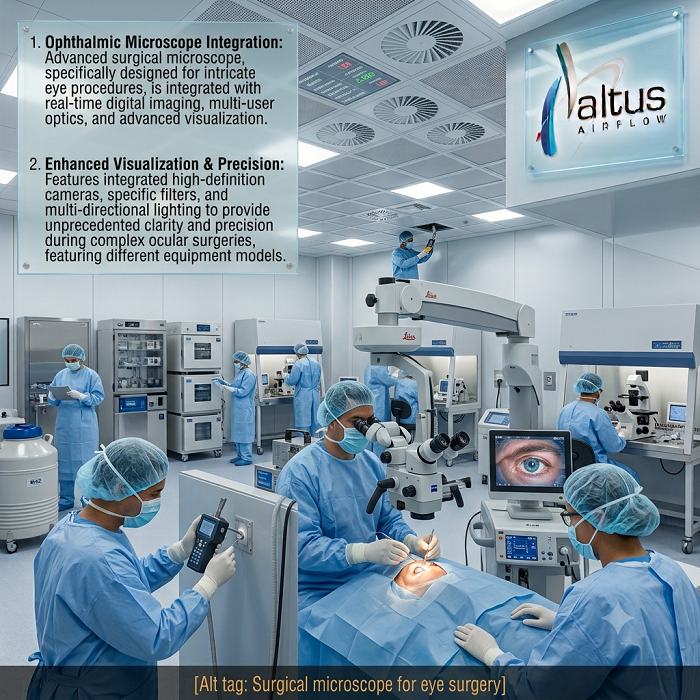
Surgical Operating Microscope
A surgical microscope is one of the primary medical devices used during ophthalmic procedures.
Its features include:
- High magnification
- Excellent illumination
- Precision visualization
- Ergonomic positioning
- Stable optical performance
Microscopes enable surgeons to perform intricate eye surgeries with exceptional accuracy.
Ophthalmic Operating Table
The operating table is specially designed for ophthalmic procedures.
It offers:
- Adjustable height
- Smooth positioning
- Patient comfort
- Stable surgical support
- Easy accessibility
Ergonomic positioning improves both surgeon efficiency and patient safety.
LED Surgical Lights
Modern ophthalmic operation theatres use advanced LED surgical lighting.
Advantages include:
- Bright illumination
- Shadow-free lighting
- Low heat generation
- Long service life
- Energy efficiency
Proper lighting improves surgical visibility.
Medical Gas Pipeline System
Medical gas systems provide essential clinical support.
Typical services include:
- Oxygen supply
- Vacuum systems
- Compressed air
- Emergency gas outlets
Reliable medical gas infrastructure supports uninterrupted procedures.
Ceiling-Mounted Surgical Pendants
Surgical pendants organize equipment and utilities efficiently.
They provide:
- Utility connections
- Equipment mounting
- Cable management
- Better workspace organization
Ceiling-mounted systems reduce floor clutter.
Modular Wall Panels
Wall panels are constructed using hygienic materials.
Benefits include:
- Smooth surfaces
- Easy cleaning
- Moisture resistance
- Chemical resistance
- Long operational life
Seamless walls support contamination control.
Modular Ceiling System
The ceiling integrates multiple engineering systems.
It accommodates:
- Laminar airflow modules
- LED lights
- Surgical pendants
- Air diffusers
- Utility services
Its modular design simplifies maintenance.
Hermetically Sealed Doors
Specialized doors help maintain pressure stability.
Features include:
- Airtight sealing
- Smooth operation
- Hygienic construction
- Noise reduction
They help preserve the sterile operating environment.
Environmental Monitoring System
Continuous monitoring maintains stable operating conditions.
Parameters monitored include:
- Temperature
- Humidity
- Differential pressure
- Airflow velocity
- Air quality
Real-time monitoring supports quality assurance.
Electrical Distribution System
Reliable electrical infrastructure powers critical equipment.
The system includes:
- Dedicated power circuits
- UPS backup
- Emergency power supply
- Control panels
- Equipment outlets
Continuous electrical availability is essential for surgical safety.
Nurse Control Panel
The nurse control panel provides centralized operation of essential systems.
Functions may include:
- Lighting control
- HVAC monitoring
- Alarm management
- Communication systems
- Environmental display
Centralized controls improve operational efficiency.
Surgeon Control Panel
Many modern operation theatres include dedicated surgeon controls.
These may operate:
- Surgical lights
- Microscope settings
- Equipment positioning
- Integrated communication
Convenient controls improve workflow.
Stainless Steel Furniture
Hygienic stainless steel furniture is widely used throughout the operation theatre.
Equipment includes:
- Instrument tables
- Storage cabinets
- Utility trolleys
- Shelving units
These furnishings are durable and easy to disinfect.
Scrub Station
A scrub station supports proper surgical hand preparation.
Typical features include:
- Hands-free operation
- Hygienic design
- Water control
- Easy maintenance
Proper hand hygiene supports infection prevention.
Communication Systems
Modern operation theatres often include integrated communication systems.
These provide:
- Staff coordination
- Emergency communication
- Equipment alerts
- Interdepartmental connectivity
Efficient communication improves workflow.
Fire Safety Systems
Safety equipment is integrated into the operation theatre infrastructure.
Common systems include:
- Fire detection
- Smoke alarms
- Emergency lighting
- Fire-resistant materials
These systems enhance occupant safety.
Validation Equipment
Before commissioning, the operation theatre undergoes comprehensive validation.
Testing includes:
- HEPA filter integrity
- Airflow velocity
- Air balancing
- Pressure verification
- Particle count analysis
- Environmental testing
Validation confirms proper system performance.
Benefits of Comprehensive Equipment Integration
Professionally integrated equipment provides numerous advantages.
Major benefits include:
- Superior contamination control
- Improved infection prevention
- Better surgical precision
- Enhanced workflow
- Greater patient safety
- Easier maintenance
- Long equipment lifespan
- Regulatory compliance
Integrated engineering ensures every system works together efficiently.
Future Technologies in Modular Ophthalmic Operation Theatres
Emerging innovations continue to improve ophthalmic surgical facilities.
Modern developments include:
- AI-assisted environmental monitoring
- IoT-enabled HVAC controls
- Smart Building Management Systems
- Predictive maintenance software
- Digital equipment monitoring
- Energy-efficient airflow technologies
These technologies improve operational efficiency while reducing maintenance costs.
Conclusion
A modern Modular Ophthalmic Operation Theatre includes advanced engineering and medical equipment such as laminar airflow systems, HEPA filtration, HVAC infrastructure, Air Handling Units, surgical microscopes, ophthalmic operating tables, LED surgical lights, medical gas pipeline systems, ceiling-mounted pendants, modular wall and ceiling panels, hermetically sealed doors, environmental monitoring systems, electrical distribution systems, control panels, scrub stations, stainless steel furniture, communication systems, and comprehensive validation equipment. Together, these systems create a sterile, efficient, and technologically advanced surgical environment that supports precision eye surgeries, enhances patient safety, reduces contamination risks, and ensures long-term operational reliability. For complete modular ophthalmic operation theatre engineering, equipment integration, validation, and turnkey project execution, Altus Airflow provides customized solutions that meet the highest standards of modern healthcare.
Frequently Asked Questions
1. What equipment is installed in a Modular Ophthalmic Operation Theatre?
A Modular Ophthalmic Operation Theatre typically includes laminar airflow systems, HEPA filtration, HVAC systems, surgical microscopes, operating tables, LED surgical lights, Air Handling Units, medical gas pipelines, environmental monitoring systems, and modular infrastructure.
2. Why is laminar airflow important in a Modular Ophthalmic Operation Theatre?
Laminar airflow in a Modular Ophthalmic Operation Theatre delivers HEPA-filtered air uniformly, helping reduce airborne contamination and maintain sterile surgical conditions.
3. Does a Modular Ophthalmic Operation Theatre include environmental monitoring systems?
Yes. A Modular Ophthalmic Operation Theatre incorporates environmental monitoring systems to continuously track temperature, humidity, pressure, airflow, and air quality.
4. What role does the HVAC system play in a Modular Ophthalmic Operation Theatre?
The HVAC system in a Modular Ophthalmic Operation Theatre regulates temperature, humidity, ventilation, pressure, and airflow to maintain optimal surgical conditions.
5. What are the benefits of installing advanced equipment in a Modular Ophthalmic Operation Theatre?
Installing advanced equipment in a Modular Ophthalmic Operation Theatre improves surgical precision, contamination control, patient safety, workflow efficiency, regulatory compliance, and long-term operational performance.
Read Our Previous Blog------>What standards and certifications do Laminar Airflow System Manufacturers follow?

 English
 French
 Spanish
 Portuguese
 Deutsch
 Turkish
 Dutch
Dutch
 Italiano
 Russian
 Romaian
 Portuguese (Brazil)
 Greek
Greek
