


What is the ideal air change rate in an Ophthalmic Modular OT With Laminar Airflow?
INTRODUCTION
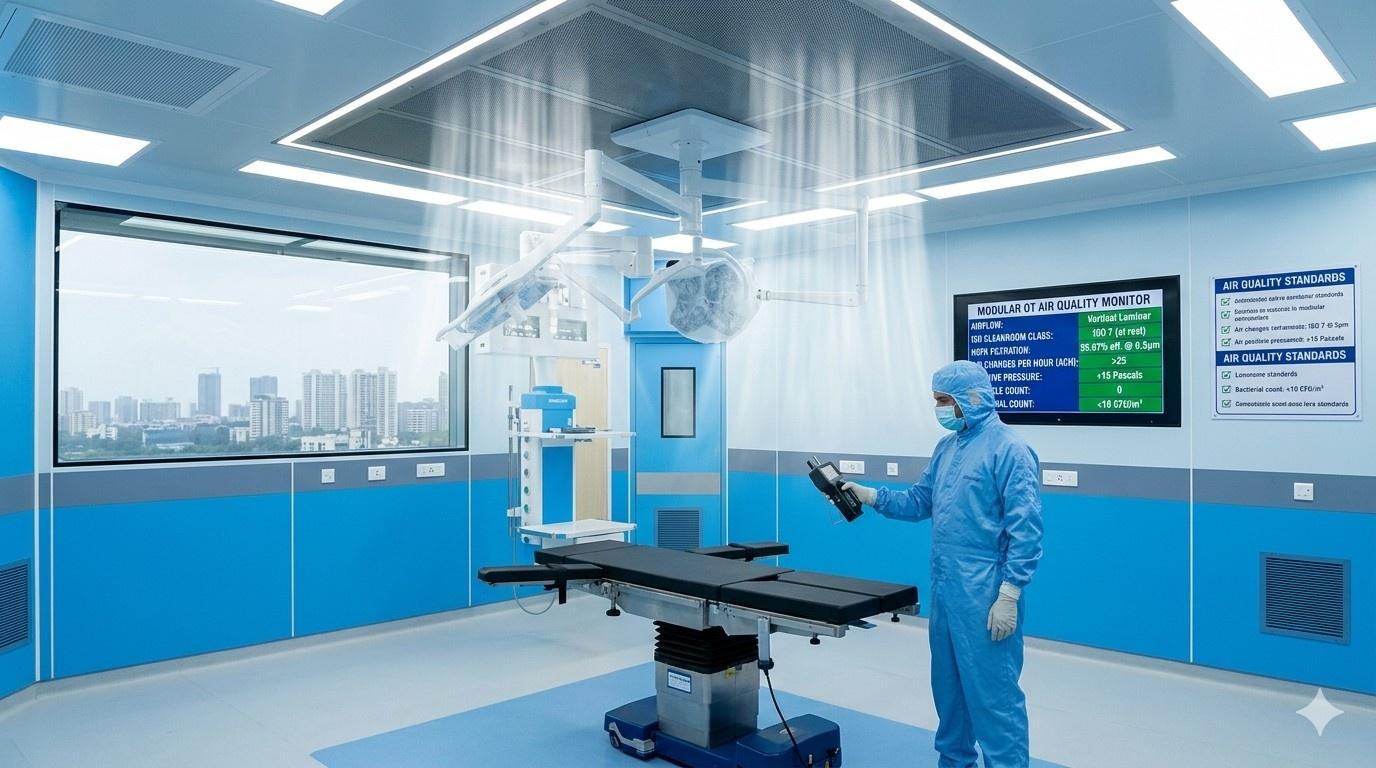
Maintaining a sterile and controlled environment is essential for the success of ophthalmic surgeries. One of the most critical factors in achieving this is the air change rate, especially in an Ophthalmic Modular OT With Laminar Airflow. Air change rate refers to how many times the air within the operation theatre is replaced in an hour, directly influencing air quality, contamination control, and patient safety.
In ophthalmic procedures, where precision is paramount and even microscopic contamination can affect outcomes, ensuring the correct air change rate is not optional—it is a necessity. This blog explores the ideal air change rate, its importance, influencing factors, and how it contributes to maintaining a safe surgical environment.
Understanding Air Change Rate (ACH)
Air Change Rate, commonly referred to as Air Changes per Hour (ACH), measures how frequently the total volume of air in a room is replaced within one hour.
Key Functions of ACH:
- Removes airborne contaminants
- Controls microbial load
- Maintains air freshness
- Supports temperature and humidity control
In an Ophthalmic Modular OT With Laminar Airflow, ACH plays a crucial role in maintaining a cleanroom-like environment.
Ideal Air Change Rate for Ophthalmic Modular OT
For an Ophthalmic Modular OT With Laminar Airflow, the recommended air change rate typically falls within:
20 to 25 Air Changes Per Hour (ACH)
In some high-end or ultra-clean setups, this can go up to:
25 to 30 ACH
These values align with healthcare and cleanroom standards to ensure optimal air quality.
Why Air Change Rate Is Critical in Ophthalmic OTs
1. Infection Control
Higher ACH reduces airborne bacteria and pathogens, minimizing the risk of surgical site infections.
2. Protection of Sensitive Eye Tissues
Ophthalmic surgeries involve delicate structures like the cornea and retina. Clean air ensures no particulate matter interferes during procedures.
3. Maintaining Sterile Environment
Frequent air replacement ensures that contaminants do not accumulate in the OT.
4. Compliance with Standards
Healthcare guidelines recommend specific ACH levels to maintain safety and accreditation.
Role of Laminar Airflow in Enhancing ACH
Laminar airflow systems work in conjunction with ACH to provide superior air quality.
Key Features:
- Unidirectional airflow (vertical or horizontal)
- Continuous removal of contaminants
- Reduced turbulence
In an Ophthalmic Modular OT With Laminar Airflow, this ensures that clean air flows directly over the surgical field, pushing contaminants away.
Components That Influence Air Change Rate
1. HVAC System Design
- Capacity of Air Handling Units (AHUs)
- Efficiency of ducting systems
- Integration with filtration units
2. HEPA Filtration
- Removes 99.97% of particles ≥0.3 microns
- Ensures clean air supply
3. Room Size and Volume
Larger rooms require higher airflow capacity to maintain the desired ACH.
4. Airflow Velocity
Proper airflow speed ensures effective air distribution without turbulence.
5. Pressure Differentials
Positive pressure helps maintain clean air within the OT.
Recommended Standards for Air Change Rates
Air change rates in ophthalmic OTs are guided by various standards:
- NABH (India) guidelines
- ISO 14644 cleanroom standards
- International healthcare guidelines
These standards typically recommend a minimum of 20 ACH for operation theatres with laminar airflow.
Air Change Rate vs Laminar Airflow: Key Differences
| Aspect | Air Change Rate (ACH) | Laminar Airflow |
|---|---|---|
| Function | Measures air replacement frequency | Controls airflow direction |
| Purpose | Removes contaminants | Prevents contamination spread |
| Role | Maintains overall air quality | Protects surgical zone |
Both work together to create a sterile environment.
Benefits of Maintaining Ideal ACH
Maintaining the correct air change rate in an Ophthalmic Modular OT With Laminar Airflow offers several benefits:
- Reduced infection rates
- Improved surgical outcomes
- Enhanced patient safety
- Better compliance with standards
- Increased operational efficiency
Challenges in Maintaining Proper ACH
Despite its importance, maintaining ideal ACH can be challenging:
- High energy consumption
- Complex HVAC system design
- Regular maintenance requirements
- Need for skilled technicians
Proper planning and maintenance help overcome these challenges.
Monitoring and Validation of Air Change Rate
Regular monitoring is essential to ensure consistent performance.
Methods Include:
- Airflow measurement tests
- Particle count analysis
- HVAC system validation
- Periodic maintenance checks
These ensure that the OT maintains the required standards.
Energy Efficiency Considerations
While high ACH is important, energy efficiency must also be considered.
Strategies Include:
- Energy-efficient HVAC systems
- Smart airflow control
- Variable air volume systems
These help balance performance and operational costs.
Future Trends in Airflow Management
The future of Ophthalmic Modular OT With Laminar Airflow includes:
- AI-based airflow monitoring
- Smart HVAC systems
- Advanced filtration technologies
- Sustainable and energy-efficient designs
These innovations will further enhance air quality and efficiency.
Importance of Expert Design
Achieving the ideal air change rate requires expertise in:
- HVAC engineering
- Cleanroom design
- Healthcare standards
Professional design ensures that the OT meets all requirements without compromise.
Conclusion
The ideal air change rate for an Ophthalmic Modular OT With Laminar Airflow typically ranges between 20 to 25 ACH, with higher values for advanced setups. This ensures effective contamination control, optimal air quality, and a safe surgical environment.
By combining proper ACH with laminar airflow systems, healthcare facilities can significantly reduce infection risks and improve surgical outcomes. With advanced engineering and expertise, Altus Airflow delivers high-performance modular operation theatre solutions that meet the highest standards of safety and efficiency.
Frequently Asked Questions (FAQs)
1. What is the ideal air change rate in an Ophthalmic Modular OT With Laminar Airflow?
The ideal air change rate in an Ophthalmic Modular OT With Laminar Airflow is typically 20 to 25 ACH, depending on the setup.
2. Why is air change rate important in ophthalmic OTs?
Air change rate in an Ophthalmic Modular OT With Laminar Airflow helps remove contaminants and maintain a sterile environment.
3. Can ACH be higher than 25 in operation theatres?
Yes, in advanced Ophthalmic Modular OT With Laminar Airflow setups, ACH can go up to 30 for enhanced cleanliness.
4. How is ACH measured in an operation theatre?
ACH in an Ophthalmic Modular OT With Laminar Airflow is measured by calculating airflow volume and room size.
5. Does laminar airflow replace the need for high ACH?
No, both laminar airflow and ACH work together in an Ophthalmic Modular OT With Laminar Airflow to ensure optimal air quality.
Read Our Previous Blog------>How long does it take to install an Ophthalmic Modular Operation Theatre?

 English
 Arabic
 French
 Spanish
 Portuguese
 Deutsch
 Turkish
 Dutch
Dutch
 Russian
 Romaian
 Portuguese (Brazil)
 Greek
Greek
