Introduction
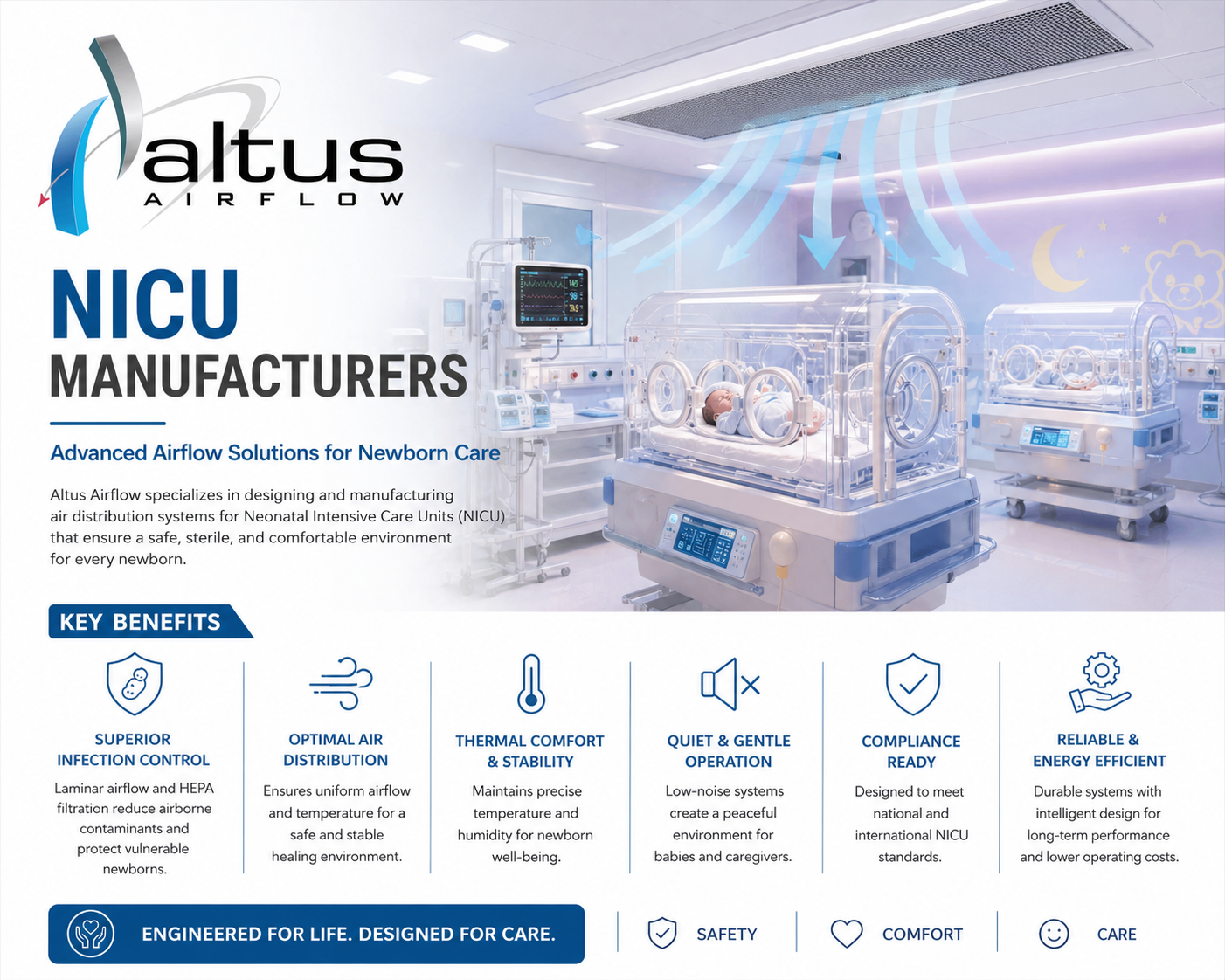
Neonatal care requires highly specialized medical environments where premature and critically ill newborns can be continuously monitored and treated with precision. Modern neonatal intensive care units depend heavily on advanced medical technologies that ensure real-time tracking of vital signs and immediate clinical response. In this ecosystem, NICU Manufacturers play a key role in developing integrated infrastructure and monitoring solutions that support neonatal survival and recovery. These manufacturers design systems that combine incubators, patient monitoring devices, ventilation support, and alarm systems to ensure continuous observation of infants who require intensive care.
Neonatal Monitoring Systems in Modern NICU Facilities
Neonatal monitoring systems are essential components of any intensive care setup for newborns. These systems continuously track vital parameters such as heart rate, oxygen saturation, respiratory rate, blood pressure, and body temperature. The primary goal is to detect even the slightest physiological changes in real time so that medical teams can respond immediately.
Modern monitoring systems used in neonatal care are highly sensitive and specifically calibrated for infants, as newborn physiology differs significantly from adults. These systems include multi-parameter monitors, pulse oximeters, apnea monitors, and temperature sensors that are designed to be non-invasive and safe for fragile patients.
Integration is another critical aspect of neonatal monitoring technology. Today’s systems are often connected to central monitoring stations, allowing healthcare providers to observe multiple patients simultaneously from a single control point. This improves response time and enhances workflow efficiency in high-pressure ICU environments.
Alarm systems are also a vital feature. These alerts notify medical staff of any abnormal changes in vital signs, ensuring immediate intervention. The alarm thresholds are customizable based on the condition and gestational age of the newborn, which helps in reducing false alarms while maintaining safety.
Data recording and analytics have also become an important part of neonatal care. Monitoring systems store patient data over time, allowing doctors to track trends, evaluate treatment effectiveness, and make informed clinical decisions. Some advanced systems also use predictive analytics to identify potential complications before they become critical.
In addition to physiological monitoring, environmental monitoring is equally important in neonatal intensive care. Factors such as incubator temperature, humidity levels, and oxygen concentration are continuously regulated and monitored to maintain an optimal healing environment for newborns.
Wireless technology has further improved neonatal monitoring systems. Portable and wireless sensors reduce physical constraints on infants, allowing for more natural movement while still ensuring continuous data tracking. This also reduces the risk of infection caused by excessive wiring and physical contact.
Cybersecurity and data protection are increasingly important as monitoring systems become more digitally integrated. Hospitals must ensure that patient data is securely stored and transmitted to prevent unauthorized access and maintain confidentiality.
In many modern healthcare setups, monitoring systems are integrated with electronic health record (EHR) systems. This ensures that all patient data is automatically updated and accessible to healthcare providers, reducing manual documentation errors and improving clinical efficiency.
Training and usability are also key considerations in system design. Medical staff must be able to quickly interpret readings and respond to alerts without delay. Therefore, manufacturers focus on creating user-friendly interfaces with clear visual indicators and simplified navigation systems.
In advanced neonatal care infrastructure, system reliability is critical. Continuous uptime is ensured through backup power systems, redundant monitoring channels, and fail-safe mechanisms. These features are essential in preventing data loss or monitoring interruptions during emergencies.
Regulatory compliance plays a major role in the development of neonatal monitoring systems. Equipment must meet strict international standards for medical safety, electrical performance, and biological compatibility. These standards ensure that devices are safe for continuous use on newborns without causing discomfort or harm.
Maintenance and calibration are also essential for long-term accuracy. Regular servicing ensures that sensors and monitors maintain precision, as even minor deviations can impact clinical decisions in neonatal care.
The demand for integrated neonatal care solutions has increased significantly in recent years due to rising awareness of infant health and advancements in medical technology. Hospitals are now investing in fully equipped NICU setups that combine monitoring systems, incubators, ventilators, and centralized control systems into a unified care environment.
Within this evolving landscape, NICU Manufacturers continue to innovate by developing compact, energy-efficient, and highly sensitive monitoring solutions that improve survival rates and support better clinical outcomes for newborns.
Conclusion
Neonatal monitoring systems are a fundamental part of modern intensive care units for newborns. They provide continuous, accurate, and real-time data that helps medical professionals make critical decisions quickly. With advancements in technology, these systems have become more integrated, reliable, and efficient, significantly improving neonatal care outcomes. As healthcare infrastructure continues to evolve, the importance of advanced monitoring systems in NICU environments will only continue to grow.
FAQs
1. Do companies provide neonatal monitoring systems?
Yes, NICU Manufacturers provide neonatal monitoring systems that are specifically designed to track vital signs such as heart rate, oxygen levels, and respiration in newborns. These systems are built with high sensitivity and safety standards to ensure continuous and accurate monitoring in critical care environments.
2. What vital signs are monitored in neonatal care systems?
Neonatal monitoring systems track heart rate, oxygen saturation, respiratory rate, blood pressure, and body temperature. Some advanced systems also monitor environmental conditions inside incubators.
3. Are neonatal monitoring systems safe for premature babies?
Yes, these systems are designed specifically for premature and low-birth-weight infants. They use non-invasive sensors and gentle monitoring techniques to ensure safety and comfort.
4. Can neonatal monitoring systems be integrated with hospital software?
Yes, most modern systems can be integrated with electronic health records and centralized monitoring stations, allowing healthcare providers to access real-time and historical patient data efficiently.
5. How often do neonatal monitoring systems require maintenance?
Regular maintenance is recommended to ensure accuracy and reliability. Calibration and system checks are typically performed periodically based on manufacturer guidelines and hospital protocols.





 English
 French
 Spanish
 Portuguese
 Deutsch
 Turkish
 Dutch
Dutch
 Italiano
 Russian
 Romaian
 Portuguese (Brazil)
 Greek
Greek