


Where to Buy Reliable NICU Manufacturers for Hospitals?
Introduction
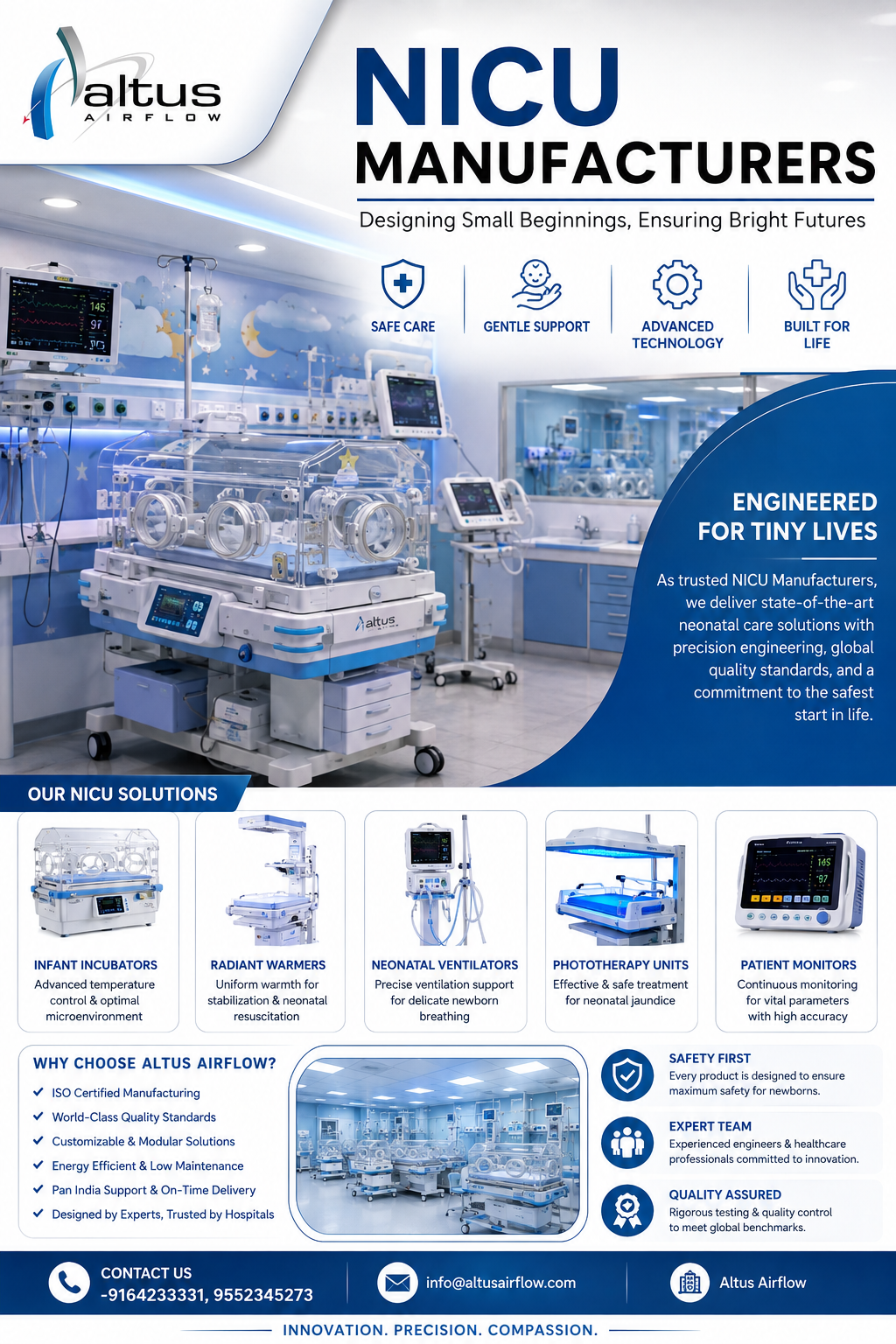
Hospitals looking for NICU Manufacturers should focus on technical quality, neonatal suitability, equipment compatibility, safety, and dependable after-sales support rather than choosing a supplier based only on price or appearance. A reliable provider should understand the specialized requirements of newborn care and offer equipment and solutions that support clinical workflows, monitoring, respiratory care, thermal management, and emergency preparedness.
Evaluate Neonatal Equipment Requirements
A modern neonatal intensive care environment requires specialized equipment designed for newborn and premature infant care. NHSRC maintains dedicated technical specifications for neonatal and pediatric intensive-care equipment, while its more recent technical documentation includes specifications for equipment used in NICU and PICU settings.
Hospitals should therefore check whether a prospective supplier can provide suitable solutions for the specific level and clinical requirements of the facility.
Check Technical Specifications
Technical documentation is an important part of the purchasing process. Hospitals should review operating features, safety functions, accessories, patient suitability, electrical requirements, alarms, and compatibility with existing systems.
For example, current NHSRC specifications for neonatal and pediatric intensive-care ventilators address invasive and non-invasive ventilation, monitoring parameters, humidification, power backup, and multiple ventilation modes.
Consider Product Quality and Safety
Newborn patients require carefully selected equipment and controlled clinical environments. Hospitals should assess the quality of construction, reliability of components, ease of cleaning, alarm systems, electrical safety, and suitability for continuous clinical use.
Equipment such as incubators may also require precise environmental controls. NHSRC specifications for transport incubators include temperature and system alarms, oxygen-related functions, monitoring features, and infant-contact considerations.
Review Installation and Training
A dependable provider should offer more than equipment delivery. Hospitals should ask about installation, commissioning, testing, documentation, staff training, and troubleshooting assistance. Proper orientation can help clinical and technical teams understand equipment operation and routine procedures.
It is also useful to determine whether the provider can support future upgrades, additional equipment, or modifications as the neonatal unit develops.
Examine Maintenance and Service Support
Long-term maintenance should be considered before purchasing. NHSRC's Biomedical Equipment Management and Maintenance Program includes dedicated technical specifications for SNCU and NICU equipment along with guidance on maintenance, calibration, and testing.
Hospitals should therefore evaluate preventive-maintenance schedules, calibration support, spare-parts availability, technical assistance, and service responsiveness. Strong maintenance planning can help support equipment uptime and reduce avoidable operational interruptions.
Compare Suppliers Before Buying
Hospitals can compare potential providers using consistent criteria such as technical capability, neonatal suitability, product documentation, safety, installation, training, maintenance, and previous healthcare experience. Clinical users and biomedical engineers should also participate in the evaluation.
ICU planning guidance recommends seeking feedback from medical and nursing staff as well as biomedical engineers when selecting and purchasing equipment.
Conclusion
Finding reliable NICU Manufacturers requires careful evaluation of neonatal suitability, technical specifications, safety, equipment compatibility, installation, training, and long-term maintenance. Hospitals that compare providers against clinical and technical requirements can make more informed purchasing decisions and establish neonatal care environments that better support healthcare teams and newborn patients.
FAQs
1. What should hospitals check before buying NICU equipment?
Hospitals should review technical specifications, neonatal suitability, product quality, safety features, installation support, training, maintenance, and after-sales service.
2. What types of equipment are required in neonatal care?
Requirements may include ventilators, CPAP systems, incubators, radiant warmers, phototherapy equipment, monitors, infusion pumps, suction systems, and transport equipment.
3. Why are technical specifications important?
Technical specifications help hospitals compare equipment based on functionality, safety, performance, patient suitability, and compatibility with clinical requirements.
4. Why is after-sales service important?
Regular maintenance, calibration, testing, repairs, and technical support can help maintain equipment performance and availability over its operational life.
5. Who should participate in equipment selection?
Clinical professionals, nursing teams, biomedical engineers, hospital administrators, and other relevant end users can contribute valuable technical and practical feedback during the selection process.
Read Our Previous Blog----------->What Are the Benefits of Choosing Top ICU Manufacturers?

 English
 Arabic
 French
 Portuguese
 Deutsch
 Turkish
 Dutch
Dutch
 Italiano
 Russian
 Romaian
 Portuguese (Brazil)
 Greek
Greek
