


Start a Business in India from Europe: Step-by-Step Guide
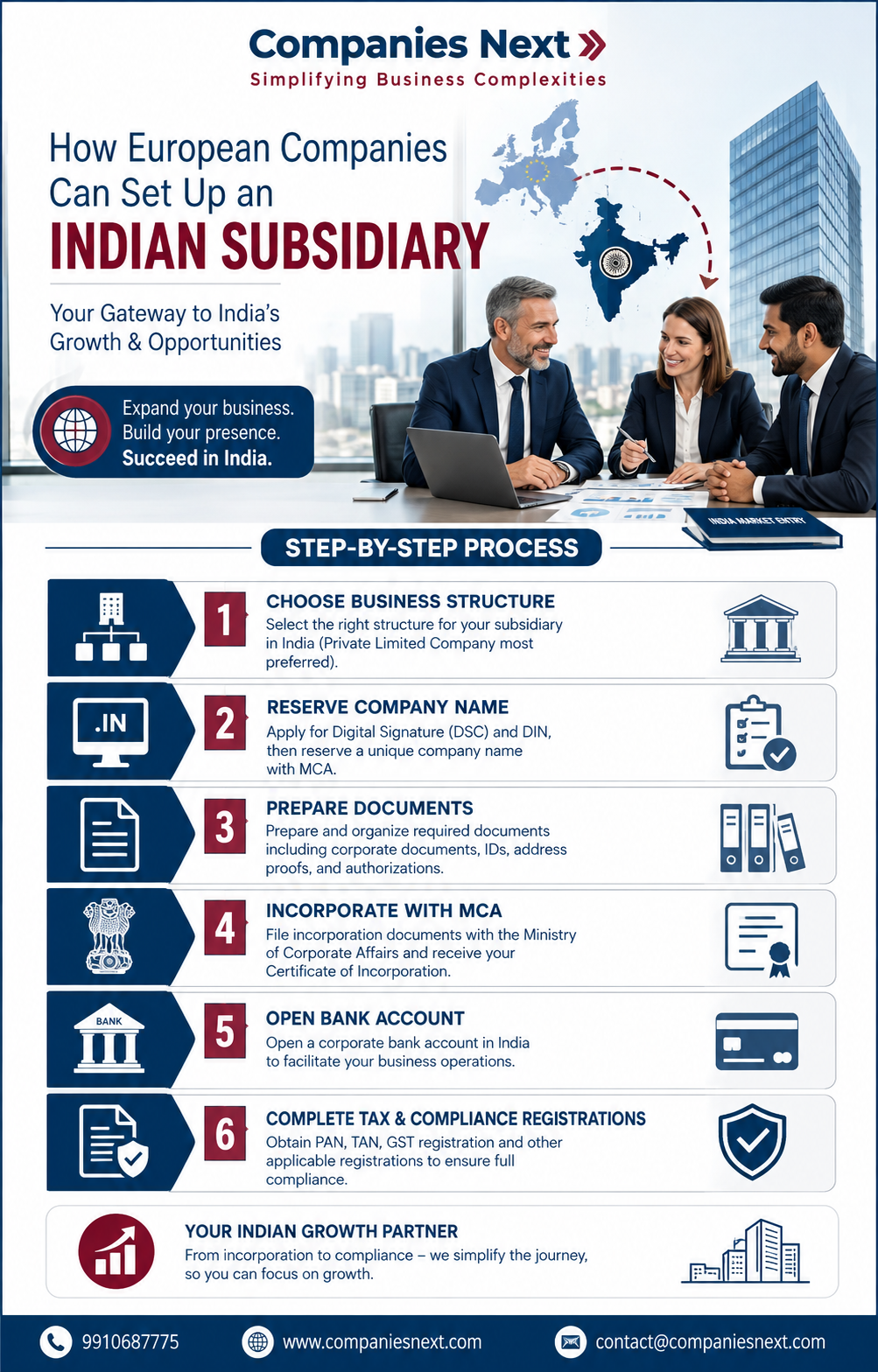
India has become an attractive destination for European entrepreneurs and companies looking to expand into a growing market. With a large consumer base, a strong technology ecosystem, skilled professionals, and opportunities across manufacturing and services, India can offer significant potential for international businesses.
However, setting up a business in another country requires careful planning. European investors need to understand India's company structures, foreign investment rules, taxation, registrations, banking requirements, and ongoing compliance.
This guide explains how to Start a Business in India from Europe through a practical step-by-step process.
Why European Businesses Choose India
India offers opportunities across industries such as information technology, consulting, manufacturing, renewable energy, e-commerce, healthcare, education, logistics, and professional services.
European businesses may consider India because of:
- Access to a large and diverse customer market
- Availability of skilled professionals
- Competitive operating costs in several sectors
- Expanding digital and technology infrastructure
- Opportunities for manufacturing and sourcing
- Growing demand for international products and services
- Potential for long-term business expansion
Before investing, however, European entrepreneurs should evaluate the sector, market demand, competition, investment regulations, and expected costs.
Step 1: Choose the Right Business Structure
The first important decision is selecting an appropriate legal structure in India. The right structure depends on the nature of the business, ownership, investment plans, and activities.
Common options include:
Private Limited Company
A private limited company is one of the most commonly used structures for foreign-owned businesses entering India. It provides a separate legal identity and can generally accommodate foreign shareholders, subject to applicable foreign investment rules.
This structure may be suitable for businesses planning long-term operations, hiring employees, entering contracts, and building an independent presence in India.
Limited Liability Partnership
An LLP combines elements of a partnership with limited liability protection. It can be considered for certain professional and service-oriented businesses, although foreign investment rules need to be checked for the proposed activity.
Branch Office
A European company may establish a branch office in India for permitted activities. A branch office is an extension of the foreign company rather than a separate Indian company.
Liaison Office
A liaison office can be used for limited representative activities, such as communication and promotion, subject to applicable permissions. It generally cannot conduct normal commercial business activities in India.
Step 2: Check Foreign Investment Rules
Foreign investors should determine whether their proposed business activity is eligible for foreign investment and whether any specific conditions apply.
India's foreign direct investment framework differs depending on the industry. Some sectors permit foreign investment through an automatic route, while others may have additional requirements or government approval.
Therefore, before incorporating the company, European investors should verify:
- Whether foreign investment is permitted in the selected sector
- Applicable investment limits
- Whether government approval is required
- Sector-specific conditions
- Applicable pricing and reporting requirements
- Foreign exchange regulations
Professional advice can help prevent delays caused by choosing an unsuitable investment structure.
Step 3: Prepare the Required Documents
European entrepreneurs will need to prepare documentation for incorporation and related registrations.
Depending on the structure and circumstances, documents may include:
- Passport and identity proof of foreign directors or shareholders
- Address proof
- Photographs where applicable
- Proof of registered office
- Constitutional documents of the foreign parent company, if involved
- Board resolutions or authorization documents
- Incorporation documents of the overseas entity
Foreign documents may need notarization, apostille or consular authentication, and appropriate certification depending on the country where they were issued.
Because documentation requirements can vary, it is important to confirm the current requirements before submission.
Step 4: Obtain Digital Signatures and Director Identification
For an Indian company, proposed directors generally need the required identification and digital signature credentials to complete electronic filings.
Digital signatures are used for submitting various documents electronically to Indian regulatory authorities.
Foreign nationals who become directors may need additional documentation and verification before the incorporation process can be completed.
Step 5: Register the Indian Company
Once the structure and documents are ready, the company incorporation application can be submitted through India's corporate regulatory system.
The incorporation process generally involves:
- Selecting and checking the proposed company name.
- Preparing incorporation documents.
- Providing details of directors and shareholders.
- Providing the registered office details.
- Filing the applicable incorporation forms.
- Paying the required government fees and stamp duty.
- Receiving the Certificate of Incorporation after approval.
The Certificate of Incorporation confirms that the company has been legally registered in India.
Step 6: Obtain PAN, TAN and Other Registrations
After incorporation, the business needs to complete relevant tax and regulatory registrations.
A company generally requires a Permanent Account Number (PAN) for tax-related activities. Tax Deduction and Collection Account Number (TAN) may also be required when the business has obligations involving tax deducted or collected at source.
Depending on the nature of the business, additional registrations may include:
- Goods and Services Tax (GST) registration
- Import Export Code (IEC)
- Professional tax registration where applicable
- Shops and Establishments registration
- Sector-specific licenses
- Employee-related registrations
Not every business requires every registration, so requirements should be assessed based on actual operations.
Step 7: Open an Indian Business Bank Account
Once the company is incorporated, an Indian corporate bank account can be opened with the required documentation.
Banks generally conduct customer due diligence and may request incorporation documents, identity documents, business information, beneficial ownership details, and information relating to foreign shareholders.
For foreign investment, the movement of funds should also comply with India's foreign exchange regulations and applicable reporting requirements.
Maintaining clear records of foreign investment is important for both regulatory compliance and financial reporting.
Step 8: Understand Taxation and Accounting
Tax planning should be considered before starting operations rather than after the business begins earning revenue.
An India-based business may have obligations relating to corporate income tax, GST, withholding taxes, payroll-related deductions, and other applicable taxes.
European businesses should also consider whether transactions between an Indian company and its European parent or related entities could create transfer pricing obligations.
Proper bookkeeping and timely tax filings help maintain compliance and reduce the risk of penalties.
Step 9: Hire Employees and Set Up Operations
Once the business is ready to operate, it can establish its workplace, hire employees, enter supplier agreements, and begin commercial activities.
Employers should understand Indian employment requirements, including applicable salary deductions, workplace rules, employee benefits, and statutory registrations.
European companies should also consider differences in employment practices, contracts, working arrangements, and business culture when building an Indian team.
Step 10: Maintain Ongoing Compliance
Company registration is only the beginning. Businesses must continue meeting statutory and financial obligations after incorporation.
Ongoing compliance may include:
- Annual company filings
- Income tax returns
- GST returns, where applicable
- Maintenance of accounting records
- Financial statement preparation
- Board and shareholder requirements
- Foreign investment reporting
- Tax deducted at source compliance
- Statutory audits where applicable
The exact compliance calendar depends on the company's structure, turnover, activities, investment pattern, and other factors.
Common Mistakes European Entrepreneurs Should Avoid
Foreign entrepreneurs can face unnecessary delays when they do not understand local requirements. Some common mistakes include:
Choosing the Wrong Structure
Selecting a branch office, LLP, or company without considering the intended activities can create regulatory complications.
Ignoring Sector Restrictions
Foreign investment rules differ between sectors. Assuming that every Indian business activity follows the same investment rules can create problems.
Using Incomplete Documentation
Foreign documents may require specific authentication or certification. Incorrect paperwork can delay incorporation.
Underestimating Tax Compliance
Tax obligations can involve multiple areas. Businesses should establish accounting and tax processes from the beginning.
Treating Incorporation as the Final Step
After registration, companies still have ongoing legal, tax, accounting, and regulatory responsibilities.
How Professional Support Can Help
The process to Start a Business in India from Europe can become easier when entrepreneurs work with professionals familiar with Indian corporate and tax regulations.
A professional service provider can assist with company structure selection, incorporation documentation, foreign investment compliance, tax registrations, accounting, bookkeeping, and ongoing statutory filings.
This can allow European entrepreneurs to focus on market development and business operations while reducing administrative complications.
Conclusion
To Start a Business in India from Europe, entrepreneurs need more than company incorporation. They should understand the Indian market, choose an appropriate business structure, review foreign investment rules, prepare the necessary documents, complete registrations, establish banking and accounting systems, and maintain ongoing compliance.
With proper planning and professional guidance, European businesses can build a structured presence in India and explore opportunities in one of the world's major emerging markets. The most important step is to assess the proposed business activity and regulatory requirements before making the investment, so the Indian operation starts on a legally and financially sound foundation.

 English
 Arabic
 French
 Spanish
 Portuguese
 Deutsch
 Turkish
 Dutch
Dutch
 Italiano
 Russian
 Portuguese (Brazil)
 Greek
Greek
