


Why Your Social Media Posts Get Views but No Customers: A Complete Conversion Strategy
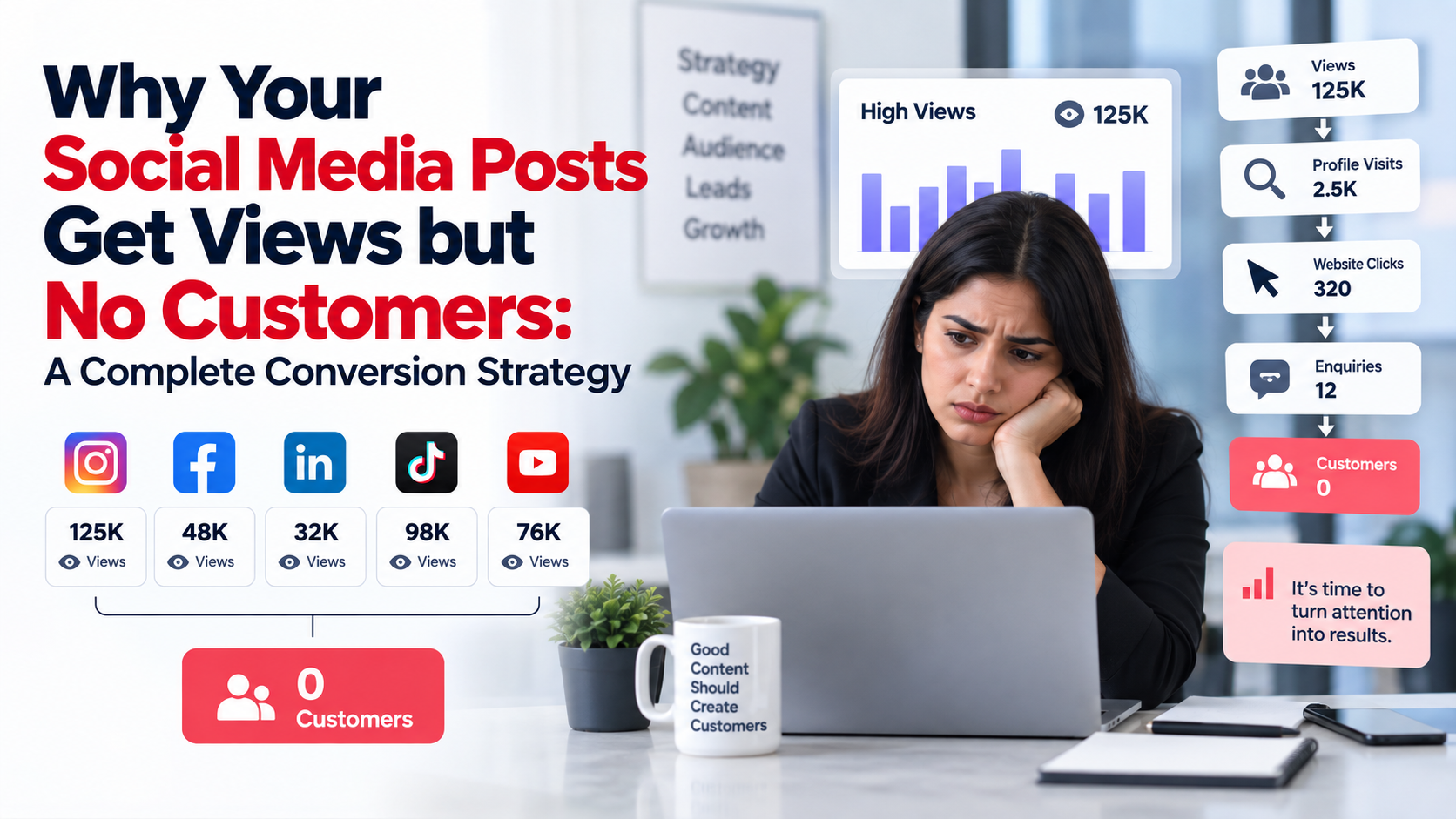
Getting views on social media feels good, but views alone do not pay the bills. Many businesses regularly post on Instagram, Facebook, LinkedIn, and other platforms, yet they struggle to turn that attention into enquiries, leads, and customers.
A post may receive thousands of views but generate only a few clicks. Another post may get fewer views but bring several genuine enquiries. The difference is not always the number of followers or reach. It is often the strategy behind the content and the path a user follows after seeing it.
In 2026, businesses need to look beyond vanity metrics and build social media strategies that connect content with actual business goals.
If your social media is getting attention but not generating customers, here are the major reasons and what you can do about them.
1. Views Are Not the Same as Business Growth
One of the biggest mistakes businesses make is assuming that high reach automatically means successful social media marketing.
Reach tells you how many people saw your content. Views tell you how many times content was watched or displayed. Likes and comments indicate engagement.
But none of these metrics automatically mean that someone is interested in buying.
For example, a funny video may receive 50,000 views because it is entertaining. However, if the people watching it have no connection with your product or service, those views may produce zero business enquiries.
A smaller post that reaches 2,000 highly relevant people can sometimes generate more leads.
This is why businesses should track:
- Website visits
- Profile visits
- Link clicks
- Direct messages
- Enquiries
- Lead forms
- Calls
- Product enquiries
- Sales
- Cost per lead
- Conversion rate
The goal should not simply be “get more views.”
The better question is:
“What happens after someone sees my content?”
2. You May Be Reaching the Wrong Audience
Sometimes the problem isn't your content. The problem is the audience seeing it.
Imagine a web development company creates content that attracts students who are interested in learning HTML and CSS. The content may get excellent engagement, but those students may not be looking for professional website development services.
Meanwhile, business owners who actually need a website may never see the content.
Your social media strategy should therefore begin with a clear understanding of your target customer.
Consider:
- Who needs your service?
- What type of business do they run?
- What problem are they facing?
- What are they searching for?
- What makes them hesitate before buying?
- What information do they need before contacting you?
- Which social platforms do they actually use?
When your content is created for a specific audience, engagement becomes more meaningful.
3. Your Content Is Informing but Not Persuading
Educational content is useful, but education alone does not always create customers.
For example:
“5 Benefits of Having a Business Website”
is informative.
But a conversion-focused post could say:
“Is your website costing you potential customers? Here are 5 problems that may be stopping visitors from contacting your business.”
The second topic connects directly with a business problem.
Good social media content should do more than provide information. It should make the audience think:
“This is exactly the problem I'm facing.”
A strong content strategy should include different content types:
Educational Content
Teach the audience something useful.
Problem-Based Content
Highlight problems your potential customers are already experiencing.
Trust Content
Show expertise, experience, results, processes, reviews, or customer experiences.
Solution Content
Explain how your service can solve a particular problem.
Conversion Content
Give people a clear reason and method to take the next step.
This combination is much stronger than posting promotional content every day.
4. There Is No Clear Connection Between Social Media and Your Website
A person may discover your business through Instagram but still need more information before making a decision.
If your social media profile sends users to a confusing, slow, outdated, or irrelevant website, the conversion opportunity can disappear.
Your social media and website should work together.
For example:
Social Media Post → Profile → Website/Landing Page → Enquiry → Follow-Up → Customer
Every step should have a purpose.
If your post talks about website development but the link takes users to a generic homepage without explaining your service, the visitor may leave.
Instead, send users to a relevant page that matches the promise made in the post.
For example:
Post: “Need an eCommerce website for your growing business?”
CTA: “Explore our eCommerce development services.”
Landing page: Detailed information about eCommerce development, features, process, benefits, FAQs, and enquiry option.
The smaller the gap between the user's interest and the page they reach, the better the chance of conversion.
5. Your CTA Is Not Strong Enough
A surprisingly common problem is simply having a weak call-to-action.
Many posts end with:
“Follow us for more.”
That's fine for audience building, but it doesn't necessarily generate leads.
Instead, your CTA should match the objective of the post.
Examples:
- Need a business website? Send us a message.
- Want to discuss your app idea? Book a consultation.
- Not sure why your website isn't ranking? Request an SEO audit.
- Looking for professional digital marketing support? Contact our team.
- Have a project in mind? Share your requirements with us.
A good CTA tells people exactly what to do next.
Don't make users guess.
6. People Need Trust Before They Buy
Social media users see hundreds of promotional messages every day.
Simply saying:
“We provide the best services.”
is unlikely to convince someone.
People want evidence.
Businesses can build trust through:
- Client testimonials
- Case studies
- Portfolio work
- Before-and-after examples
- Behind-the-scenes content
- Team expertise
- Educational posts
- Project explanations
- Customer feedback
- Frequently asked questions
- Transparent processes
Instead of repeatedly telling people that you're an expert, show them how you solve problems.
For example, rather than posting:
“We are experts in SEO.”
create content such as:
“Why your website traffic dropped and the 5 checks we perform before changing an SEO strategy.”
That demonstrates expertise instead of simply claiming it.
7. Your Social Media Profile May Be Losing Potential Leads
Your post might successfully attract a potential customer, but your profile can still lose them.
When someone becomes interested, they often visit the profile before contacting the business.
Your profile should quickly answer:
Who are you?
What do you offer?
Who do you help?
Why should someone trust you?
How can someone contact you?
Your bio should be simple and specific.
Instead of:
“Helping businesses grow | DM us”
you could use:
“Web Development, App Development, SEO & Digital Marketing Solutions for Growing Businesses.”
Your profile should also have:
- Clear business information
- Professional branding
- Relevant contact details
- Website link
- Strong content
- Service information
- Reviews or proof where appropriate
Your social media profile is often the first business impression after someone discovers you.
8. Posting Every Day Does Not Guarantee Results
Posting consistently is important, but posting more does not automatically mean getting more customers.
A business can publish seven posts every week and still have poor results if those posts don't address customer problems.
Instead of asking:
“What should we post today?”
ask:
“What problem does our target customer need help solving today?”
This small change can completely improve your content strategy.
Create content around:
- Customer questions
- Common mistakes
- Buying concerns
- Industry problems
- Service comparisons
- Pricing considerations
- Success stories
- Frequently asked questions
- Myths and misconceptions
- Practical solutions
Quality and relevance should come before simply increasing posting frequency.
9. Too Much Promotional Content Can Push People Away
Imagine following a business account and every post says:
“Buy now.”
“Contact us today.”
“Limited offer.”
“Get our service.”
After some time, people stop paying attention.
Social media works better when businesses provide value before asking for something.
A useful content mix could include:
40% Educational
Helpful information, tips, guides, explanations.
30% Problem/Solution
Common customer problems and practical solutions.
20% Trust & Brand
Reviews, projects, team, process, expertise.
10% Direct Promotion
Offers, services, consultations, or enquiries.
The exact ratio can vary by business, but the principle is simple:
Don't make every post feel like an advertisement.
10. Your Business May Be Ignoring Comments and DMs
A comment or direct message is not just engagement.
It can be a buying signal.
Someone asking:
“How much does this cost?”
may be interested in your service.
Someone saying:
“Can you build this type of website?”
could be a potential lead.
Businesses should therefore treat social media conversations as part of the sales process.
Respond quickly and professionally.
Instead of simply replying:
“DM us.”
try:
“Yes, we can help with that. Please share your requirements through DM and our team can guide you regarding the suitable solution.”
The objective is to move the conversation forward.
11. Build a Social Media Conversion Funnel
A strong social media strategy should not depend on a single post.
Think of it as a funnel.
Stage 1: Discovery
The user sees your Reel, post, carousel, video, or other content.
Stage 2: Interest
The content addresses a problem they care about.
Stage 3: Trust
They visit your profile and consume more content.
Stage 4: Consideration
They visit your website, portfolio, service page, or case study.
Stage 5: Action
They send a message, fill out a form, call, or request a consultation.
Stage 6: Follow-Up
You respond, understand their requirements, provide information, and continue the conversation.
Stage 7: Conversion
The prospect becomes a customer.
This means your social media content doesn't have to sell immediately.
Its job may simply be to move the person to the next stage.
12. Measure Social Media by Business Results
If you're only checking likes and followers, you may not know whether your strategy is actually working.
Create a simple monthly report containing:
| Metric | What It Tells You |
|---|---|
| Reach | How many people discovered your content |
| Engagement | How people interacted with it |
| Profile Visits | Level of interest in your business |
| Link Clicks | Interest in learning more |
| DMs | Direct buying conversations |
| Leads | Potential customers generated |
| Conversion Rate | Percentage becoming customers |
| Cost Per Lead | How efficiently you generate leads |
| Sales | Actual business outcome |
This gives you a much clearer picture.
For example:
Post A: 20,000 views → 300 likes → 2 enquiries
Post B: 5,000 views → 120 likes → 15 enquiries
Post B may be far more valuable for the business.
That's why social media performance should ultimately be connected to business objectives.
13. Stop Copying Your Competitors
Another common mistake is copying competitors because their posts appear successful.
You may copy:
- Their topics
- Their captions
- Their designs
- Their Reels
- Their hashtags
- Their posting style
But their audience, positioning, budget, brand reputation, and customer journey may be completely different.
Instead, study competitors to understand the market—but build your own strategy.
Ask:
- What questions are customers asking?
- Which problems aren't competitors explaining?
- What content receives meaningful responses?
- What makes your business different?
- What expertise can you demonstrate?
- What customer concerns can you answer better?
The objective isn't to become another version of your competitor.
It is to give your audience a reason to choose your business.
14. Create Content Around the Customer Journey
One of the easiest ways to improve social media conversions is to create content for different stages of the buying journey.
People Who Don't Know Your Brand
Create:
- Educational Reels
- Problem-focused posts
- Industry tips
- Beginner guides
People Considering Your Service
Create:
- Comparisons
- FAQs
- Service explanations
- Process guides
- Mistake-based content
People Ready to Buy
Create:
- Case studies
- Testimonials
- Portfolio
- Service pages
- Consultation CTAs
Existing Customers
Create:
- Support content
- Tips
- Updates
- Product/service education
- Loyalty content
This prevents your entire social media strategy from targeting only one type of user.
15. A Practical 30-Day Social Media Conversion Strategy
If your current social media isn't producing enough leads, start with a simple 30-day plan.
Week 1 – Understand the Audience
Identify:
- Target customers
- Their biggest problems
- Their questions
- Their objections
- Their buying motivations
Create content based on these insights.
Week 2 – Build Trust
Publish:
- Expertise-based content
- FAQs
- Portfolio examples
- Testimonials
- Behind-the-scenes content
Give people reasons to believe your business can solve their problem.
Week 3 – Introduce Solutions
Create posts that connect specific problems with your services.
For example:
Problem: Website visitors aren't converting.
Content: Explain common conversion problems.
Solution: Explain how better UX, navigation, CTAs, and landing pages can help.
Week 4 – Focus on Conversion
Use stronger CTAs.
Promote:
- Consultations
- Audits
- Service pages
- Product demos
- Enquiry forms
- Direct messages
Then compare your results with previous weeks.
What Businesses Should Change in Their Social Media Strategy
If you're getting views but very few customers, don't immediately assume that you need more followers.
First check your complete customer journey.
Ask yourself:
Is my content reaching the right people?
Does my content address real problems?
Does my profile explain what I offer?
Do I provide enough trust signals?
Is my CTA clear?
Does my website match my social media message?
Do I respond properly to enquiries?
Am I tracking leads instead of only likes?
If the answer to several of these questions is “no,” increasing your posting frequency probably won't solve the problem.
You need a better conversion strategy.
Final Thoughts
Social media marketing is no longer just about collecting followers, likes, and views. A successful strategy connects content, audience, trust, website experience, conversations, and conversion.
A post with fewer views can be more valuable than a viral post if it reaches the right audience and generates genuine enquiries.
Businesses should therefore stop asking:
“How can we get more views?”
and start asking:
“How can we turn the right attention into business?”
That shift from social media visibility to social media conversion can make your entire digital marketing strategy more focused and measurable.
Whether you're promoting Web Development, App Development, SEO, Digital Marketing, or another service, the strongest social media strategy is the one that doesn't just attract attention but gives potential customers a clear reason to take the next step.
FAQs
1. Why do my social media posts get views but no customers?
High views don't necessarily mean you're reaching potential buyers. Your audience targeting, content strategy, CTA, trust signals, website experience, or follow-up process may need improvement.
2. Are followers important for social media marketing?
Followers are useful for building an audience, but follower count alone doesn't determine business success. Relevant engagement, leads, conversions, and sales are more meaningful business metrics.
3. How can I turn social media followers into customers?
Create problem-solving content, build trust, use clear CTAs, direct users to relevant landing pages, respond to DMs quickly, and maintain a consistent follow-up process.
4. What type of social media content generates leads?
Problem-solving posts, educational content, case studies, testimonials, FAQs, service-related content, and strong conversion-focused posts can help generate qualified leads.
5. Should every social media post promote my service?
No. Constant promotion can reduce audience interest. A balanced strategy should provide education, value, trust, engagement, and occasional promotional content.
6. How should businesses measure social media success?
Track profile visits, website traffic, link clicks, enquiries, leads, conversion rates, cost per lead, and sales—not just likes and followers.
7. Does a business need a website for social media marketing?
A website can provide a dedicated place where potential customers can learn about your services, review your work, understand your offerings, and submit enquiries. Social media and the website should work together.
8. Can a social media marketing company help improve conversions?
Yes. A professional social media marketing team can help businesses with audience research, content planning, platform strategy, creative development, campaign management, lead generation, and performance tracking.

 English
 French
 Spanish
 Portuguese
 Deutsch
 Turkish
 Dutch
Dutch
 Italiano
 Russian
 Romaian
 Portuguese (Brazil)
 Greek
Greek
