


Factory Water Treatment Chemicals Market Set to Hit USD 58.7 Billion by 2034 at 5.7% CAGR
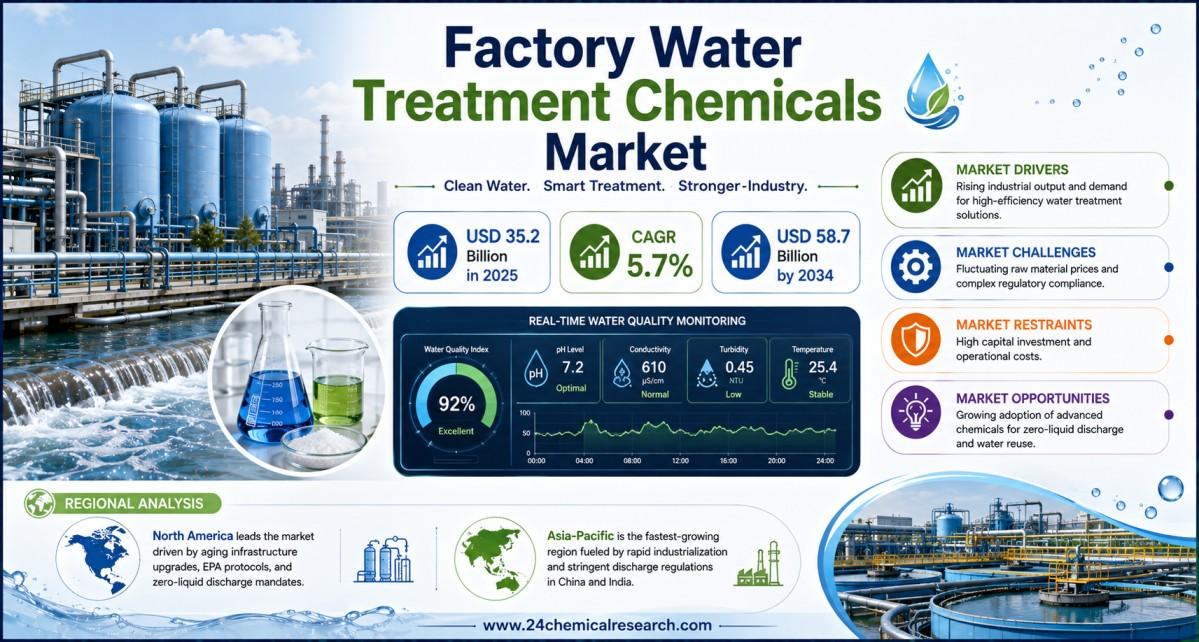
According to 24ChemicalResearch latest industry analysis, the global Factory Water Treatment Chemicals market was valued at USD 35.2 billion in 2025 and is projected to reach USD 58.7 billion by 2034, growing at a compound annual growth rate (CAGR) of 5.7% during the forecast period. Reflecting accelerated demand for sustainable water reuse solutions, the compound annual growth rate has been revised upward to 5.7%. The market's expansion is fueled by increasing regulatory pressure on water reuse, rising water scarcity, and advances in digital dosing and low‑dose eco‑friendly chemistries.
View the complete report: https://www.24chemicalresearch.com/reports/305370/factory-water-treatment-chemicals-market
Factory water treatment chemicals comprise coagulants, flocculants, biocides, scale inhibitors, pH adjusters, defoamers, and softeners engineered to treat process water and wastewater in industrial facilities. These formulations safeguard equipment, improve process efficiency, and help facilities comply with tightening environmental regulations. "Water quality today must match the stringent process specifications embedded in high‑value manufacturing lines. Failure to monitor pH, turbidity, and residual chlorine correctly leads to batch failures, compliance audits, and downtime costs that dwarf the purchase of chemicals," notes an analyst from 24ChemicalResearch. The convergence of regulatory pressure, water scarcity, and technological advances drives adoption of greener, multi‑functional chemistries.
What Is Driving the Factory Water Treatment Chemicals Market?
The global market for factory water treatment chemicals is propelled by several interconnected factors, ranging from water reuse adoption to digital transformation in chemical dosing.
Water Reuse Adoption
Industry adoption of in‑situ water reuse systems has accelerated, driven by declining raw water availability and tightening environmental constraints. Production facilities already working to meet regulatory limits on effluent discharge see reusable treatment as a way to decouple production volumes from water input. The main benefit is a reduction in both operating expenses and regulatory fines. Moreover, the increased demand for completed beverage and pharmaceutical manufacturing has raised production volumes, thereby heightening the need for reliable treatment. In this environment, manufacturers view chemical treatment as a cost‑effective lever for compliance, creating a strong push for new chemical solutions across plant and mill sites.
Sustainability Optimization
Emerging inventories of rainwater capture and decentralized treatment modules dovetail with the push for sustainability. Thermally driven acid–base neutralisation processes are being customised to support precision in disturbed solids removal while minimising corrosion of downstream equipment. Manufacturers increasingly rely on chemical additives that also perform nutrient control, eliminating the need for secondary physical filtration stages. Consequently, the footprint of chemical usage decreases, and the complexity of plant infrastructure lightens. Businesses noting a 10‑15% reduction in alarm incidents over a three‑year baseline are re‑allocating budgets to acquire next‑generation antichlorination agents.
Digital Control Integration and Smart Dosing
Digital control integration is reshaping chemical dosing. Real‑time dashboards provide operators with instant visibility into pH, conductivity, and effluent quality, while automated valves adjust flows instantaneously. Coupling data streams with dose‑optimisation algorithms allows operators to maintain the exact chemical balances required, increasing throughput, reducing waste, and ensuring product consistency. This convergence reduces operator error, curtails training cycles, and accelerates time‑to‑market for new treatments. For suppliers, the shift opens the door to subscription‑based services, ensuring recurring revenue streams. Early adopters of such systems report heightened plant resilience and a competitive advantage in markets where water‑controlled processes dictate product quality.
Market Segmentation Insights
The factory water treatment chemicals market is segmented by type, application, end user, function, and form, each revealing distinct competitive dynamics and investment opportunities. The diversity in applications, from chemical manufacturing to food and beverage, underscores the material's versatility and the specialized nature of its adoption across various industrial verticals.
By Type
Coagulants & Flocculants form the backbone of industrial water treatment, delivering essential solids removal and clarification for a wide array of processes. Their ubiquity across sectors ensures a steady demand, providing operators with a reliable first line of defense against turbidity, sediment, and microbial load. The robustness of these chemicals, combined with their relatively low cost and compatibility with subsequent treatment steps, positions them as the default choice in most industrial plants seeking to maintain operational continuity and meet discharge standards.
By Application
Chemical Manufacturing stands out as a demanding application segment, requiring a complex mix of advanced cleaning, neutralizing, and corrosion‑preventing chemicals to manage the harsh effluents generated by its processes. Firms in this space prioritize high‑purity solutions that enforce tight control over pH, metal ion concentrations, and pathogen loads, ensuring product integrity and plant longevity. The sophistication of its chemical palette fuels continuous innovation, with suppliers vying to deliver multifunctional blends that reduce dosage and streamline automation.
Regional Market Analysis
The global factory water treatment chemicals market is characterized by distinct regional dynamics, with North America leading in value and Asia-Pacific emerging as the fastest-growing region.
North America Region
North America is the leading regional market, experiencing renewed demand for factory water treatment chemicals as legacy power utilities and oil‑and‑gas operators accelerate upgrades to meet tightening EPA discharge protocols and water‑reuse mandates. The region's aging infrastructure necessitates deep wells, corrosion protection, and scale suppression, making advanced biocides and mixed‑function antiscalants essential. Recent investments in smart‑plant initiatives—integrating real‑time sensing, automated dosing, and remote analytics—have shifted procurement toward chemically formulated solutions that are readily compatible with digital regulatory dashboards. The strategic push toward zero‑liquid discharge in California's Delta region has further spurred demand for high‑purity flocculants and membrane‑cleaning chemicals.
Asia-Pacific Region
Asia-Pacific is the fastest-growing emerging market for factory water treatment chemicals, with China's manufacturing cluster and India's burgeoning industrial base together driving the bulk of demand. Regulatory frameworks such as China's National Water Resources Law and India's Water (Prevention and Control of Pollution) Act have mandated strict discharge limits, compelling factories to adopt sophisticated treatment protocols. Coupled with the rapid expansion of the chemical, food‑and‑beverage, and textile sectors, these legislative pushes translate directly into higher consumption of coagulants, biocides, and antiscalants. The growth of mega‑project infrastructure—new power plants, petrochemical complexes, and composite material mills—amplifies the need for closed‑loop water systems.
Report Summary
The global Factory Water Treatment Chemicals market is on a robust growth trajectory, propelled by tightening environmental regulations, water scarcity, and digital dosing innovations. While the market faces challenges such as capital investment headwinds and energy consumption, opportunities in green chemistry and digital transformation are set to reshape the industry's future landscape.
Key Report Highlights:
-
The global Factory Water Treatment Chemicals Market was valued at USD 35.2 billion in 2025 and is projected to reach USD 58.7 billion by 2034.
-
The market is expected to expand at a CAGR of 5.7% during the 2025–2034 forecast period.
-
North America remains the leading regional market, driven by aging infrastructure upgrades and EPA protocols.
-
Coagulants & Flocculants form the backbone of industrial water treatment, delivering essential solids removal and clarification.
-
The market grapples with capital investment headwinds, high energy consumption, supply chain uncertainty, and regulatory compliance complexity.
-
The competitive landscape includes major industry participants such as BASF SE and Ecolab Inc., with regional players such as Thermax, SUEZ, and Solenis bolstering market depth.
-
The report provides comprehensive insights into market size, growth forecasts, emerging technologies, regional trends, competitive analysis, key growth opportunities, and strategic developments shaping the global Factory Water Treatment Chemicals Market through 2034.
Frequently Asked Questions Factory Water Treatment Chemicals Market
Q: What is the current size of the global Factory Water Treatment Chemicals market?
A: According to 24ChemicalResearch, the global Factory Water Treatment Chemicals market was valued at USD 35.2 billion in 2025 and is projected to reach USD 58.7 billion by 2034.
Q: Which region dominates the Factory Water Treatment Chemicals market?
A: North America is the leading regional market, driven by aging infrastructure upgrades, tightening EPA protocols, and zero-liquid discharge mandates.
Q: What are the key growth drivers of the Factory Water Treatment Chemicals market?
A: The primary growth drivers include Water Reuse Adoption, Sustainability Optimization, and Digital Control Integration and Smart Dosing.
Q: Which segment leads the market by type?
A: Coagulants & Flocculants lead the type segment, delivering essential solids removal and clarification for a wide array of industrial processes.
Q: Who are the leading companies in this market?
A: The top companies include BASF SE and Ecolab Inc., with significant players such as Dow Inc., Kurita Water Industries, Solenis, Buckman Laboratories, Kemira Oyj, SUEZ, SNF Group, Thermax Limited, Veolia, and Lonza Group.
View the complete report: https://www.24chemicalresearch.com/reports/305370/factory-water-treatment-chemicals-market
Download the free sample report: https://www.24chemicalresearch.com/download-sample/305370/factory-water-treatment-chemicals-market
About 24ChemicalResearch
Founded in 2015, 24ChemicalResearch has established itself as a leading provider of chemical market intelligence, serving clients including over 30 Fortune 500 companies across North America, Europe, and Asia-Pacific. The company delivers data-driven insights through rigorous primary and secondary research methodologies.
Contact: +91 9169162030
Website: https://www.24chemicalresearch.com

 English
 Arabic
 Spanish
 Portuguese
 Deutsch
 Turkish
 Dutch
Dutch
 Italiano
 Russian
 Romaian
 Portuguese (Brazil)
 Greek
Greek
