


Company Incorporation in India: Common Legal Mistakes and How to Avoid Them
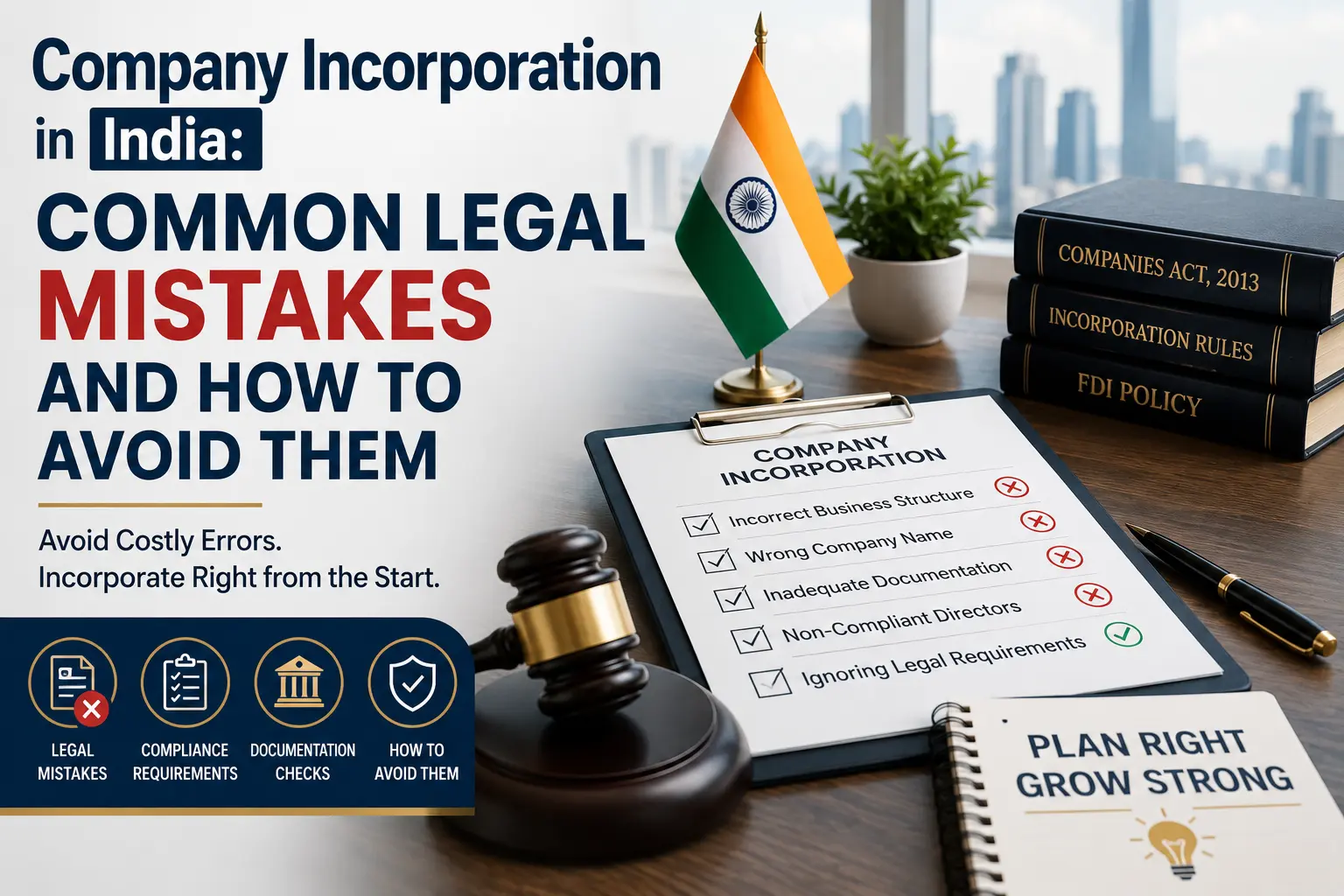
Incorporating a company in India has become more streamlined with the Ministry of Corporate Affairs online filing system. Yet, a simple filing process does not mean the legal requirements are simple. Mistakes in company structure, documentation, business objects, registered office details or director information can result in resubmission, delays and future compliance problems.For founders, incorporation is more than obtaining a Certificate of Incorporation. It establishes the legal framework within which the business will operate. Decisions made at this stage can affect ownership, taxation, investment, governance and regulatory obligations.Understanding the most common legal mistakes can help entrepreneurs approach incorporation with greater confidence and avoid problems later.
Choosing the Wrong Business Structure
One of the first mistakes founders make is selecting a business structure without considering their long term objectives.A Private Limited Company may be suitable for businesses planning to raise equity investment, expand operations or bring in institutional investors. An LLP can be more appropriate for certain professional businesses and closely held ventures seeking greater flexibility in management.The decision should take into account the number of founders, proposed investment, liability exposure, taxation, compliance requirements and future exit plans.Choosing a structure simply because it appears inexpensive or easy to incorporate may create difficulties if the business later needs external investment or restructuring.
Failing to Check the Proposed Company Name Properly
A proposed company name must satisfy the applicable requirements under company law and should not conflict with existing registered names, trademarks or other protected interests.A common mistake is to select a name based only on domain availability or branding preference. A commercially attractive name may still face objections during incorporation.Founders should conduct appropriate checks before submitting a name reservation application. Trademark considerations are particularly important because company name approval does not automatically provide comprehensive trademark protection.Early legal and commercial checks can reduce the risk of having to change the company's name after incorporation.
Providing Incorrect Director Information
Details relating to proposed directors must be accurate and consistent with their identification documents.Errors in names, dates of birth, addresses, nationality or other identification details can create problems during filing. The Ministry of Corporate Affairs has specifically identified incorrect or incomplete director and subscriber documentation as a reason for rejection or resubmission in certain incorporation applications.Directors should therefore review their documents before the incorporation application is submitted. Where a director already has a Director Identification Number, the information should also be checked against existing MCA records.
Ignoring the Registered Office Requirements
The registered office is an important legal requirement for every company incorporated in India. It is the official address used for receiving statutory communications and notices.One of the most common incorporation mistakes is providing an address which does not match the supporting documents.The MCA has highlighted several registered office issues which can lead to rejection or resubmission. These include mismatches between the address in SPICe+ and the supporting proof, incomplete utility bills, illegible documents and missing NOC, lease or rent documentation where required.Founders should verify the complete address before filing. If the premises are rented or owned by another person, the necessary consent and supporting documentation should also be prepared.
Using Outdated or Inconsistent Documents
Incorporation applications rely heavily on supporting documentation. A document may be genuine but still unsuitable if it is outdated, unclear or inconsistent with the information submitted in the application.For example, an address proof showing an old residential address can create difficulties if a different address has been entered in the incorporation form.The same principle applies to registered office documents. Utility bills, lease documents and NOCs should contain information which corresponds with the proposed company details.A document checklist should therefore be prepared before filing rather than after a resubmission request is received.
Choosing Business Objects Without Proper Legal Review
The objects of a company describe the activities it is established to undertake. Founders sometimes use broad or generic wording without considering the actual nature of their proposed business.This can create difficulties when the company later applies for sector specific licences, enters regulated activities or seeks investment.The objects should reflect the intended business while remaining consistent with applicable law. If the business operates in a regulated sector, founders should determine whether additional permissions are required before selecting the relevant objects.Careful drafting at incorporation can provide greater clarity and reduce the need for unnecessary amendments later.
Overlooking Foreign Investment Regulations
Foreign shareholders introduce another layer of legal considerations.India permits foreign investment in many sectors, including up to 100 per cent foreign investment under the automatic route in most sectors, subject to applicable conditions. Certain sectors have investment limits, entry conditions or government approval requirements.A common mistake is to complete the company incorporation process without first checking whether the proposed activity is eligible for foreign investment.Foreign investors should examine the applicable FDI policy, sectoral conditions and foreign exchange requirements before funds are invested.This is particularly important for businesses operating in regulated sectors or where foreign ownership is subject to specific restrictions.
Incorrectly Handling Foreign Documents
Foreign founders and corporate shareholders may need to provide documents issued outside India.The authentication requirements can vary according to the country in which the document was issued. Depending on the circumstances, documents may need notarisation, apostille or consular attestation.The MCA has specifically identified improper authentication of foreign documents as an issue in applications involving foreign subscribers and foreign subsidiary structures.Obtaining these documents can take time. Foreign investors should therefore address authentication requirements before beginning the incorporation filing rather than waiting for a resubmission request.
Not Understanding Director Requirements
Founders sometimes assume every shareholder can automatically act as a director without considering the statutory requirements applicable to company directors.The Companies Act contains requirements concerning the number and eligibility of directors, including the requirement relating to a resident director.The distinction between shareholders and directors is important. Shareholders hold ownership interests in the company, while directors are responsible for managing its affairs within the statutory framework.The proposed board should therefore be considered carefully during incorporation, particularly where the company has foreign founders or several investors.
Treating Incorporation as the End of Compliance
Obtaining the Certificate of Incorporation is only the beginning of the company's compliance journey.A newly incorporated company may have to complete further requirements relating to share capital, statutory registers, accounting records, tax registrations, bank accounts and other regulatory matters.The exact obligations depend on the nature and circumstances of the company. Some businesses may also require sector specific licences before commencing operations.Founders should create a compliance plan from the beginning rather than assuming incorporation alone makes the business ready to operate.
Failing to Plan for Future Investment
A company structure should reflect not only current needs but also potential future plans.A startup expecting angel investment or venture capital may need a clear shareholding structure, suitable constitutional provisions and properly documented founder arrangements.If these matters are ignored during incorporation, restructuring may become necessary before an investment round.Businesses planning to company formation in india should therefore consider their expected funding requirements before finalising the shareholding and governance structure.
Neglecting Founder and Shareholder Arrangements
Where two or more founders are involved, relying only on the Articles of Association may not adequately address every commercial relationship.Founders should consider how important matters such as ownership, decision making, transfer of shares, funding obligations, intellectual property and founder exits will be handled.A properly drafted shareholders' agreement can provide greater clarity in suitable circumstances. It can also reduce the risk of disputes when the business grows or the interests of the founders change.These arrangements should ideally be considered at the beginning of the business rather than after a disagreement arises.
Failing to Consider Sector Specific Regulations
Company registration does not automatically give a business permission to conduct every proposed activity.Certain sectors are subject to additional regulatory frameworks. Financial services, insurance, pharmaceuticals, food businesses, telecommunications, education and other regulated industries may require approvals or licences from relevant authorities.Foreign investment can also introduce additional conditions depending on the sector. The FDI framework makes clear that investments remain subject to applicable laws, regulations and sector specific conditions.Founders should therefore identify the regulatory requirements applicable to their business before incorporation.
Not Taking Professional Legal Advice Where Necessary
Many straightforward incorporations can be completed through the MCA's digital process. However, legal advice becomes particularly valuable when the business involves foreign investors, multiple founders, regulated activities, intellectual property, complex ownership or significant future investment.Experienced startup law firm in india can assist with entity selection, incorporation documents, founder arrangements, foreign investment considerations and regulatory compliance.Professional advice is not simply about completing forms. It can help founders identify legal risks before they become expensive problems.
How Can These Mistakes Be Avoided?
The most effective approach is to treat incorporation as a legal structuring exercise rather than a form filling exercise.Founders should first identify the appropriate entity and understand the nature of the proposed business. They should then verify the company name, review director and shareholder information, prepare registered office documents and ensure all supporting documents are current and consistent.Foreign participation requires additional attention to FDI rules and document authentication. Regulated businesses should also identify applicable licences before commencing operations.Finally, founders should prepare for post incorporation compliance from the outset. This creates a stronger foundation for future growth and reduces the risk of avoidable regulatory issues.
Conclusion
Company incorporation in India is a structured legal process. While online filing has made incorporation more accessible, errors can still result in delays and create problems after the company begins operating.The most common mistakes involve choosing the wrong structure, submitting inconsistent documents, overlooking registered office requirements, failing to consider foreign investment rules and treating incorporation as the end of compliance.A careful approach at the beginning can prevent many of these issues. Founders should consider both their immediate requirements and future business plans before incorporating.Where the proposed structure involves foreign investment, multiple founders, regulated activities or significant future funding, obtaining appropriate legal advice can help ensure the company begins its operations on a sound legal foundation.

 English
 Arabic
 French
 Spanish
 Portuguese
 Deutsch
 Turkish
 Italiano
 Russian
 Romaian
 Portuguese (Brazil)
 Greek
Greek
