


Is It Safe to Run a Diffuser All Night?
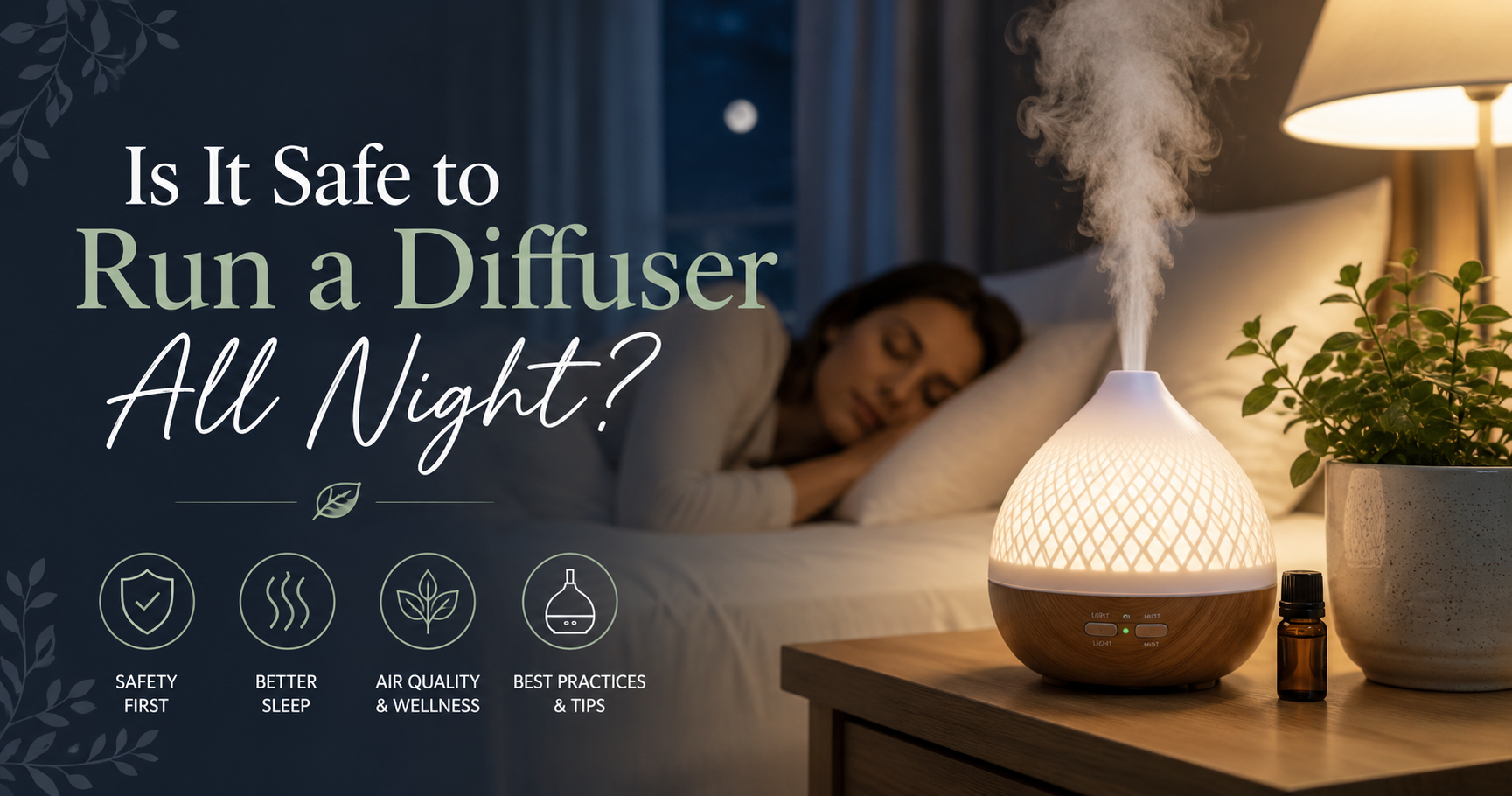
Is It Safe to Run a Diffuser All Night?
Continuous all-night diffusion is generally not the preferred approach. A safer and more efficient method for many users is to use a timer or intermittent mode, keep the scent light, allow some air exchange, and follow your diffuser's manufacturer instructions. The Tisserand Institute specifically recommends 30–60 minutes of diffusion followed by 30–60 minutes off, rather than continuous operation.
Running a diffuser all night isn't automatically dangerous, but continuous essential-oil diffusion usually isn't the best approach. The better question isn't just "can a diffuser run all night?" — it's "what diffuser, what oil, what concentration, what room, and who's sleeping there?" This guide walks through exactly that.
Can You Leave a Diffuser On All Night?
The short answer is that you can, but it's usually not necessary or ideal. Most diffusers are physically capable of running for many hours, but that capability is a device specification, not a health recommendation.
Continuous diffusion isn't usually necessary because your nose adapts to a consistent scent fairly quickly, meaning you get diminishing benefit from hours of nonstop fragrance while the room's air continues accumulating aromatic compounds.
Overnight use requires extra caution in smaller or sealed rooms, with certain diffuser types, when children or pets are present, or if anyone in the room has respiratory sensitivities.
How Long Should You Run a Diffuser at Night?
The 30–60 minute approach is the most well-supported recommendation. The Tisserand Institute specifically advises 30–60 minutes of diffusion followed by 30–60 minutes off, rather than continuous all-night operation.
Intermittent diffusion has real advantages over continuous diffusion. It reduces the buildup of aromatic compounds in the room's air, helps prevent your nose from fully adapting to the scent, and uses less oil overall while still providing consistent fragrance throughout the night.
Longer isn't always better. Running a diffuser continuously for 8 hours doesn't mean 8 hours of proportionally greater benefit — it often just means more prolonged exposure to a concentrated scent in a closed room.
What Happens If You Run a Diffuser All Night?
Stronger fragrance exposure builds up over a continuous session, particularly in smaller or less ventilated rooms.
Headaches or nausea have been reported by some users after extended exposure to concentrated essential oils, particularly with strong oils or excessive oil quantities.
Coughing or respiratory irritation can occur in sensitive individuals, especially with prolonged exposure in a closed bedroom.
Olfactory fatigue sets in as your nervous system habituates to a continuous scent, meaning you may stop noticing the fragrance well before the exposure actually ends.
Increased humidity from ultrasonic models can occur over a long overnight session, since these diffusers release water vapor along with the oil.
These are possible outcomes, not guaranteed ones. Reactions vary significantly based on the individual, the oil, the concentration, and the room's ventilation — they aren't proof that overnight diffusion is unsafe for everyone, but they're worth watching for.
Is It Safe to Sleep With Different Types of Diffusers?
Ultrasonic diffusers combine water and oil to create a fine mist, and are generally better suited to timed or intermittent overnight use rather than continuous operation.
Nebulizing diffusers disperse concentrated oil without water, which means stronger exposure per session, so these should be used more cautiously overnight, typically with shorter or more limited runtimes.
Evaporative diffusers rely on airflow moving across an absorbent material, offering a lower-moisture option that tends to produce a milder overall exposure.
Heat-based diffusers use warmth to evaporate oil, but unattended or open-flame models carry fire risk and generally aren't recommended for overnight use while you sleep.
Reed and passive diffusers don't run on electricity, so there's no device runtime to manage, but they still create ongoing fragrance exposure throughout the night simply through natural evaporation.
Does Auto Shut-Off Make an Overnight Diffuser Safe?
Auto shut-off is an important device safety feature, but it doesn't automatically make continuous essential-oil exposure appropriate.
This feature typically addresses the diffuser running without water, preventing potential damage to the unit. It doesn't address how much fragrance you've been exposed to throughout the night or how your body responds to that exposure.
Some manufacturers design diffusers with several hours of continuous runtime and automatic shut-off built in, which demonstrates device capability rather than a recommendation for how long you should actually diffuse. What a diffuser can do and what's advisable for extended essential-oil exposure are two separate questions.
Which Essential Oils Are Better for Nighttime Diffusion?
Lavender is one of the most commonly used oils for nighttime diffusion and is generally well tolerated by most people at typical concentrations.
Roman chamomile is another gentle option often associated with a calming nighttime routine.
Cedarwood offers a milder, woody profile that many people find suitable for overnight use.
Frankincense is frequently used in relaxation-focused blends, though individual preference and tolerance vary.
Some oils may feel too strong for nighttime use. Peppermint and eucalyptus, for example, have intense, stimulating profiles that some people find too invigorating before sleep or overpowering in a closed bedroom. Essential oils are concentrated substances, and misuse or high exposure levels can cause adverse effects, so start conservatively with any oil you haven't used overnight before.
Is It Safe to Run a Diffuser Around Children?
Babies and infants warrant particular caution, since their respiratory systems are still developing and they may be more sensitive to concentrated fragrance than adults.
Older children generally tolerate diffusers better, but individual sensitivity still varies, and it's worth watching for any signs of discomfort.
Ventilation matters more with children in the room, since a closed nursery or bedroom can allow fragrance to concentrate more than a space with some air exchange.
Avoid assuming there's one universal age cutoff for safe diffuser use. If you have concerns about a specific oil or your child's health situation, checking with a pediatrician is a reasonable step.
Is It Safe to Run a Diffuser Around Pets?
Cats can be particularly sensitive to essential oils, and continuous overnight exposure in a shared room is a genuine concern worth taking seriously.
Dogs are generally considered less sensitive than cats, though animal welfare organizations still recommend caution, particularly for dogs with existing respiratory problems.
Birds are especially vulnerable due to their highly sensitive respiratory systems. The ASPCA specifically advises that households with birds should avoid essential-oil diffusers altogether.
Pets with respiratory problems need extra consideration regardless of species, since ongoing exposure throughout the night could worsen existing conditions. If your pet sleeps in the same room, consider whether they can access another space, or use shorter, intermittent sessions instead of continuous overnight diffusion.
Where Should You Put a Diffuser at Night?
Keep it away from your face to avoid concentrated direct exposure while you sleep, rather than placing it right on a nightstand next to your pillow.
Use a stable, water-resistant surface to prevent spills or tipping, especially with ultrasonic models that hold water.
Keep it away from electronics to avoid any risk of moisture affecting nearby devices.
Avoid curtains and bedding near the diffuser, both for fire safety with heat-based models and to prevent fabric from absorbing excess moisture or oil.
Allow some air exchange in the room rather than running the diffuser in a completely sealed space all night.
How Many Drops Should You Use Overnight?
Start with the manufacturer's instructions for your specific diffuser rather than guessing based on what you've seen elsewhere.
Use less rather than more when experimenting with a new oil or a longer overnight session, since it's easier to add more the next time than to correct an overpowering room.
Consider room size and diffuser output together — a small bedroom needs considerably less oil than a large open room to achieve a comparable fragrance level.
Stop if the scent becomes overpowering. An intensely strong smell isn't a sign of better aromatherapy — it usually just means the concentration has gotten ahead of what's comfortable.
Never assume a larger tank automatically requires proportionally more oil. Follow your specific diffuser's guidance rather than scaling oil quantity purely based on tank size.
Signs You Should Turn Off Your Diffuser
Watch for headache, coughing, throat irritation, eye irritation, nausea, dizziness, or breathing discomfort in yourself or anyone sharing the room. A strong or unpleasant scent that feels overwhelming rather than pleasant is also a clear signal to reduce exposure. Pet distress, such as unusual restlessness or avoidance behavior, and excess condensation around the diffuser are additional signs worth acting on.
If breathing difficulty or a serious reaction occurs, stop exposure immediately and seek appropriate medical attention.
How to Use a Diffuser More Safely Overnight
- Use a timer rather than running the diffuser indefinitely
- Choose intermittent mode over continuous operation where available
- Keep the scent intensity low rather than maximizing oil quantity
- Maintain some ventilation in the room instead of sealing it completely
- Clean the diffuser regularly to prevent residue and buildup
- Follow your manufacturer's specific instructions for water, oil, and runtime
Common Mistakes to Avoid
- Assuming auto shut-off makes unlimited overnight exposure automatically safe
- Running a diffuser continuously simply because the device is capable of it
- Adding extra oil to compensate for a large room instead of adjusting placement or diffuser output
- Placing a diffuser directly beside your pillow or a sleeping child's crib
- Ignoring headaches, coughing, or irritation and continuing to run the diffuser anyway
- Using a diffuser in a completely sealed room with no air exchange
- Assuming "natural" essential oils are automatically risk-free at any concentration or duration
Frequently Asked Questions
"Is it OK to sleep with an essential oil diffuser on?" It can be, but continuous all-night operation isn't usually the best approach. Intermittent diffusion with a timer is generally preferred over running it nonstop.
"Can I leave my diffuser running for 8 hours?" Many diffusers are physically capable of this, but that capability doesn't mean 8 hours of continuous exposure is the ideal approach for most users.
"How long should I run my diffuser before bed?" A common approach is 30–60 minutes of diffusion followed by 30–60 minutes off, rather than one long continuous session.
"Is intermittent diffusion better than continuous diffusion?" Yes, according to guidance from the Tisserand Institute, intermittent diffusion is generally preferred over continuous operation for most home aromatherapy use.
"Can a diffuser cause headaches?" Some individuals report headaches after prolonged or concentrated essential-oil exposure, particularly with strong oils or excessive quantities, though experiences vary by person.
"Can a diffuser cause breathing problems?" Respiratory irritation is possible in sensitive individuals, especially with prolonged exposure in a poorly ventilated room. Stop use if breathing discomfort occurs.
"Is lavender oil safe to diffuse overnight?" Lavender is commonly used for nighttime diffusion and generally well tolerated by most people, though individual sensitivity always varies.
"Are ultrasonic diffusers safe overnight?" They can be used overnight with reasonable caution, but intermittent settings are generally preferable to continuous operation, especially in smaller rooms.
"Are diffusers safe around cats?" Extra caution is needed. Cats can be particularly sensitive to essential oils, so shorter sessions and close attention to their behavior are recommended.
"Are diffusers safe around dogs?" Dogs are generally considered less sensitive than cats, but caution is still advised, particularly for dogs with existing respiratory issues.
"Can babies sleep in a room with a diffuser?" This requires extra caution due to babies' developing respiratory systems. Consider shorter sessions, good ventilation, and consulting a pediatrician if you have specific concerns.
"Does a diffuser increase humidity?" Ultrasonic diffusers do add a small amount of moisture to the air, though they aren't designed to function as a dedicated humidifier.
"Should I leave the window open while using a diffuser?" Some air exchange is generally beneficial, helping prevent fragrance compounds from concentrating too heavily in a sealed room overnight.
Conclusion
Running a diffuser all night isn't automatically dangerous, but continuous operation usually isn't the most effective or comfortable approach. The strongest evidence-backed recommendation is intermittent diffusion — roughly 30–60 minutes on, followed by 30–60 minutes off — rather than leaving a diffuser running nonstop through the night.
Consider your diffuser type, the oil you're using, your room's ventilation, and whether children or pets share the space before deciding on an overnight routine. A few simple adjustments — a timer, a lighter scent, and some air exchange — go a long way toward safer, more comfortable use.
Looking for a diffuser built for controlled, comfortable nighttime use? Explore our range of Affordable Scent Diffusers In UAE For Homes & Businesses, featuring timers, auto shut-off, and quiet operation suited to bedrooms and beyond.

 English
 Arabic
 French
 Spanish
 Portuguese
 Deutsch
 Turkish
 Italiano
 Russian
 Romaian
 Portuguese (Brazil)
 Greek
Greek
