


Light Conversion Film Market Set to Hit USD 1,230 Million by 2034 at 6.0% CAGR
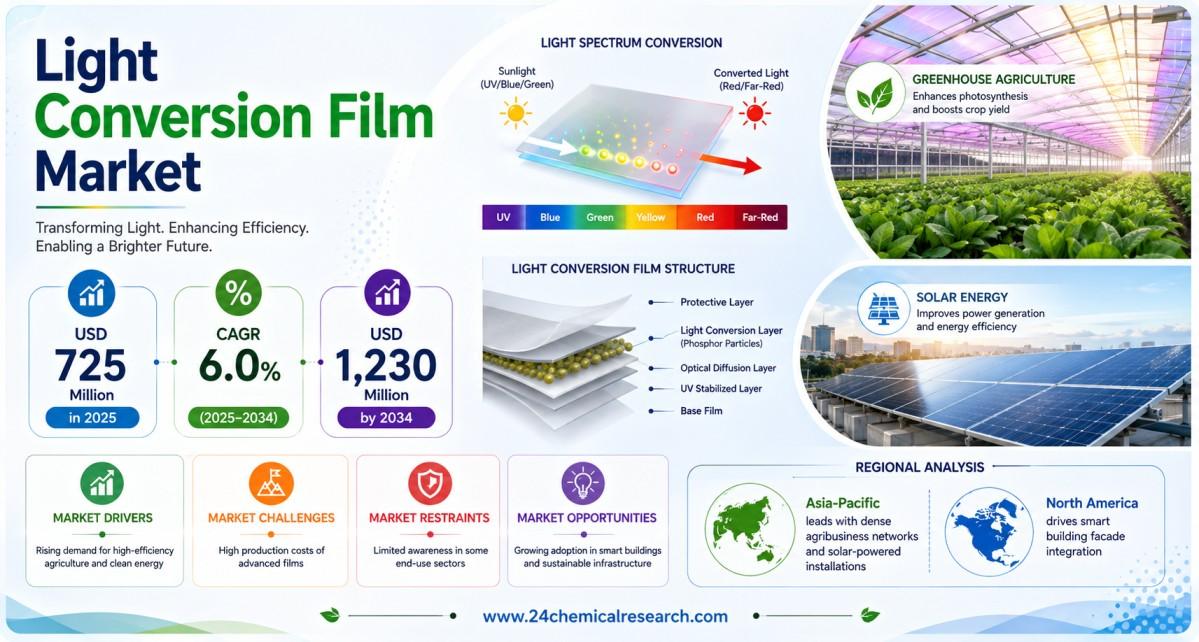
According to 24ChemicalResearch latest industry analysis, the global Light Conversion Film market was valued at USD 725 million in 2025 and is projected to reach USD 1,230 million by 2034, growing at a compound annual growth rate (CAGR) of 6.0% during the forecast period. The market's expansion is fueled by the convergence of energy efficiency imperatives and precision agriculture demands, accelerated renewable-energy deployment integrating high-efficiency films into photovoltaic modules, and heightened adoption of spectral-optimised coatings to boost agricultural yields and reduce operating costs.
View the complete report: https://www.24chemicalresearch.com/reports/284257/regional-light-conversion-film--supply-dem-analysis-competitive-market
Light conversion films are thin, multifunctional polymeric coatings that alter the spectral composition of incident light. By transforming non-photosynthetic wavelengths into visible light with high efficiency, they enhance plant growth, increase photovoltaic energy capture, and improve indoor lighting quality. According to the report, "The market's expansion is underpinned by the convergence of energy efficiency imperatives and precision agriculture demands. As renewable energy deployment accelerates, manufacturers are integrating high-efficiency films into photovoltaic modules, while growers are adopting spectral-optimised coatings to boost yields and reduce operating costs."
What Is Driving the Light Conversion Film Market?
The global Light Conversion Film market is experiencing robust growth driven by three primary factors that are reshaping the industry landscape and creating new opportunities for market participants.
Rising Demand for Energy-Efficient Lighting Solutions
High-efficiency blue LEDs have become industry staples, ushering in a wave of decarbonisation initiatives worldwide. When integrated with light conversion films, these sources yield luminaires that both conserve energy and extend service life. The widespread deployment of LED street lighting and commercial fixtures now accounts for roughly 45% of global lighting installations, a proportion that grew from 30% in 2020. Manufacturers are now focusing on enhancing the spectral conversion efficiency of these films, boosting luminous efficacy by 15% on average. This technical progress directly raises the adoption rate among municipalities and corporate campuses striving for low-carbon footprints. Adopting light-conversion films has reduced overall lighting power draw in large office complexes by up to 30%, translating into substantial yearly savings.
Technological Advancements in Film Fabrication
The push toward smart building and Internet-of-Things ecosystems is reinforcing the need for quasi-transparent illumination solutions. Projects involving smart retail displays and adaptive mood lighting now routinely incorporate light-conversion layers to modulate color temperature dynamically. Because the films can be seamlessly integrated into existing LED modules, the barrier to entry for innovative lighting concepts remains low, encouraging experimentation across sectors from hospitality to automotive. Quantum-dot-based films have entered early-stage commercial deployment, offering a 1.5% lift in photovoltaic conversion on a per-module basis. This convergence of sustainability goals and digital experience design is the linchpin driving the market forward.
Expanding Use in Agriculture and Photovoltaics
In food-security-critical regions such as China, India, and Brazil, greenhouse operators have adopted conversion films to shift ultraviolet and blue spectra into the optimal growth window, boosting crop yields by up to 30% and cutting supplemental lighting needs by a third. Parallel developments in Asia-Pacific's solar panels—already producing more than 30 GW of renewable power—demonstrate that converting low-energy photons to higher-energy equivalents can lift module efficiency by 2–3 percentage points. Photovoltaic represents the foremost application for light conversion films, as they directly enhance solar panel performance by tailoring incident light spectra to the needs of photovoltaic cells. Agricultural use, particularly in controlled-environment greenhouses, is second in prominence and leverages spectral manipulation to accelerate photosynthesis and reduce the need for supplemental lighting.
Market Segmentation Insights
The Light Conversion Film market exhibits diverse segmentation patterns across product types, applications, and end-users, each revealing distinct competitive dynamics and investment opportunities.
By Product Type
PO Film has emerged as the primary driver due to its combination of high light transmittance and environmental resilience, making it ideal for long-term outdoor use in both agricultural and photovoltaic settings. EVA films remain the standard for many established frameworks because of their proven reliability and straightforward processing technique. While other materials offer specialized spectral shifts, their limited scalability tends to confine them to niche industrial applications. Providers that can seamlessly integrate PO film technologies into existing manufacturing lines and achieve consistent structural integrity tend to secure a competitive edge across multiple verticals.
By Application
Photovoltaic represents the foremost application for light conversion films, as they directly enhance solar panel performance by tailoring incident light spectra to the needs of photovoltaic cells. Agricultural use, particularly in controlled-environment greenhouses, is second in prominence and leverages spectral manipulation to accelerate photosynthesis and reduce the need for supplemental lighting. Other sectors such as architectural shading, specialty lighting fixtures, and medical devices are adopting light conversion films to improve energy efficiency and user experience, yet they currently remain in early adoption phases.
Regional Market Analysis
Asia-Pacific remains the principal hub for light-conversion film adoption. Its dense network of agribusinesses, combined with a high penetration of solar-powered installations, creates a natural confluence of demand. Local producers have sharpened their production lines to align with the stringent quality benchmarks set by overseas buyers, particularly in Japan and South Korea, where certification frameworks are highly prescriptive. The region's manufacturing prowess in polymer technology, paired with organized supply chains for advanced nanomaterials, enables cost control that is difficult to replicate elsewhere. Regional trade agreements have lowered tariff barriers, easing cross-border shipment and reinforcing a virtuous cycle of consumption. Key highlights include a robust polymer R&D ecosystem sustaining fast innovation, strategic free-trade corridors reducing input costs, established certification pathways boosting buyer confidence, high-volume manufacturing reducing per-unit cost, and an integrated supply chain for exotic dopants. Rapid grid electrification and the roll-out of rural agricultural extensions in India, Southeast Asia, and parts of Latin America are reshaping demand profiles, with new infrastructure projects frequently incorporating solar façades and greenhouses.
North America drives demand for smart building facade integration, with architectural facades equipped with dynamic light-conversion films modulating interior daylight and reducing HVAC loads. Pilot projects have captured significant reductions in simulated winter heating energy and occupant glare incidents, demonstrating a growing demand for films that couple optical conversion with structural resilience. In the United States, updated federal incentives encourage the installation of solar-facade systems, signaling a national push toward including light-conversion capacity. The public-sector procurement pipeline increasingly favors suppliers that can demonstrate lifecycle environmental gains, further driving investments in film alternatives that are recyclable or fabricated from bio-based polymers. The industrial and specialty lighting sector seeks films that provide uniform illumination and improve energy efficiency within commercial and institutional settings.
Report Summary
The global Light Conversion Film market is poised for steady growth over the 2025-2034 period, driven by expanding applications in photovoltaics, controlled-environment agriculture, smart building facades, and automotive interior lighting. The industry is witnessing significant transformation as manufacturers increasingly focus on quantum-dot and phosphor-based technologies, sustainable polymer substrates, and regulatory harmonisation to meet evolving consumer expectations and environmental standards.
Key Report Highlights:
-
The global Light Conversion Film Market was valued at USD 725 million in 2025 and is projected to reach USD 1,230 million by 2034.
-
The market is expected to expand at a CAGR of 6.0% during the 2025–2034 forecast period.
-
Asia-Pacific remains the dominant regional market, with dense agribusiness networks and high solar-powered installation penetration.
-
Photovoltaic represents the foremost application, enhancing solar panel performance by tailoring incident light spectra to photovoltaic cells.
-
PO Film leads the product type segment, combining high light transmittance with environmental resilience for long-term outdoor use.
-
The competitive landscape includes major industry participants such as Shandong Tianhe Plastic, Cybrid Technologies, Cascade Light Technologies, LUGUAN Plastic, Hangzhou Xinguang Plastic, Weifang Zhaotong Agri-Tech, Dongda Plastic, Huasun, and Shanxi Zhonghua, with Shandong Tianhe Plastic and Cybrid Technologies commanding roughly 35% of global capacity.
-
The report provides comprehensive insights into market size, growth forecasts, emerging technologies, regional trends, competitive analysis, key growth opportunities, and strategic developments shaping the global Light Conversion Film Market through 2034.
Frequently Asked Questions Light Conversion Film Market
Q: What is the current size of the global Light Conversion Film market?
A: According to 24ChemicalResearch, the global Light Conversion Film market was valued at USD 725 million in 2025 and is projected to reach USD 1,230 million by 2034.
Q: Which region dominates the Light Conversion Film market?
A: Asia-Pacific remains the principal hub, with dense agribusiness networks and high solar-powered installation penetration, while North America drives smart building facade integration.
Q: What are the key growth drivers of the Light Conversion Film market?
A: The primary growth drivers include rising demand for energy-efficient lighting solutions, technological advancements in film fabrication, and expanding use in agriculture and photovoltaics.
Q: Which segment leads the market by product type?
A: PO Film leads the product type segment, combining high light transmittance with environmental resilience for long-term outdoor use in agricultural and photovoltaic settings.
Q: Who are the leading companies in this market?
A: Market leadership rests with Shandong Tianhe Plastic and Cybrid Technologies, commanding roughly 35% of global capacity, with other significant players including Cascade Light Technologies, LUGUAN Plastic, Hangzhou Xinguang Plastic, Weifang Zhaotong Agri-Tech, Dongda Plastic, Huasun, and Shanxi Zhonghua.
View the complete report: https://www.24chemicalresearch.com/reports/284257/regional-light-conversion-film--supply-dem-analysis-competitive-market
Download the free sample report: https://www.24chemicalresearch.com/download-sample/284257/regional-light-conversion-film--supply-dem-analysis-competitive-market
About 24ChemicalResearch
Founded in 2015, 24ChemicalResearch has established itself as a leading provider of chemical market intelligence, serving clients including over 30 Fortune 500 companies across North America, Europe, and Asia-Pacific. The company delivers data-driven insights through rigorous primary and secondary research methodologies.
Contact: +91 9169162030
Website: https://www.24chemicalresearch.com

 Arabic
 French
 Spanish
 Portuguese
 Deutsch
 Turkish
 Dutch
Dutch
 Italiano
 Russian
 Romaian
 Portuguese (Brazil)
 Greek
Greek
