


How to Start Your Pilot Career in India in 2026: Courses, Costs and DGCA Preparation
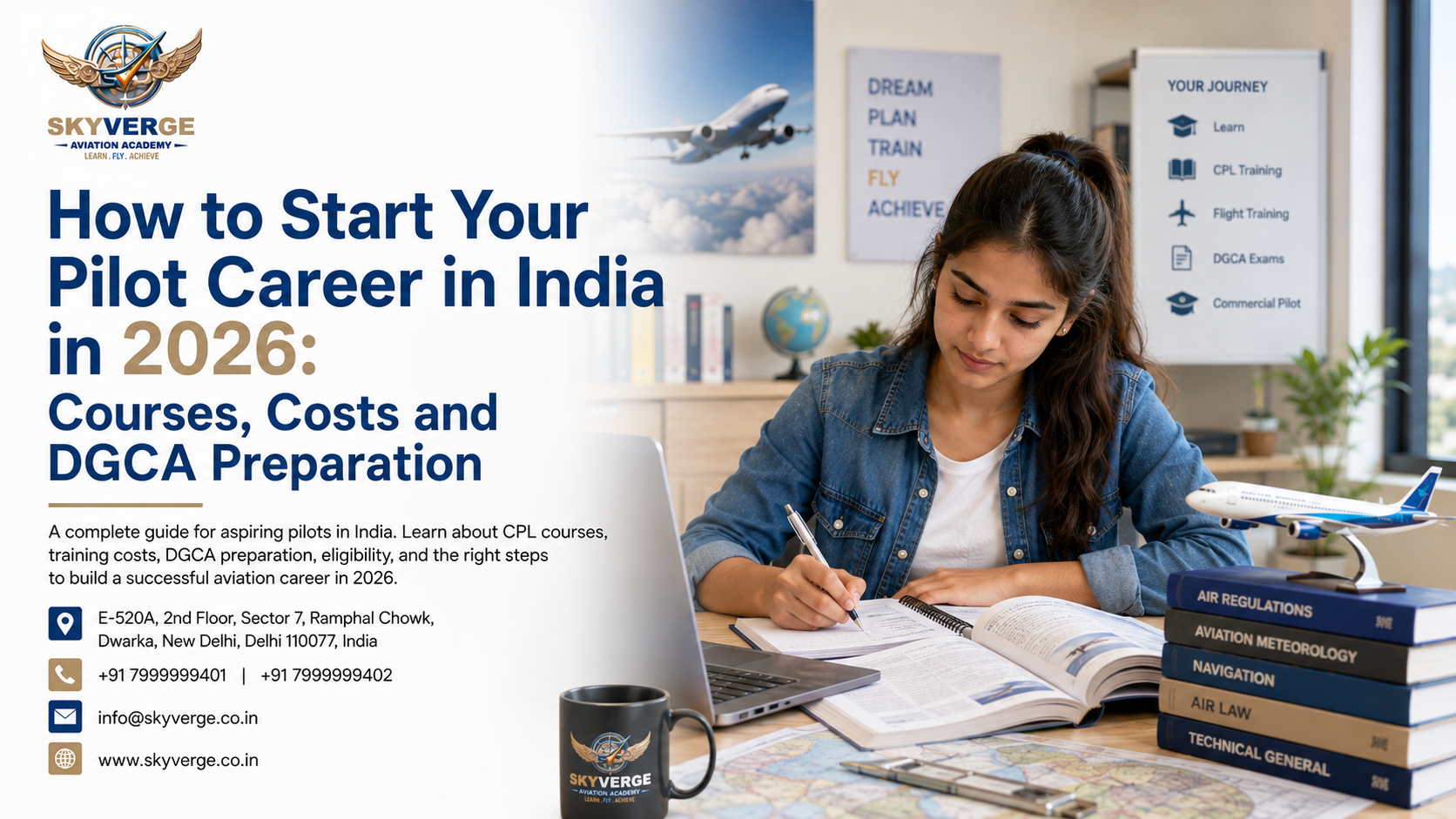
Becoming a commercial pilot in India is a structured career path that requires academic eligibility, medical fitness, theoretical knowledge, flight training, examinations, and licensing. In 2026, students planning an aviation career need to understand not only the training process but also the financial, regulatory, and academic commitments involved.
For students who are serious about aviation, choosing the right training pathway at the beginning can make the journey more organised. From understanding the CPL course in India to preparing for DGCA examinations and completing flight training, every stage requires careful planning.
Understanding the Commercial Pilot Career Path
A Commercial Pilot Licence (CPL) allows a qualified pilot to pursue professional flying opportunities, subject to the applicable regulatory requirements and aircraft/operator requirements.
The journey generally involves:
- Meeting the required educational eligibility
- Obtaining the appropriate DGCA medical clearance
- Completing theoretical examinations
- Undertaking flight training
- Maintaining the required flight records and documentation
- Completing applicable skill tests and regulatory requirements
- Applying for the CPL after fulfilling the prescribed requirements
Students should understand that pilot training is not simply about learning to fly an aircraft. A professional pilot must also understand aviation regulations, navigation, meteorology, aircraft systems, human factors, and operational procedures.
What Does DGCA Ground School Mean?
One of the most important academic components of pilot preparation is DGCA ground school.
Ground classes help students build the theoretical knowledge required for aviation examinations and later flight training. Depending on the applicable requirements and training pathway, students may study subjects related to areas such as:
- Air Regulations
- Air Navigation
- Aviation Meteorology
- Technical General
- Technical Specific
- Radio Telephony and communication-related preparation
Strong theoretical knowledge becomes particularly important once students begin connecting classroom concepts with actual flight operations.
Instead of treating ground subjects as examinations that simply need to be passed, students should understand how these subjects contribute to safe decision-making in aviation.
How Much Does Pilot Training Cost in India?
One of the first questions students and parents ask is about the Pilot training cost in India.
The overall expense can vary significantly depending on the flight school, aircraft type, training location, number of flying hours required, accommodation, examination expenses, medical requirements, equipment, documentation, and whether additional flying is needed.
Therefore, students should avoid choosing a flight school solely on the basis of an advertised package price.
When comparing training options, ask what is actually included in the quoted amount. A transparent comparison should consider:
- Ground training charges
- Flight training charges
- Aircraft and instructor-related costs
- Examination and regulatory expenses
- Medical expenses
- Accommodation and living costs
- Study materials
- Additional flying requirements
- Administrative and documentation charges
Understanding the complete financial structure can help families prepare a realistic aviation education budget.
What Are Commercial Pilot Course Fees?
The commercial pilot course fees can differ from one training organisation to another. There is no single universal price that applies to every student because the total cost depends on the training arrangement and the student's individual progress.
Students should also distinguish between the cost of academic preparation and the cost of completing flight training.
A student may attend ground classes at one institution while completing flight training through an approved flight training organisation. Because of this, it is important to understand exactly which services an institution provides before making a financial commitment.
A good approach is to request a detailed fee structure and clarify whether the quoted amount includes all major training components or whether certain expenses are payable separately.
Choosing a Pilot Training Institute
Selecting a Pilot training institute in Delhi or elsewhere in India should involve more than looking at advertisements or promises of quick completion.
Students should evaluate factors such as:
- Faculty experience and teaching methodology
- DGCA examination preparation
- Academic support
- Training structure
- Student guidance
- Transparency in fees
- Communication and documentation support
- Student feedback and institutional reputation
- Whether the institute clearly explains what it does and does not provide
It is also useful to speak directly with counsellors or faculty members and ask detailed questions about the complete training pathway.
What Makes an Institute the Best Pilot Training Institute in India?
Students often search for the Best pilot training institute in India, but "best" can mean different things for different students.
A suitable institute should provide structured education, realistic guidance, experienced faculty, and a clear understanding of the student's complete aviation journey.
Students should not select an institute merely because it claims to be the best. Instead, compare institutions based on measurable factors such as course structure, faculty support, academic resources, transparency, student guidance, and how clearly they explain the requirements of professional pilot training.
The right choice is ultimately the institute that matches the student's educational needs, budget, preparation level, and long-term career objectives.
CPL Course in India: What Should Students Expect?
A CPL course in India requires commitment both inside and outside the classroom.
Students should be prepared to spend substantial time studying aviation theory, preparing for examinations, completing practical training, and maintaining the discipline expected in aviation.
A typical student journey may look like:
Eligibility → Medical Assessment → Ground Preparation → DGCA Examinations → Flight Training → Skill/Regulatory Requirements → CPL Application
However, the exact sequence and requirements can depend on the student's circumstances and the applicable DGCA regulations.
Students should always verify current regulatory requirements before beginning training because aviation rules, examination processes, approved organisations, and administrative procedures can change.
Why Medical Preparation Should Not Be Ignored
Medical fitness is an important consideration for anyone planning a professional pilot career.
Students should investigate the applicable DGCA medical requirements early rather than investing heavily in training before understanding their medical eligibility.
This is particularly important for students who are still deciding whether aviation is the right career for them.
Aviation is a safety-sensitive profession, and medical requirements exist to ensure that pilots are capable of performing their responsibilities safely.
Skills Students Should Develop Before Flight Training
Academic preparation is only one part of becoming a professional pilot.
Students can begin developing several useful skills before entering flight training:
Communication
Pilots need clear and precise communication. Improving English communication and aviation terminology can make classroom and operational training easier.
Discipline
Flight training requires punctuality, preparation, documentation, and consistent study habits.
Decision-Making
Pilots regularly assess information and make decisions within operational limitations. Students should develop logical and responsible decision-making habits.
Technical Understanding
A basic interest in mathematics, physics, aircraft systems, navigation, and weather can help students adapt to aviation studies.
Situational Awareness
Understanding what is happening around you and responding appropriately is an essential aviation skill.
Questions Students Commonly Ask About Pilot Training
1. What qualifications do I need to become a commercial pilot in India?
Students generally need to meet the prescribed educational, medical, examination, flight-training, and licensing requirements applicable to commercial pilot licensing. The exact requirements should be checked against current DGCA regulations before starting the process.
2. Is pilot training difficult for students from a non-aviation background?
Pilot training can be challenging, but students do not need to come from an aviation family. What matters is consistent study, understanding of concepts, discipline, and willingness to learn technical subjects.
3. How much money should I budget for pilot training?
There is no single amount that applies to every student. The Pilot training cost in India depends on the flight school, training structure, flying requirements, accommodation, examinations, medical expenses, and other associated costs. Students should obtain a detailed fee breakdown before enrolling.
4. Should I join ground classes before starting flight training?
Strong theoretical preparation can help students understand the concepts used during flight training. A structured DGCA ground school can therefore be valuable for students preparing for their examinations and building their aviation knowledge.
5. How should I choose a pilot training institute?
Compare institutes based on faculty, course structure, academic support, fee transparency, student guidance, training arrangements, reputation, and the clarity of information provided. Do not make the decision solely on the basis of marketing claims or the lowest advertised price.
Start Your Aviation Journey With Proper Planning
Aviation can be an exciting and rewarding career, but becoming a professional pilot requires serious preparation. Students should understand the regulatory pathway, medical requirements, academic subjects, flight training process, and financial commitment before enrolling.
In 2026, informed decision-making is more important than simply finding an institute that promises a quick route to a licence. Students should focus on developing strong aviation fundamentals and choosing an educational environment where they can receive structured guidance throughout their preparation.
SkyVerge Aviation Academy is based in Dwarka, New Delhi, and focuses on aviation education and student guidance. Students can visit the academy to discuss their aviation career plans, understand the training pathway, and get guidance based on their individual circumstances.
SkyVerge Aviation Academy
Address: E-520A, 2nd Floor, Sector 7, Ramphal Chowk, Dwarka, New Delhi, Delhi 110077, India
Phone: +91 7999999401 | +91 7999999402
Email: info@skyverge.co.in
Students considering a career in aviation should take the time to understand their options, verify current regulatory requirements, compare training pathways, and make an informed decision before beginning their pilot training journey.

 Arabic
 French
 Spanish
 Portuguese
 Deutsch
 Turkish
 Dutch
Dutch
 Italiano
 Russian
 Romaian
 Portuguese (Brazil)
 Greek
Greek
