


The Future of Instant Loans in India: AI, Digital KYC, UPI & Personalized Credit
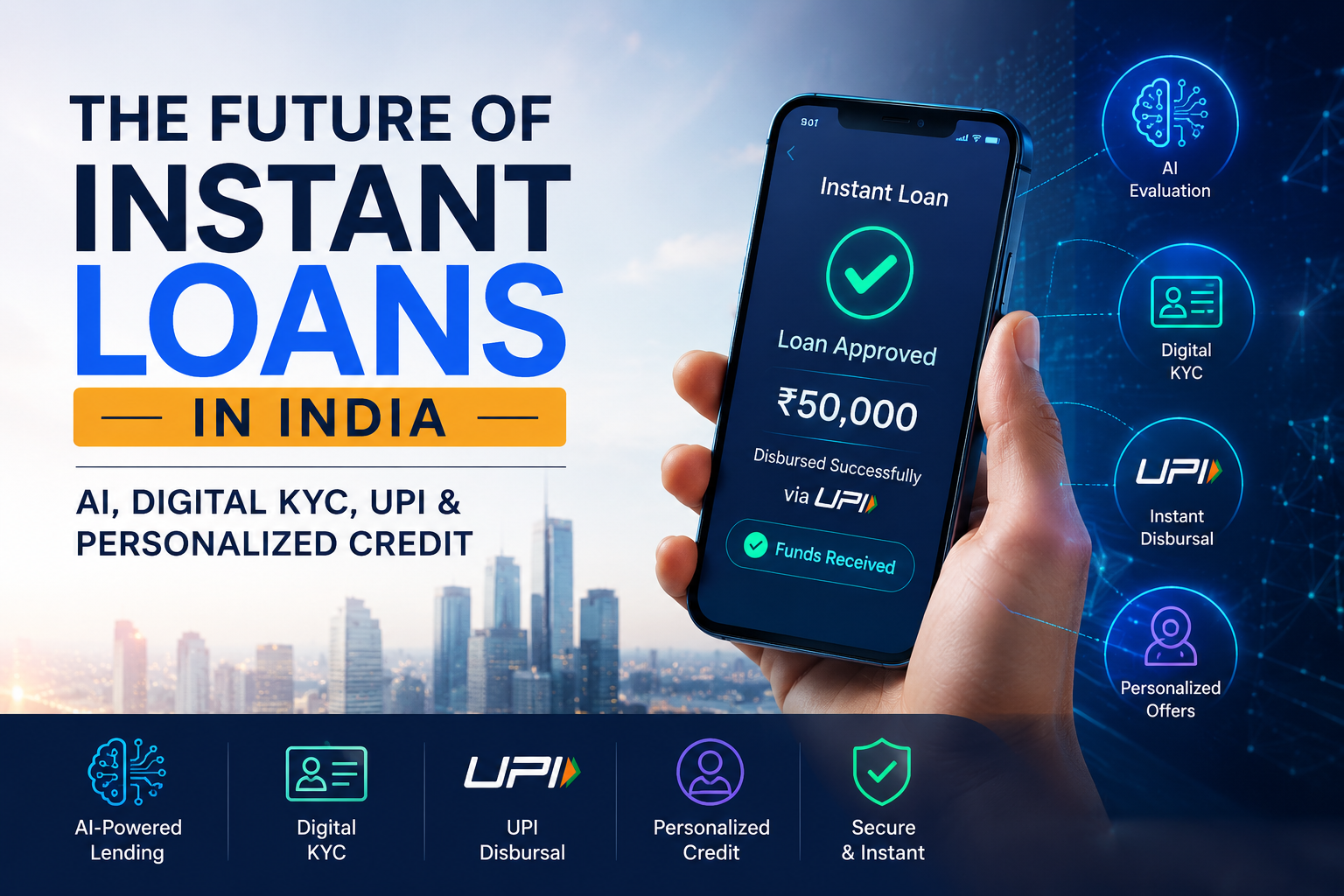
The way Indians borrow money is changing rapidly. Traditional loan applications that once required branch visits, lengthy paperwork, and days of waiting are increasingly being replaced by digital lending experiences. With smartphones, UPI, artificial intelligence, digital KYC, and automated credit assessment becoming mainstream, the future of instant loans is expected to be faster, more personalized, and increasingly technology-driven.
From small emergency loans to personal credit, borrowers can now complete much of the lending process online. Lenders and financial technology companies are using digital systems to verify applicants, assess creditworthiness, process applications, and disburse funds with minimal manual intervention.
But what will instant lending look like over the next few years? The answer lies in the convergence of AI-powered lending, digital KYC, UPI payments, alternative credit scoring, and personalized loan offers.
What Is the Future of Instant Loans in India?
The future of instant loans is moving toward a model where loan applications, verification, underwriting, approval, and disbursal happen almost entirely through digital channels.
Instead of relying only on traditional documents and historical credit records, lenders can increasingly use verified digital information and advanced analytics to understand a borrower's financial profile.
Several technologies are driving this transformation:
-
Artificial intelligence and machine learning
-
Digital KYC and electronic verification
-
UPI and real-time payment infrastructure
-
Automated credit underwriting
-
Alternative credit data
-
Personalized loan offers
-
Open banking and consent-based financial data sharing
This does not mean every applicant will automatically receive a loan instantly. Responsible lenders will still evaluate affordability, credit history, income, existing obligations, and other risk factors.
1. AI-Powered Lending Will Make Credit Decisions Smarter
Artificial intelligence is likely to become one of the biggest forces shaping the future of instant loans.
Traditional loan underwriting can involve manual checks and predefined rules. AI and machine learning systems can analyze large amounts of structured financial information to identify patterns and assess risk more efficiently.
For example, an AI-powered lending system may evaluate factors such as:
-
Income and employment information
-
Existing loans and EMIs
-
Credit history
-
Repayment behavior
-
Banking activity where legally and appropriately available
-
Loan amount requested
-
Existing financial obligations
This can help lenders automate parts of the underwriting process and potentially reduce processing time.
However, AI should not mean completely automated decision-making without safeguards. Transparency, data protection, fairness, and regulatory compliance will remain important as AI becomes more deeply integrated into lending.
2. Digital KYC Will Reduce Friction
Digital KYC is another major development transforming online borrowing.
In traditional lending, customers may need to submit physical copies of identity and address documents. Digital processes can significantly reduce this friction by allowing eligible borrowers to complete identity verification electronically.
The expansion of digital financial infrastructure in India has made remote verification increasingly practical.
For borrowers, this can mean:
-
Less paperwork
-
Fewer branch visits
-
Faster verification
-
More convenient online applications
-
Reduced duplication of information
As digital lending develops, digital KYC for loans is likely to become an increasingly important part of the application journey.
Nevertheless, borrowers should always verify that they are dealing with a legitimate lender or authorized lending platform before sharing personal information.
3. UPI Will Become More Important in Digital Lending
UPI has transformed how Indians send and receive money, and its role in digital financial services continues to expand.
The connection between UPI and lending can create a smoother borrowing and repayment experience. Depending on the lender and applicable regulations, digital platforms can use established payment infrastructure to facilitate transactions.
For borrowers, the broader integration of UPI loans and digital lending could make certain parts of the process more convenient.
Potential applications include:
-
Faster loan disbursal
-
Digital repayment
-
Automated payment reminders
-
Simplified EMI payments
-
Easier transaction tracking
UPI itself does not guarantee loan approval or instant credit. A legitimate lender will still conduct appropriate checks before extending credit.
4. Personalized Credit Offers Will Replace One-Size-Fits-All Lending
Another important trend is the move toward personalized credit.
Historically, lenders often offered standardized loan products with fixed eligibility requirements. Technology now allows financial institutions to analyze individual borrower profiles and potentially create more targeted offers.
For example, two customers with the same monthly income may receive different credit decisions because their credit histories, existing EMIs, employment profiles, or repayment behavior differ.
This could lead to more personalized:
-
Loan amounts
-
Interest rates
-
Repayment periods
-
EMI structures
-
Eligibility criteria
-
Credit limits
The growth of personalized loan offers in India could make borrowing more relevant to individual financial circumstances.
At the same time, borrowers should compare the complete cost of credit rather than choosing a loan simply because an app displays a personalized offer.
5. Alternative Credit Scoring Could Expand Access
One of the biggest challenges in traditional lending is evaluating customers with limited credit history.
A borrower who is new to formal credit may not have enough conventional credit information for a traditional assessment. Technology can potentially help lenders build a broader picture using legally permitted and consent-based financial information.
This development is sometimes referred to as alternative credit scoring.
Instead of depending exclusively on traditional credit history, lenders may increasingly consider additional financial indicators where permitted.
This could be particularly relevant for:
-
Young professionals
-
First-time borrowers
-
Self-employed individuals
-
Gig workers
-
Small entrepreneurs
-
Individuals with limited formal credit history
However, alternative data must be handled responsibly. Consumers should understand what information they are consenting to share and why it is being used.
6. Open Banking Can Improve Financial Assessment
Open and consent-based financial data sharing can further change how lenders assess borrowers.
India's digital financial ecosystem is increasingly focused on enabling consumers to securely share financial information with authorized entities through consent-driven mechanisms.
For lending, this could help eligible borrowers provide verified financial information without repeatedly submitting multiple documents.
For example, a borrower may be able to authorize access to relevant financial information instead of manually collecting and uploading numerous records.
This could make digital personal loan applications more efficient while potentially improving the quality of information available to lenders.
Privacy and consent will be critical. Consumers should carefully review permissions before authorizing access to financial data.
7. Instant Loan Processing Will Become More Automated
The phrase "instant loan" does not necessarily mean money is transferred in seconds for every borrower.
Instead, the future of instant lending is likely to involve increasing automation across the complete lending workflow.
A digital application may follow a process such as:
Application → Digital KYC → Data Verification → Credit Assessment → Decision → Agreement → Disbursal
Automation can reduce manual processing and help lenders handle applications more efficiently.
This may make fast personal loan approval increasingly common for borrowers who meet predefined eligibility and verification requirements.
However, applications requiring additional verification may still take longer.
8. Responsible Digital Lending Will Become More Important
Technology can make borrowing easier, but easier access to credit also creates risks.
The growth of instant lending makes it increasingly important for consumers to distinguish legitimate lending platforms from fraudulent loan apps.
Before accepting a loan, borrowers should check:
-
Who the actual lender is
-
Interest rate and applicable charges
-
Processing fees
-
Total repayment amount
-
EMI amount and tenure
-
Privacy policy and permissions
-
Loan agreement
-
Grievance redressal mechanism
-
Whether the lending arrangement complies with applicable regulations
Borrowers should also avoid sharing sensitive information with suspicious websites or applications.
The future of digital lending will therefore depend not only on speed but also on transparency, consumer protection, and responsible lending practices.
What Will Instant Loans Look Like in the Next Few Years?
The lending experience of the future could become increasingly seamless.
A borrower may be able to complete an application from a smartphone, verify their identity digitally, provide consent for relevant financial information, receive a personalized credit decision, electronically accept the agreement, and receive eligible funds through digital payment infrastructure.
AI could handle much of the initial risk assessment, while automated systems could monitor repayment behavior and help lenders identify potential risks.
The result could be a lending ecosystem that is:
Faster + More Digital + More Personalized + More Data-Driven
But technology alone will not determine whether a loan is suitable. Borrowers will still need to evaluate affordability and understand the terms before taking credit.
Benefits of the Future of Instant Loans
The evolution of instant lending could provide several benefits:
Faster Access to Credit
Automated verification and underwriting can reduce unnecessary processing delays.
Greater Convenience
Borrowers may complete more of the application process remotely.
Personalized Products
Technology can help lenders tailor products to individual financial profiles.
Better Financial Inclusion
Alternative data and digital infrastructure may help eligible borrowers with limited traditional credit histories access formal credit.
Easier Repayment
UPI and other digital payment systems can simplify EMI and loan repayments.
Challenges and Risks
The future also comes with challenges.
Data privacy: More digital lending means more financial data may be processed, making strong privacy protections essential.
Algorithmic bias: AI-based systems need appropriate monitoring to prevent unfair outcomes.
Over-borrowing: Extremely easy access to credit can encourage borrowers to take loans they cannot comfortably repay.
Fraud: Fake loan apps and phishing attempts remain important concerns.
Transparency: Borrowers need clear information about interest rates, fees, penalties, and repayment obligations.
Therefore, the best future for instant loans is not simply one where loans become faster. It is one where speed is combined with responsible underwriting, transparency, security, and consumer protection.
Conclusion
The future of instant loans in India is being shaped by a powerful combination of AI, digital KYC, UPI, automated underwriting, alternative credit scoring, and personalized financial products.
These technologies can make borrowing more convenient and potentially reduce the time required to process eligible applications. At the same time, responsible lending and informed borrowing will remain essential.
For consumers, the key will be to look beyond the word "instant." A good digital loan should not only be fast. It should also be transparent, affordable, secure, and provided through a legitimate lending arrangement.
As India's digital financial ecosystem continues to evolve, instant lending is likely to become less about simply getting money quickly and more about delivering the right credit product to the right borrower at the right time.

 English
 Arabic
 French
 Spanish
 Portuguese
 Deutsch
 Turkish
 Dutch
Dutch
 Italiano
 Russian
 Romaian
 Portuguese (Brazil)
