


Silica Beads Go Bad Before Anyone Notices
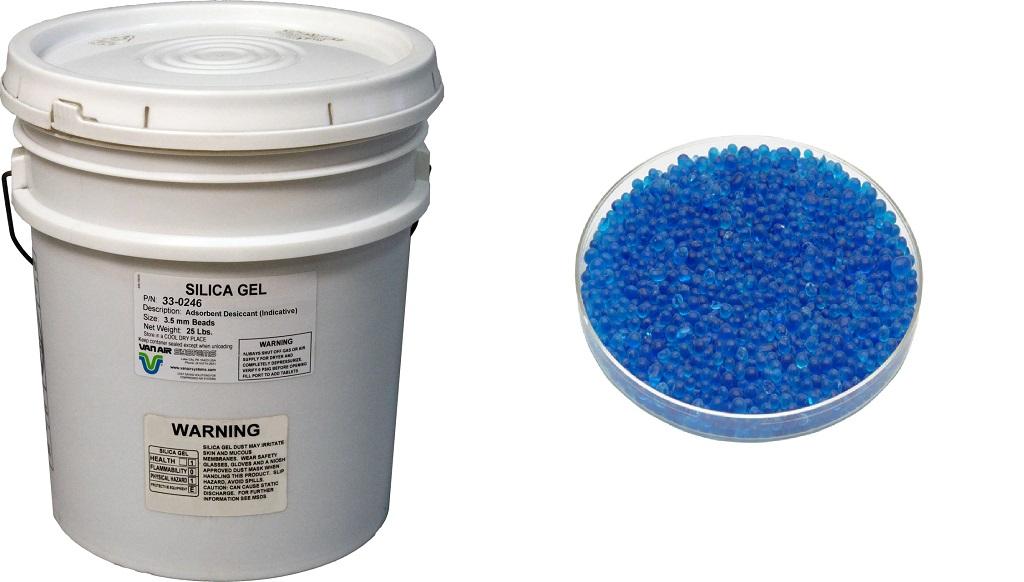
When a facility specifies a desiccant dryer to hit -40°F dew point, the assumption baked into that number is that the dryer's media is in good condition. Silica beads are what actually do the work inside those dryers, and they degrade. They get contaminated. They saturate without fully regenerating. The dryer keeps running, the panel shows normal operation, and moisture slips through anyway. The spec on paper reflects the original equipment design. The performance you get reflects the condition of the bead bed. In pharmaceutical lines, food processing facilities, and precision instrumentation systems, that gap is exactly where air quality problems start.
What's Actually Happening Inside Your Silica Beads (And How to Know)
Desiccant dryers don't announce when their media has lost capacity. The unit cycles, pressures look right, and nothing on the control panel flags a problem. But silica beads lose adsorption capacity gradually. Oil contamination from an upstream compressor coats the pore structure and cuts humidity absorption.
Liquid water intrusion fractures individual beads, creating fine particles that channel airflow around the remaining bed instead of through it. Regeneration cycles that run too short or too cool leave residual moisture behind, and the next drying cycle starts already behind. Over time, the industrial drying agents your system depends on are working at a fraction of their original capacity, and nothing on the dryer's display reflects that.
Indicating versions of silica gel desiccant make this easier to catch. The beads change color from blue to pink as they saturate, giving maintenance teams a visual read on bed condition without pulling samples or running outlet dew point measurements mid-cycle.
That kind of passive monitoring doesn't replace dew point testing, but it shortens the window between degradation and discovery. For facilities running continuous processes, that color change is one of the more reliable early signals that the bed needs attention before performance actually degrades.
The Regeneration Cycle Your Silica Beads Are Actually Getting
Silica gel is a regenerative desiccant, which is part of why facilities trust it for long-term applications. The adsorption technology is well established: apply heat to drive moisture off the bead surface, cycle the bed back online, repeat. The problem is that regeneration quality varies, and the gap between a complete cycle and an adequate-looking one adds up fast.
Temperature, duration, purge volume, and timing all affect how completely the bed dries out between cycles. Silica beads that receive partial regeneration carry residual moisture into the next drying cycle. Do that repeatedly and the effective capacity of the bed keeps shrinking, even though no one has replaced the media or flagged it as a problem.
Facilities using regenerative desiccants often track cycle counts or monitor purge temperatures, but don't always tie those numbers to dew point performance at the outlet. A dryer with 400 cycles on the same bead charge might be performing well or running on fumes, and there's rarely a warning light for the latter. The only way to know is to measure and compare against the dryer's original baseline.
Buying Better Silica Beads Is the Simplest Part of This Problem
Bead quality varies more than most buyers expect. Not all silica gel desiccant is manufactured to the same pore size distribution, crush strength, or moisture capacity. Uniform spherical desiccant beads produce lower pressure drop than granular media and less abrasion dust over time, which matters when fines migrating downstream can foul instrumentation or contaminate product.
A cracked or fractured bead passes air without drying it. For heated dryers, higher moisture retention capacity under actual operating loads means the bed holds closer to its rated spec even when regeneration temperatures are dialed back.
Good moisture control solutions start with the desiccant itself, and that means sourcing silica beads from a supplier who can document what's in the container. Air & Vacuum Process, Inc. carries indicating and non-indicating silica beads in 25lb pails, 50lb bags, and 330lb drums, with full product documentation. If your dryer's dew point performance has been drifting and the bead bed hasn't been inspected since commissioning, their product listings are a straightforward place to start.
For More Information About Robo Drain and Regenerative Desiccant Air Dryer Please Visit: Air & Vacuum Process Inc.

 Arabic
 French
 Spanish
 Portuguese
 Deutsch
 Turkish
 Dutch
Dutch
 Italiano
 Russian
 Romaian
 Portuguese (Brazil)
 Greek
Greek
