


What the Hilt of a Rapier Tells You
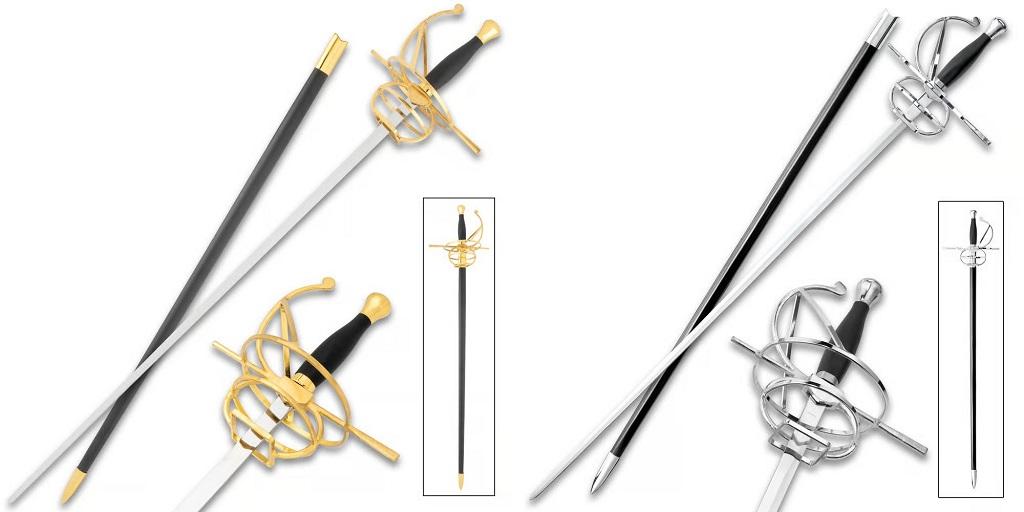
A rapier is a sword pattern that has a long, thin, needle-pointed blade and a characteristic swept hilt, which is one of its most distinctive features.
Here’s what you should know about that hilt design.
Rapier Hilt Design
Typically, rapiers sported a configuration known as a swept hilt. The thing the design of the hilt could offer you some insight into was the status of the owner.
Rapiers were often worn by Europeans as status symbols, so the hilts of the rapiers were often ornately decorated, which was often the case for dress weaponry.
The other thing the swept hilt of a rapier can tell you was the level of protection that was afforded to the wielder.
The swept lines of a rapier’s hilt enclosed the hand of a wielder and offered a good deal of protection against enemy combatants.
A full-swept hilt offered the best level of protection, but half-swept and quarter hilts still partially enclosed the hand, protecting it against errant and directed strikes.
There were other designs of rapier hilts as well, including ring and cup hilts. The latter was similar to the hilt that a cutlass or some sabers might have, and fully enclosed the hand.
The cup hilt is similar also to the basket hilt of some broadswords, that provided the highest level of protection to a wielder’s hand against an enemy.
In addition to protecting the wielder’s hand, the swept or cup hilt of a rapier offered one more significant advantage: it added a weight.
But in this area, it’s not just about adding weight objectively, it’s about where the weight was added and why.
In this case, the hilt of a rapier added mass near the wielder’s hand and shifted the center of gravity further away from the point of the blade.
This feature is critical and perhaps even more important than the level of protection that the hilt could offer in the first place.
A rapier, as you might recognize, had a needle-pointed profile and a very light blade. In some cases, the blade of a rapier might not even have been sharpened.
The sword itself was designed for lunging and thrusting. This made control of the tip critical, and shifting mass away from it did just that.
The heavier hilt of a rapier gave the person wielding it much finer, more precise control over the point of the sword, enabling lighter, more nimble handling, and better accuracy over the thrusts and lunges.
So, at the end of the day, the hilt of a rapier offered a higher level of protection to the hand than the hilts of some other sword patterns, and on top of that, shifted the center of mass to enable better handling.
Where to Get a Battle-Ready Rapier
In the market for a rapier that you can proudly display or even a battle-ready pattern that can be used for live practice? Visit BUDK or get in touch with them and they’ll be happy to help you out.
For more information about Lock Pick Set and Push Button Automatic Knife Please visit: BudK Worldwide Inc.

 English
 Arabic
 French
 Spanish
 Portuguese
 Deutsch
 Turkish
 Dutch
Dutch
 Russian
 Romaian
 Portuguese (Brazil)
 Greek
Greek
