


What Role Does Artificial Intelligence Play in Modern Logistics App Development?
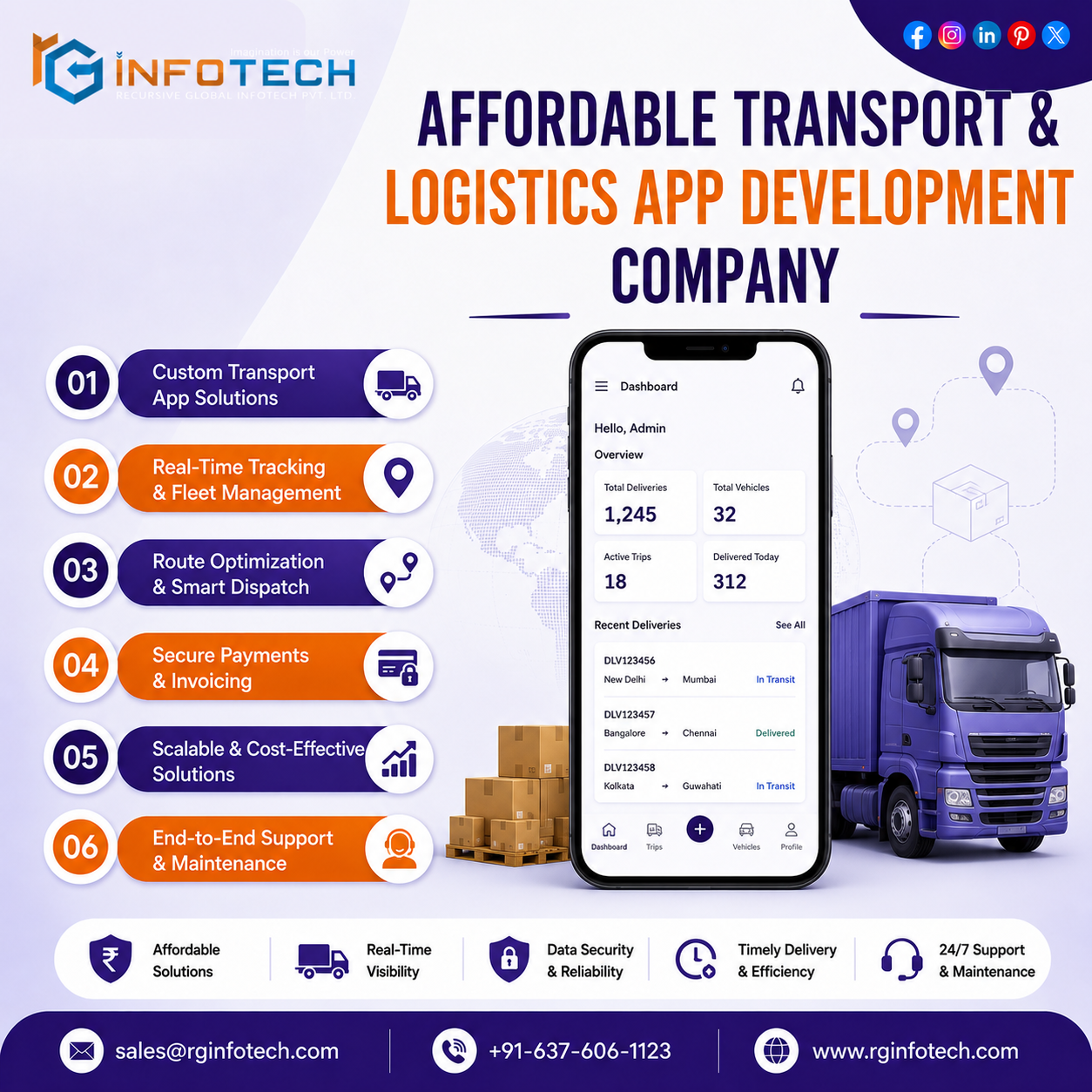
Artificial Intelligence (AI) is transforming the logistics industry by helping businesses make faster decisions, automate repetitive tasks, predict demand, and improve delivery efficiency. Traditional logistics systems often depend on manual planning and historical information. Modern AI-powered applications can analyze large volumes of real-time data and provide intelligent recommendations for routes, inventory, fleet operations, and customer service.
As supply chains become more complex, businesses are increasingly using AI to improve visibility and reduce operational costs. From intelligent route optimization to predictive maintenance, AI can turn a logistics application into a more responsive and data-driven platform.
But what role does AI actually play in modern logistics app development? Let's explore its major applications and benefits.
1. AI-Powered Route Optimization
Route planning is one of the most important areas where AI can improve logistics operations. Traditional systems may calculate routes based primarily on distance, while AI-powered systems can consider multiple factors simultaneously.
These may include:
-
Traffic conditions
-
Weather
-
Vehicle capacity
-
Delivery priorities
-
Road restrictions
-
Driver availability
-
Delivery time windows
-
Historical route performance
AI algorithms can analyze these variables and recommend efficient routes. If traffic conditions suddenly change, the system can also suggest alternatives.
For businesses managing hundreds or thousands of deliveries, intelligent route optimization can reduce unnecessary travel, fuel consumption, and delivery delays.
2. Predictive Demand Forecasting
AI can analyze historical orders, seasonal patterns, customer behavior, market trends, and other data to forecast future demand.
For example, a retailer may experience higher shipment volumes during holidays or promotional periods. An AI-powered logistics platform can identify these patterns and help businesses prepare vehicles, drivers, warehouse capacity, and inventory accordingly.
Better demand forecasting can reduce both overstocking and shortages while helping businesses allocate resources more effectively.
3. Intelligent Fleet Management
Managing a large fleet involves monitoring vehicles, drivers, fuel usage, maintenance schedules, routes, and operational performance. AI can analyze this information and identify patterns that may not be immediately visible to human operators.
An AI-enabled platform can help determine which vehicles are being underutilized, which routes generate excessive fuel consumption, and which drivers may require additional training.
This allows fleet managers to make data-driven decisions instead of relying entirely on manual reports.
4. Predictive Vehicle Maintenance
Unexpected vehicle breakdowns can disrupt deliveries and increase operating costs. AI can support predictive maintenance by analyzing information collected from connected vehicles and telematics systems.
The system can examine factors such as engine performance, mileage, temperature, fuel consumption, and sensor data to identify unusual patterns.
Instead of waiting for a vehicle to fail, fleet managers can receive early warnings and schedule maintenance at an appropriate time.
This approach can improve vehicle availability and reduce costly emergency repairs.
5. Real-Time Delivery Predictions
Customers increasingly want accurate information about when their shipments will arrive. AI can improve estimated delivery times by analyzing real-time vehicle locations, traffic conditions, historical delivery data, route information, and current operational conditions.
Rather than providing a static estimated arrival time, an intelligent logistics app can continuously update predictions as conditions change.
More accurate delivery estimates can improve customer satisfaction and reduce the number of delivery-related support requests.
6. AI-Based Warehouse Optimization
AI is also changing warehouse operations. Logistics applications can use AI to analyze inventory movement, order frequency, storage requirements, and picking patterns.
Based on these insights, businesses can determine where products should be positioned to reduce unnecessary movement and improve picking efficiency.
AI can also support automated inventory forecasting and identify products that may require replenishment.
When warehouse and transportation systems are connected, businesses can create a more coordinated supply chain from inventory management through final delivery.
7. Automated Customer Support
Logistics businesses receive numerous customer questions about shipment status, delivery times, cancellations, address changes, and delays.
AI-powered chatbots and virtual assistants can handle many routine questions automatically. Customers can enter their shipment information and receive immediate updates without waiting for a human support representative.
More complex requests can be transferred to human agents when necessary.
This helps logistics companies provide faster support while reducing the workload on customer service teams.
8. Fraud and Anomaly Detection
AI can help logistics businesses identify unusual activity across shipments, payments, accounts, and fleet operations.
For example, an AI system can detect unusual delivery patterns, unexpected route deviations, repeated failed delivery attempts, suspicious account behavior, or unusual transaction activity.
Rather than relying entirely on predefined rules, machine learning systems can identify patterns based on historical data and flag potential anomalies for investigation.
9. Smarter Logistics Analytics
Modern logistics platforms generate enormous amounts of data. Without effective analytics, much of this information may remain unused.
AI can transform raw operational data into actionable insights. Managers can use intelligent dashboards to understand delivery performance, fleet utilization, route efficiency, customer behavior, and operational bottlenecks.
AI-powered analytics can also identify recurring patterns and provide recommendations that help businesses improve their processes.
A skilled Logistics App Development Company can integrate AI analytics into an application so decision-makers can access useful insights through centralized dashboards.
10. AI and IoT Working Together
AI becomes even more powerful when combined with Internet of Things (IoT) devices.
IoT sensors can collect real-time information from vehicles, packages, warehouses, and equipment. AI can then analyze this information to identify patterns and make predictions.
For example, temperature sensors can monitor sensitive shipments while AI analyzes the data and detects abnormal temperature changes. Similarly, vehicle sensors can provide information that AI uses to predict potential maintenance requirements.
This combination creates a connected and intelligent logistics ecosystem.
11. Better Resource Allocation
AI can help logistics companies determine how to allocate vehicles, drivers, warehouse resources, and delivery capacity.
Instead of assigning resources manually, intelligent systems can evaluate current demand, availability, locations, delivery deadlines, and historical performance.
For example, if demand suddenly increases in a particular region, the system can recommend moving additional vehicles or drivers to that area.
This flexibility can help businesses respond to changing supply chain conditions more effectively.
12. What Does AI Integration Cost?
The cost of integrating AI into a logistics application depends on the type of AI functionality being implemented.
A basic chatbot or recommendation system may require a relatively modest investment. Advanced capabilities such as predictive maintenance, intelligent route optimization, demand forecasting, computer vision, and real-time machine learning require significantly more development and infrastructure.
Businesses should therefore identify the AI features that provide the greatest business value instead of adding AI simply because it is a current technology trend.
A Logistics App Development Company can help businesses prioritize AI features based on operational goals, available data, budget, and expected return on investment.
Challenges of Using AI in Logistics
Despite its advantages, AI implementation also comes with challenges. AI models require reliable and relevant data to produce useful results. Poor-quality or incomplete data can lead to inaccurate predictions.
Businesses also need to consider data security, system integration, infrastructure requirements, model maintenance, and employee adoption.
AI should therefore be implemented as part of a broader technology strategy rather than as an isolated feature.
How to Successfully Implement AI
Businesses should begin by identifying a specific operational problem that AI can solve. Next, they should assess available data, select the appropriate technology, and develop a focused AI feature.
Starting with one or two high-value use cases allows companies to measure results before expanding the system.
It is also important to monitor AI performance continuously. Models may need retraining as customer behavior, traffic patterns, market conditions, and business processes change.
Partnering with an experienced Logistics App Development Company can simplify this process by combining logistics expertise with AI development and application engineering.
Final Thoughts
Artificial Intelligence is becoming an important part of modern logistics applications. It can optimize routes, forecast demand, predict vehicle maintenance, improve delivery estimates, automate customer support, detect anomalies, and provide deeper operational insights.
The biggest advantage of AI is its ability to turn large amounts of logistics data into useful decisions. However, successful implementation requires clear objectives, quality data, appropriate technology, and continuous optimization.
As supply chains become increasingly connected and complex, AI can help logistics businesses become more efficient, responsive, and customer-focused.

 Arabic
 French
 Spanish
 Portuguese
 Deutsch
 Turkish
 Dutch
Dutch
 Italiano
 Russian
 Romaian
 Portuguese (Brazil)
 Greek
Greek
