


How Is Generative AI Creating New Opportunities in Financial Services?
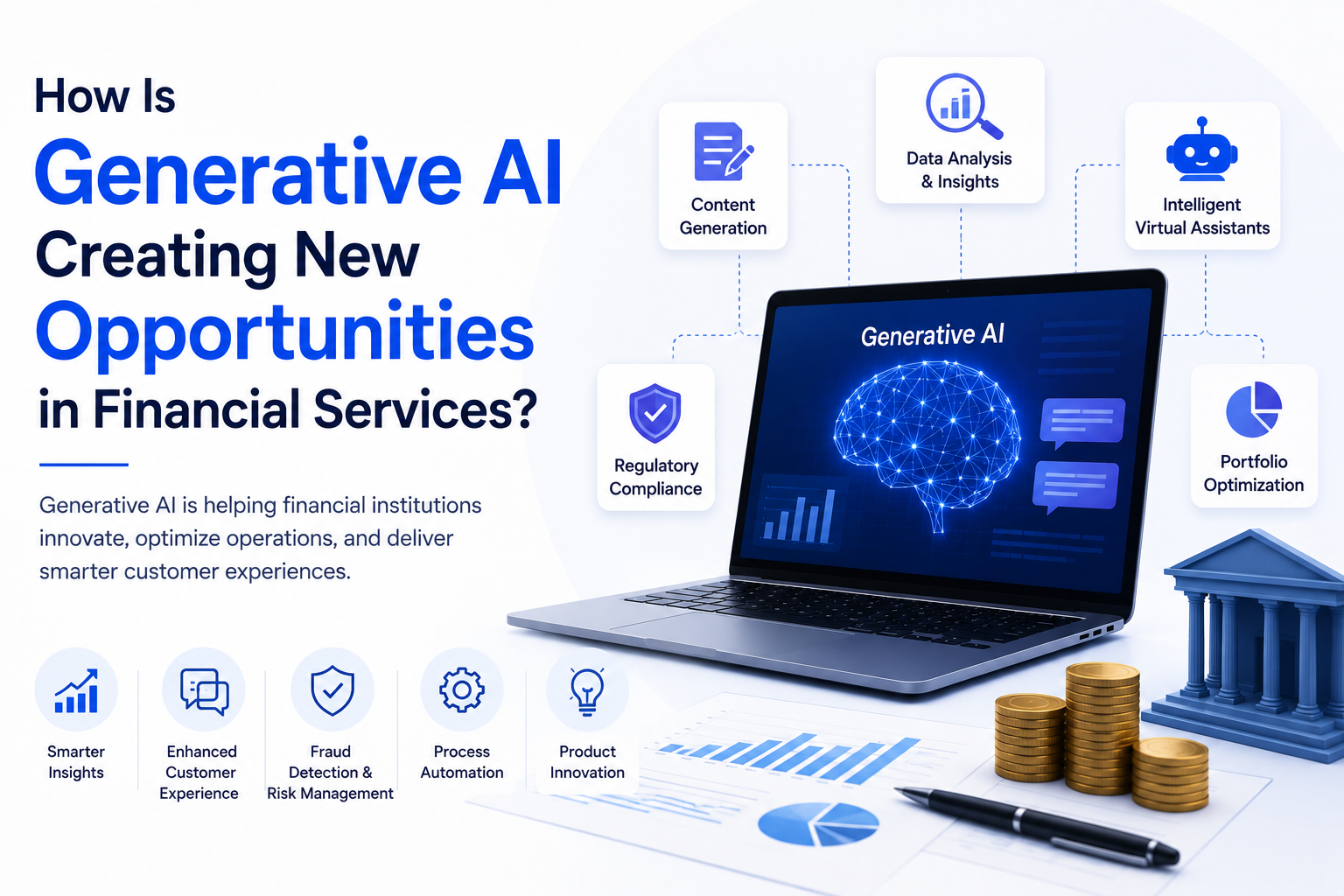
The financial services industry has always been closely connected to technology. Banks, insurance providers, investment firms, payment companies, and fintech businesses rely on digital systems to manage information, serve customers, and keep daily operations running.
But something different is happening now.
Generative AI is allowing financial organizations to work with information in a more flexible way. Instead of relying only on fixed software rules, businesses can use AI to understand natural language, summarize documents, generate responses, analyze information, and support employees across different workflows.
This is creating new opportunities across the financial sector.
From customer service and document processing to fraud investigation and employee productivity, generative AI can support many areas of financial operations. However, getting meaningful results requires more than simply adding an AI tool. Businesses need the right use case, reliable data, secure integrations, and a development strategy that fits their existing systems.
Why Is Generative AI Important for Financial Businesses?
Financial companies manage an enormous amount of information.
Customer records, transaction details, contracts, reports, applications, policies, emails, and compliance documents all contribute to daily operations. Employees often spend a considerable amount of time searching, reviewing, organizing, and explaining this information.
Generative AI can make these activities easier.
For example, an employee could ask an AI assistant to summarize a long document instead of reading every page manually. A customer support representative could receive a suggested response based on a verified knowledge source.
These applications may appear simple, but they can save time when businesses process thousands of similar tasks.
The real opportunity is not simply generating content. It is making information easier to use.
Where Can Financial Companies Apply Generative AI?
Generative AI can support many parts of the financial value chain. The best application depends on the organization's goals, data, systems, and risk requirements.
Customer Support
Customer service is one of the most practical starting points.
Customers often ask similar questions about account services, payments, cards, claims, applications, and financial products.
A conversational AI system can understand these questions and provide useful answers based on approved information.
For example, instead of directing a customer to a long FAQ page, a digital assistant could explain the relevant process in simple language.
More advanced systems can connect with internal platforms to provide information such as application status or approved account details.
Human representatives should still handle complex or sensitive cases, but AI can reduce the workload created by repetitive requests.
Making Financial Documents Easier to Process
Financial organizations deal with documents every day.
Loan applications, insurance claims, contracts, financial statements, customer correspondence, and regulatory documents may all require manual review.
Generative AI can assist employees by extracting important details, summarizing documents, identifying relevant sections, and organizing information.
Consider a loan-processing team reviewing hundreds of documents. An AI system could prepare a summary for each case, allowing the employee to begin with the most relevant information.
The final review can remain with a qualified professional.
This approach improves efficiency without handing an important decision completely to AI.
Helping Employees Find Information Faster
Internal knowledge is often spread across many systems.
Employees may need to search policies, procedures, product documents, training material, and internal communications before answering a simple question.
An internal AI assistant can provide a conversational way to access approved information.
For instance, an employee could ask about a company's procedure for handling a particular customer request. The system could search relevant internal sources and provide a concise explanation.
This type of knowledge assistant can be especially helpful for large financial institutions where employees work with complicated processes.
Supporting Fraud and Risk Teams
Fraud detection normally involves a combination of rules, analytics, and machine learning.
Generative AI can complement those systems by helping investigators understand the information they produce.
For example, if another system flags a suspicious transaction, an AI assistant could summarize the customer's recent activity, organize related information, and prepare an investigation brief.
This reduces the amount of manual information gathering required from investigators.
The AI does not need to make the final decision. Instead, it helps the professional understand the case more efficiently.
Improving Insurance Operations
Insurance is another area where generative AI can be useful.
Insurance businesses manage policies, claims, customer communications, inspection reports, and supporting documentation.
An AI system can help summarize claim information, explain policy language, prepare draft communications, and organize relevant documents.
For customers, conversational tools can make insurance processes easier to understand.
For employees, AI can reduce the time spent on repetitive administrative tasks.
The technology works best when it supports existing processes rather than trying to replace the entire workflow.
Personalizing Customer Experiences
Financial products can be difficult for customers to understand.
People may not know which service is suitable for their needs or may struggle with industry terminology.
Generative AI can help explain complex information in simpler language.
A customer could ask about the difference between two financial services and receive a clear explanation. An AI assistant could also guide customers toward relevant information based on their approved account context.
Personalization can improve digital experiences, but financial companies must handle customer data carefully.
AI systems should use only the information they are authorized to access, with appropriate privacy and security controls in place.
Generative AI and Financial Advisory Work
Financial professionals also spend time preparing reports, reviewing documents, summarizing meetings, and creating client communications.
Generative AI can assist with these activities.
An advisor, for example, could use an AI assistant to organize meeting notes and prepare a first draft of a follow-up communication.
The advisor can then verify the information, add context, and make the final decision about what to send.
This creates a collaborative workflow where AI handles routine preparation while the professional remains responsible for the final result.
Why Integration Matters More Than the AI Model
One of the biggest mistakes businesses can make is focusing only on the AI model.
A powerful model does not automatically create a useful financial application.
The real solution may need to connect with customer relationship systems, databases, document platforms, payment systems, internal knowledge bases, and other applications.
This is why AI Development Companies can become valuable technology partners for financial organizations.
Experienced teams can help businesses identify suitable use cases, design system architecture, connect AI with existing software, develop user interfaces, and create workflows around the technology.
The AI model is only one part of the overall solution.
Choosing the Right Development Partner
Not every technology provider is a good fit for financial AI projects.
Businesses should look for teams with experience in AI application development, data integration, cloud technology, security, conversational systems, and workflow automation.
Industry knowledge can also make a difference.
A partner that understands the financial sector is more likely to recognize the importance of auditability, access controls, privacy, compliance, and human review.
Businesses should also evaluate what happens after deployment.
Generative AI applications require monitoring and improvement. Models can change, data can change, and users can discover new ways to interact with the system.
A right development partner should be able to support the solution beyond the initial launch.
Security Cannot Be an Afterthought
Financial data requires strong protection.
An AI system may interact with customer records, transaction information, financial reports, and other sensitive material.
Businesses need clear rules for data access and system permissions.
An agent or assistant should not receive access to every system simply because additional access could make it more useful.
Organizations should also monitor system activity and establish procedures for handling incorrect or unexpected outputs.
Security needs to be included during architecture and development, not added after the system is already live.
Managing AI Accuracy and Hallucinations
Generative AI can sometimes produce information that sounds correct but is actually inaccurate.
This creates a particular challenge in financial services.
A wrong response about a financial product, transaction, policy, or process could create customer confusion or operational risk.
Businesses can reduce this risk by using reliable data sources, retrieval-based approaches, structured workflows, testing, and human review.
The system should also be designed to say when it does not have enough information rather than trying to provide an uncertain answer.
Should Every Financial Process Use Generative AI?
No.
Some processes are better handled by traditional software or rule-based automation.
For example, a calculation that must always follow a precise formula should not depend on a generative model when deterministic software can provide a more reliable result.
Generative AI is more useful when the task involves language, unstructured information, summarization, explanation, or flexible interaction.
The strongest financial applications will often combine different technologies instead of relying on AI alone.
Starting With a Focused AI Use Case
Financial organizations do not have to begin with a large transformation program.
A focused pilot can be a better starting point.
An organization could begin with an employee knowledge assistant, document summarization tool, customer support application, or internal reporting assistant.
The team can measure the results and identify areas that need improvement before expanding the project.
This approach also gives employees time to learn how to work with AI and helps the business establish suitable governance practices.
How Should Businesses Measure Results?
An AI project should have measurable goals.
For customer service, a business might track response time, resolution rates, customer satisfaction, and escalation volume.
For internal applications, it may measure time saved, search efficiency, document processing speed, or employee productivity.
These measurements help determine whether AI is solving a genuine business problem.
A system that produces impressive responses but does not improve the underlying workflow may not deliver meaningful value.
What Does the Future Hold?
Financial AI is likely to move beyond simple assistants and content generation.
AI agents may increasingly connect conversational capabilities with business applications and approved actions.
For example, a customer could ask about a transaction, receive information, and then be guided through an approved next step within the same interaction.
Employees may also use AI systems that coordinate information across multiple applications.
This could create more connected workflows where users spend less time switching between software systems.
As these capabilities grow, financial businesses will need development teams that understand both AI technology and the operational requirements of the financial sector.
Final Thoughts
Generative AI is giving financial services organizations new ways to work with information and interact with customers.
It can support document processing, customer service, employee productivity, fraud investigation, insurance operations, financial advisory work, and internal knowledge management.
But successful adoption requires careful planning.
Financial businesses need trustworthy data, secure integrations, clear permissions, reliable workflows, human oversight, and measurable business goals.
This is where AI Development Companies and experienced technology partners can help turn generative AI from an experimental tool into a practical business solution.
The future will not be about replacing every existing system with AI. It will be about combining AI with people, software, and established financial processes to create services that are faster, smarter, and easier to use.

 English
 Arabic
 French
 Spanish
 Portuguese
 Deutsch
 Turkish
 Dutch
Dutch
 Italiano
 Russian
 Romaian
 Portuguese (Brazil)
