


About Turning Insert Size, Shape and Nose Radius
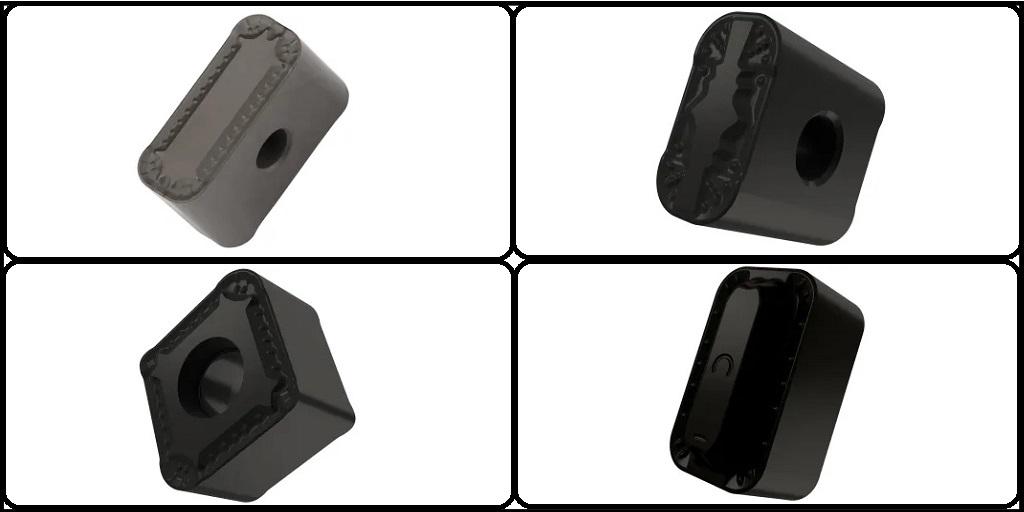
A turning insert is a piece used on a lathe which removes stock material from a workpiece that is rotated on the lathe. As such, the insert is a stationary cutting tool and the workpiece rotates, making it possible to create axially symmetrical finished pieces.
There are many factors and parameters to consider when choosing turning inserts, such as size, shape, and nose radius, among others. This short post will break down three of these.
Turning Insert Size
Turning insert size is one of the most straightforward of factors. It should be matched to the demands of the application as well as to the cutting tool. A larger insert size usually provides good stability, and heavy machining and roughing generally implicate larger inserts. The size can usually be stepped down when the application in question is finishing.
Turning Insert Shape
Turning insert shape is also important here and should be selected based on nose angle. The largest possible nose angle should be used to deliver the highest possible degree of stability, strength and reliability.
The larger the nose angle, the stronger the setup will be. The issue is that with a larger nose angle, more machining power is required, and on top of that, there is a tendency for higher vibration with a larger nose angle.
With a large nose angle in a cutting insert, you will also enjoy a stronger cutting edge and higher feed rates, though more power will be needed and more vibration will be incurred.
A smaller nose angle in a turning insert is slightly weaker and on top of that has smaller cutting edge engagement, which makes these inserts more sensitive to the effects of heat.
With a smaller nose angle, there will be increased accessibility and a smaller cutting edge engagement and will require less power, but they will experience a weaker cutting force and edge.
Nose Radius
Nose radius is another thing that must be considered in turning inserts insomuch as it impacts the depth of the cut as well as the feed, and because nose radius impacts insert strength as well as surface finish and chip breaking.
A turning insert with a smaller nose radius may be more suitable in applications in which there is a small cutting depth. A smaller nose radius also incurs less vibration as a general rule. A cutting insert with a smaller nose radius also produces better chip breaking, but it will exhibit a weaker cutting edge.
On the flipside, turning inserts with larger nose radii enjoy higher feed rates and larger depths of cut. They also enjoy stronger edge security, but at the same time, they experience increased radial forces.
Here for High-Quality Turning Inserts?
This short post only covers a few aspects of turning inserts from a very high level. There is a lot more to learn, and you can start at TMT Toolbox (or just pick up some new cutting tools from them). They carry a wide range of metal cutting tools like end mills and milling inserts in addition to turning inserts and other machine tool accessories. Visit their website for more information and get in touch with them if you have any questions.
For more information about Machine Tool Accessories and Grinding Abrasives Please visit: TMT Toolbox.

 English
 Arabic
 French
 Spanish
 Portuguese
 Deutsch
 Turkish
 Dutch
Dutch
 Russian
 Romaian
 Portuguese (Brazil)
 Greek
Greek
