


100 KG, 300 KG or 500 KG/Day Laundry Setup: How Much Investment Do You Need?
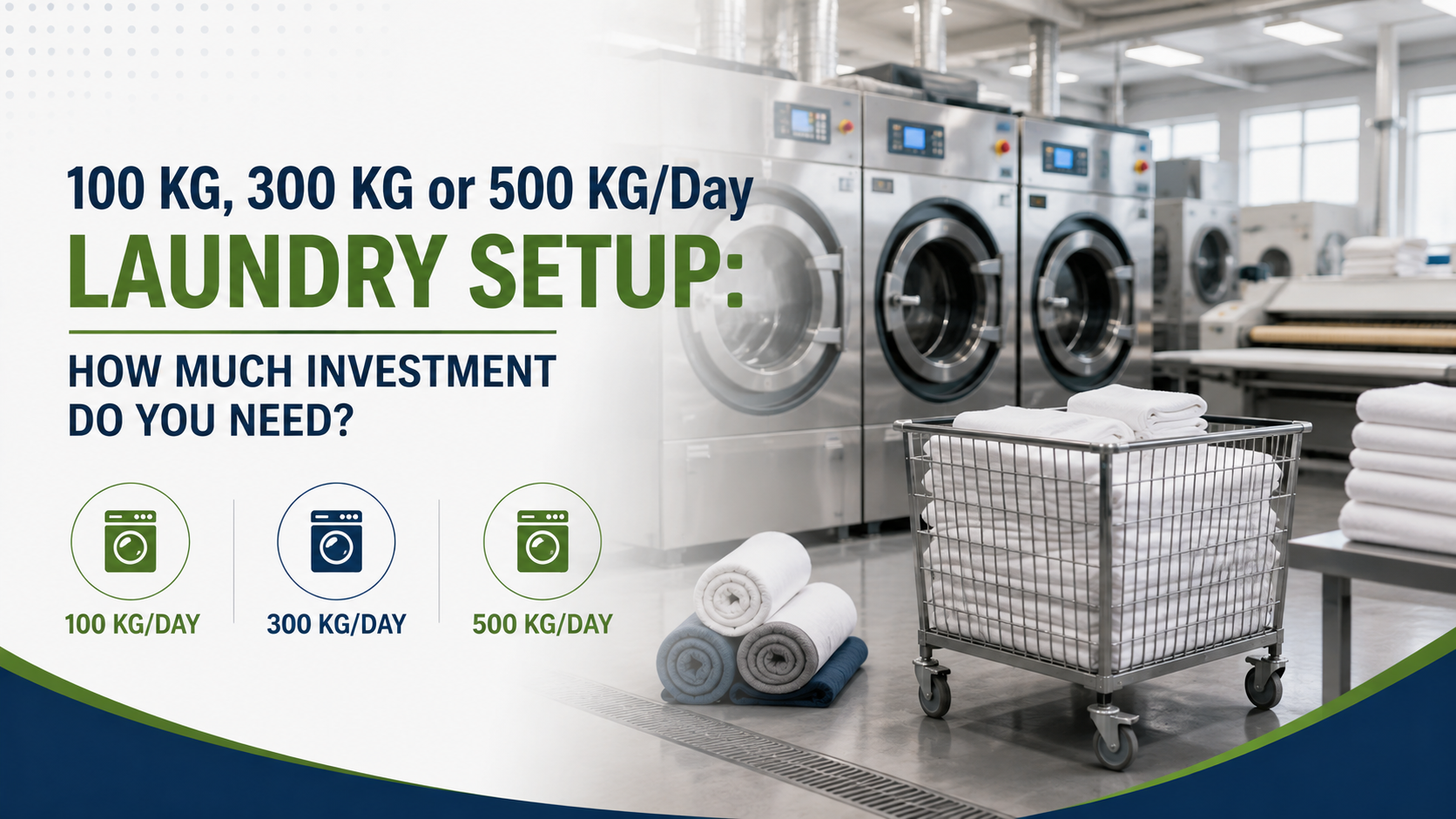
Starting a commercial laundry becomes easier to plan when you stop thinking only about individual machines and start with one important number: how many kilograms of laundry will you process each day?
A 100 KG/day operation has very different equipment, space, utility, and manpower requirements from a 500 KG/day facility. This is why understanding your expected capacity is essential before estimating the laundry business setup cost.
Instead of starting with a fixed budget and fitting random machines into it, calculate your expected workload first. Then build the washing, drying, finishing, and supporting infrastructure around that volume.
How Much Does It Cost to Set Up a Commercial Laundry Business?
There is no single price for starting a commercial laundry. The total investment depends on the scale and type of operation you are planning.
Your overall commercial laundry setup cost may include:
Machines + Installation + Utilities + Site Preparation + Supporting Equipment + Initial Operating Requirements
A small retail laundry and a B2B facility handling hotel linen may process similar daily kilograms but require different equipment configurations.
Therefore, machine quotations alone should not be treated as the complete project cost.
What Determines Your Laundry Business Setup Cost?
Several factors influence your laundry business investment:
-
Required daily processing capacity
-
Number and capacity of machines
-
Type of customers
-
Textile and linen mix
-
Operating hours
-
Washing and drying requirements
-
Finishing requirements
-
Water, electricity, gas or steam infrastructure
-
Installation and site preparation
-
Future expansion plans
Your service model matters just as much as your daily KG.
Why Should You Calculate Daily Laundry KG Before Buying Machines?
Daily volume provides the foundation for equipment planning.
Start with:
Required Hourly Throughput = Daily Laundry KG ÷ Available Processing Hours
Then consider actual machine cycle times, textile segregation, loading practices, peak-day demand, and practical operating efficiency.
A business expecting 300 KG per day should not simply purchase machines whose nameplate capacities mathematically add up to 300 KG. Machines operate in cycles, and linen must move through washing, drying, and finishing throughout the day.
100 KG/Day Laundry Setup: What Equipment Do You Need?
A 100 KG laundry setup can suit a smaller commercial operation, depending on the customer and textile mix.
The core configuration may include:
-
Commercial washing machine or washer extractor
-
Commercial tumble dryer
-
Basic ironing or pressing equipment
-
Sorting and work tables
-
Linen or garment trolleys
-
Chemical storage and dosing arrangements
-
Packaging and storage areas
The exact washer and dryer capacities should be selected according to the number of practical loads you expect to process.
How Much Investment Should You Plan for a 100 KG/Day Laundry?
Avoid assigning one fixed investment figure to every 100 KG/day project.
For example, a basic garment laundry may require less finishing infrastructure than a 100 KG/day hotel linen operation requiring professional flatwork finishing.
Build the budget in categories:
Washing + Drying + Finishing + Utilities + Installation + Supporting Equipment
This gives a much more realistic estimate of the laundry business startup cost than looking only at washer prices.
300 KG/Day Laundry Setup: What Machines and Capacity Do You Need?
At around 300 KG/day, workflow becomes increasingly important.
A 300 KG laundry setup may require multiple washers or a combination of capacities to handle different textile categories efficiently.
Drying capacity also needs to keep pace with washer output. If the washing section can process laundry faster than the drying section, wet linen begins accumulating and reduces overall productivity.
For B2B operations, finishing capacity should also be included when planning the production line.
How Much Investment Should You Plan for a 300 KG/Day Laundry?
The investment generally becomes more infrastructure-dependent as volume increases.
Apart from commercial laundry equipment, your budget may need to account for increased electrical load, water supply, drainage, ventilation, heating systems, chemical management, storage, material handling, and workspace.
This is why two 300 KG/day projects can have substantially different costs.
Your laundry plant cost should be calculated from the complete workflow rather than a generic capacity package.
500 KG/Day Laundry Setup: What Equipment Configuration Makes Sense?
A 500 KG laundry setup should usually be approached as a production system rather than a collection of individual machines.
The workflow may include:
Soiled Linen Receiving → Sorting → Washing → Drying → Finishing → Folding → Clean Storage → Dispatch
Depending on the business model, the setup may require multiple washer extractors, industrial drying capacity, finishing systems, chemical dosing, trolleys, and dedicated clean and soiled handling areas.
Equipment redundancy also becomes more important as daily production increases.
How Much Investment Should You Plan for a 500 kg/day Laundry?
At this scale, industrial laundry equipment can represent only one part of the total project investment.
Infrastructure may contribute significantly to the budget.
Before finalizing the investment, evaluate water availability, drainage, electrical requirements, steam or other heating requirements where applicable, ventilation, floor loading, equipment access, storage, and installation.
Request model-specific utility requirements before completing the site.
100 KG vs 300 KG vs 500 KG Laundry Setup: What's the Difference?
|
Daily Capacity |
Typical Positioning |
Planning Priority |
|
100 KG/Day |
Smaller commercial operation |
Essential machines and controlled investment |
|
300 KG/Day |
Growing commercial/B2B operation |
Balanced throughput and flexibility |
|
500 KG/Day |
Higher-volume B2B/institutional operation |
Production flow, infrastructure and redundancy |
These are planning categories, not fixed equipment packages. Actual requirements depend on the workload.
How Many Washer Extractors Does Your Laundry Setup Need?
Use this basic calculation:
Average Load Requirement = Daily Laundry KG ÷ Practical Loads Per Day
For example, 300 KG divided across 10 practical loads gives an average requirement of 30 KG per load.
That does not automatically mean one 30 KG washer is the correct solution.
Textile segregation, simultaneous processing, peak demand, maintenance requirements, and turnaround times can make multiple machines or mixed capacities more practical.
How Much Tumble Dryer Capacity Should You Plan?
Your commercial tumble dryer or industrial dryer capacity should be based on the amount of washed laundry that actually requires tumble drying.
Consider:
-
Washer extraction performance
-
Textile type
-
Residual moisture
-
Number of washers
-
Dryer cycle time
-
Daily operating hours
-
Items sent directly to another finishing process
A large washing section with insufficient drying capacity creates a bottleneck.
What Finishing Equipment Should Be Included in the Laundry Setup Cost?
Finishing equipment should match your target customers.
A hotel-focused operation processing bedsheets and table linen may require a flatwork ironer or other linen-finishing equipment. A garment-focused laundry may require steam pressing and garment-finishing systems.
Don't automatically add every available finishing machine. Invest according to the services customers will actually pay for.
What Supporting Equipment Does a Commercial Laundry Need?
Your laundry business machines are only part of the setup.
You may also need weighing scales, sorting tables, linen trolleys, racks, stain-treatment areas, folding tables, chemical storage, packaging equipment, water-treatment systems where necessary, and clean-linen storage.
These smaller components can significantly influence workflow efficiency.
How Much Space Is Required for a 100–500 KG/Day Laundry?
Space should never be calculated from machine dimensions alone.
Allow room for:
Receiving + Sorting + Machine Access + Loading/Unloading + Trolleys + Finishing + Storage + Staff Movement + Service Access
A well-planned layout should also avoid unnecessary movement between dirty and clean processing stages.
There is no universal square-foot requirement for each daily capacity. Machine dimensions and workflow requirements should determine the final layout.
What Utility Costs Should You Consider Before Setting Up a Laundry?
Before purchasing laundry machines for business, check their model-specific utility requirements.
Depending on the equipment, your facility may require water, drainage, electricity, exhaust, ventilation, gas, steam, compressed air, or other supporting connections.
Utilities affect both initial laundry setup cost and long-term operating expenses.
Should You Start with 100 KG/Day and Expand Later?
For some entrepreneurs, starting smaller can reduce initial capital exposure while allowing demand to develop.
But expansion should be planned from the beginning.
If you expect to move from 100 KG to 300 KG/day, consider whether your premises can accommodate additional machines, electrical load, drainage, storage, ventilation, and finishing equipment.
Buying smaller today without planning tomorrow can make expansion expensive.
How to Calculate Laundry Equipment Investment Based on Daily KG
Use a structured sequence:
Expected Daily KG → Operating Hours → Practical Loads → Washer Capacity → Dryer Requirement → Finishing Requirement → Supporting Equipment → Utilities
Only after establishing these requirements should you compare laundry equipment prices.
This prevents the common mistake of building an entire business around whichever machine happens to fit the initial budget.
Which Laundry Setup Is Right for Your Target Customers?
Your ideal capacity depends on who will generate the laundry.
A retail laundry may start with lower volumes but a diverse garment mix. Hotels can generate recurring linen volumes. Restaurants may add heavily soiled table and kitchen linen. Hospitals and institutional customers can require structured processing and operational procedures.
Before deciding between a 100, 300, or 500 KG/day commercial laundry setup, estimate realistic customer demand rather than choosing capacity only because you want a larger business.
How Orgaearth Can Help Plan Your Commercial Laundry Setup
Orgaearth helps businesses evaluate commercial and industrial laundry equipment based on expected daily volume, customer segment, available space, utilities, and processing requirements.
Instead of selecting a washer, dryer, or finishing machine independently, the setup can be evaluated as a complete workflow.
Whether you are planning a smaller commercial operation or a higher-capacity B2B facility, Orgaearth can help you identify suitable equipment configurations and plan for future expansion.
Contact Us
Orgaearth Laundry Solutions
Plot no. 774, Udyog Vihar, Phase 5, Gurugram, Haryana, India-122016
Email: marketing@orgaearth.com
Contact No.: +91 7042912777
FAQs
How much does it cost to start a laundry business in India?
There is no single laundry business cost in India. Investment depends on processing capacity, equipment specifications, site preparation, utilities, finishing requirements, and the business model.
Is a 100 KG/day laundry setup enough for a startup?
It can be suitable for certain smaller commercial operations, but the correct capacity depends on expected orders, customer type, operating hours, textile mix, and growth plans.
What machines are required for a 300 KG/day laundry?
A 300 KG/day operation may require washer extractors, suitable drying capacity, finishing equipment according to its services, chemical systems, trolleys, sorting equipment, and supporting infrastructure. Exact capacities should be calculated from the intended workflow.
How do I calculate the capacity of a 500 KG/day laundry plant?
Start with daily volume, available operating hours, practical loads, wash cycle requirements, drying demand, and finishing throughput. Avoid calculating capacity from washer KG alone.
Should I buy industrial laundry equipment when starting a laundry business?
It depends on your required workload, customer segment, operating pattern, infrastructure, and expansion plans. Equipment should be selected according to actual production requirements rather than choosing “industrial” equipment simply because it is larger.

 English
 French
 Spanish
 Portuguese
 Deutsch
 Turkish
 Dutch
Dutch
 Italiano
 Russian
 Romaian
 Portuguese (Brazil)
 Greek
Greek
