


Cocoa nibs market reaches USD 1.20 billion in 2026 and is projected to grow at 3.8% CAGR through 2036
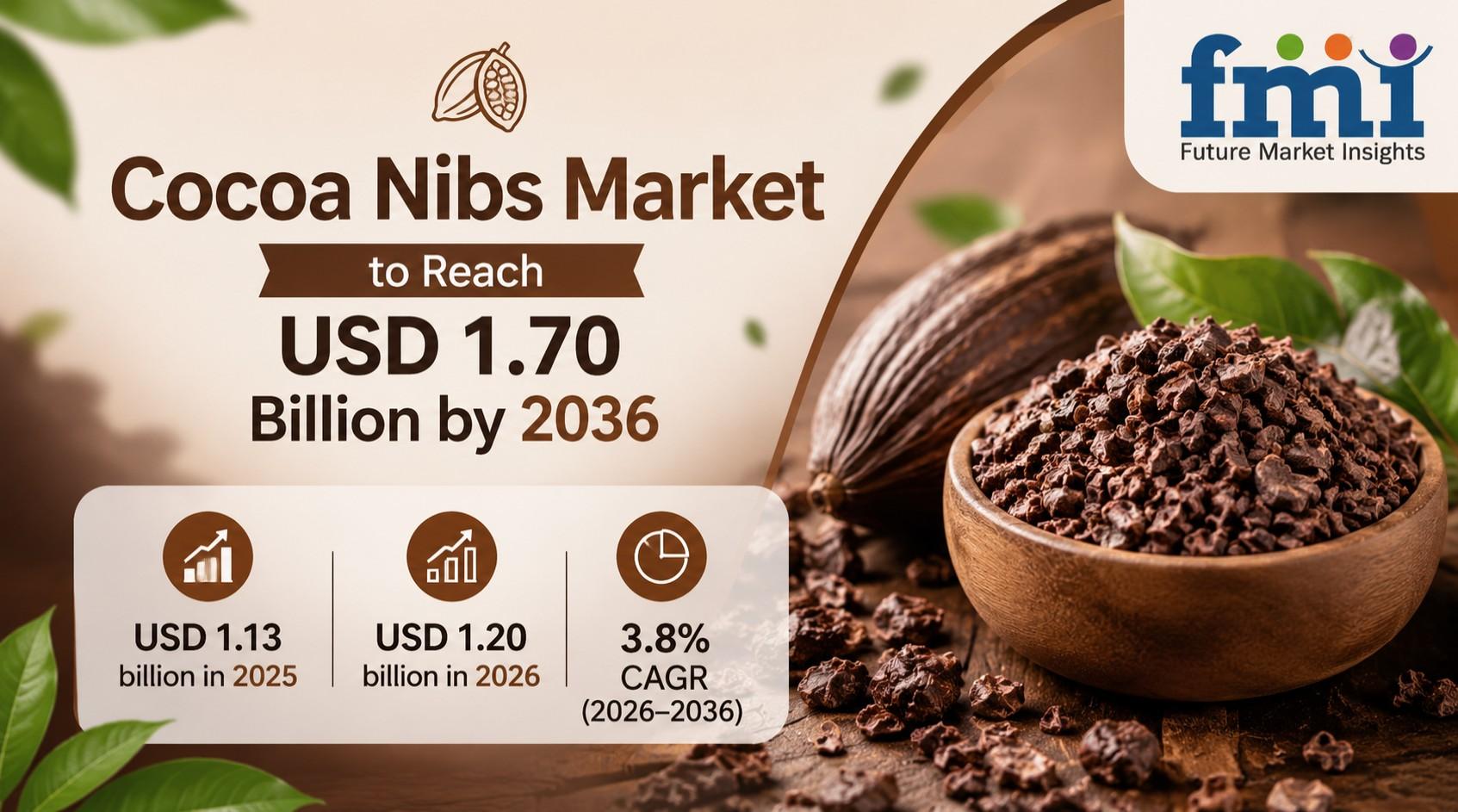
The global cocoa nibs market is projected to reach USD 1.70 billion by 2036, rising from USD 1.20 billion in 2026 at a 3.8% CAGR, according to latest insights by Future Market Insights. The market was valued at USD 1.13 billion in 2025 and represents an incremental opportunity of USD 0.53 billion over the forecast decade. Conventional cocoa nibs are expected to account for 68.0% of product type demand in 2026, while food and beverage manufacturing represents 72.0% of application category sales.
The growth outlook answers a practical question for chocolate makers, bakery formulators, and health food processors: where is demand concentrating? FMI data points to bean-to-bar artisan chocolate production, superfood snack inclusions, clean-label antioxidant claims, and industrial confectionery sourcing. Japan is projected to be the fastest-growing country among primary markets, recording a 6.0% CAGR through 2036, followed by the United Kingdom at 4.2%.
Cocoa Nibs Market Growth Reflects Clean-Label Snacking and Industrial Processing Food processors and consumers are increasingly utilizing crushed, roasted cocoa beans as a nutrient-dense, minimally processed alternative to processed chocolate. Cocoa nibs deliver rich concentrations of flavanols, dietary fiber, magnesium, and healthy fats with zero added sugars, driving application across high-protein granola mixes, breakfast cereals, artisan bakery toppings, and premium dark chocolate manufacturing.
Food and beverage processing operations remain the primary anchor of the global cocoa nibs market. Industrial confectioners and bakeries rely on standardized nib grades to ensure predictable roasting notes, flavor extraction, and texture consistency across commercial lines. The food and beverage application sector is projected to hold a leading 72.0% market share in 2026.
Conventional cocoa nibs dominate product categories. FMI estimates that conventional cocoa nibs will account for 68.0% share in 2026 because they provide cost-effective bulk supply for large-scale confectionery and bakery plants. Mitigating global cocoa bean crop yield volatility, high farm-gate commodity pricing, and strict international quality standards, however, remains a persistent operational challenge for processors.
“The cocoa nibs market is transitioning from a traditional procurement category into a more established industrial supply segment as adoption accelerates across primary end-use environments.” Nandini Roy Choudhury, Principal Consultant for Food and Beverage, Future Market Insights. Nandini Roy Choudhury also highlights the importance of cost efficiency and supply chain integrity. “Companies that can deliver validated performance, competitive pricing, and reliable supply are positioned to capture growing procurement volume during the forecast period,” Nandini Roy Choudhury noted in the supplied FMI analysis.
Future Market Insights is a market research firm that analyzes confectionery ingredient demand, processing splits, country growth rates, and competitive benchmarking across global food and beverage sectors.
Conventional Nibs and B2B Processing Channels Lead Market Segmentation
Conventional cocoa nibs lead product types with a projected 68.0% share in 2026, supported by high-volume utilization in commercial chocolates, cookies, and breakfast bars. Organic cocoa nibs represent 32.0% of demand, expanding steadily across single-origin retail pouches, raw vegan superfood mixes, and specialty wellness products.
By application, food and beverages command 72.0% share in 2026, followed by nutraceuticals/health foods (protein mixes, dietary supplements) and personal care/cosmetics (exfoliating scrubs, antioxidant skincare formulations). B2B supply contracts with industrial chocolate producers and commercial bakeries drive bulk volume movement, while supermarkets, specialty organic grocers, and online storefronts capture consumer retail demand.
The competitive landscape includes Barry Callebaut (holding a leading estimated 23.0% market share), Navitas Organics, Sunfood Superfoods, and The Raw Chocolate Company. Multinational ingredient processors maintain market leadership through global bean origin networks, state-of-the-art roasting and winnowing infrastructure, and long-term industrial supply agreements.
Product differentiation continues across niche channels: boutique labels and health brands are pairing single-origin Criollo or Trinitario cocoa nibs with fair-trade and regenerative agriculture certifications, catering to consumers seeking complete provenance transparency.
Request Exclusive Sample (Top Performing Strategies (Next 10 years):
https://www.futuremarketinsights.com/reports/sample/rep-gb-22304
Japan and the United Kingdom Show the Fastest Growth Japan is projected to record a 6.0% CAGR through 2036. Expanding functional confectionery demand, growing consumer awareness of cocoa polyphenol health benefits, and innovative bakery and dessert inclusions anchor Japanese market growth.
The United Kingdom is forecast to expand at a 4.2% CAGR through 2036, driven by strong consumer demand for premium bean-to-bar dark chocolates and clean-label breakfast granolas.
The United States is projected to grow at 3.9% CAGR, supported by widespread adoption of cocoa nibs in functional snack bars and sports nutrition blends. Germany follows at 3.8%, while France tracks at 3.6% through 2036.
Get More Insights from the Full Research Report:
https://www.futuremarketinsights.com/reports/cocoa-nibs-market
Origin Traceability and Sourcing Resilience Shape Category Economics Cocoa nib processors are navigating significant raw material cost fluctuations tied to West African harvest pressures and evolving climate conditions. In response, ingredient manufacturers are diversifying their sourcing networks across Latin America and Southeast Asia, investing in direct-trade partnerships with farming cooperatives.
At the same time, compliance with international deforestation regulations and heavy metal testing (such as cadmium and lead screening) is becoming non-negotiable. Suppliers capable of providing verified, traceable cocoa nibs with documented safety standards and consistent roast profiles are best positioned to secure high-margin supply contracts with global food brands.
FMI defines the market as commercially traded pieces of crushed, roasted, or raw dried cocoa beans (Theobroma cacao) with their shells removed. The scope includes conventional and organic cocoa nibs sold into food and beverage processing, dietary supplements, and cosmetic formulations across B2B and retail channels. Whole unhusked cocoa beans, finished chocolate bars, isolated cocoa butter, and defatted cocoa powders are excluded.
About Future Market Insights Future Market Insights, Inc. is a market research and consulting firm providing syndicated and customized research across global industries. The company’s cocoa nibs market study covers product type, application, distribution channel, and regional markets across 2026 to 2036. The Cocoa Nibs Market report was published on May 21, 2026, and reviewed by Nandini Roy Choudhury. The study covers 250 pages and uses a hybrid bottom-up and top-down methodology cross-referenced against global cocoa grindings data, confectionery trade flows, and retail point-of-sale audits.
For Press & Corporate Inquiries
Rahul Singh AVP - Marketing and Growth Strategy
Future Market Insights,
Inc. +91 8600020075
For Sales - sales@futuremarketinsights.com
For Media - Rahul.singh@futuremarketinsights.com
For web - https://www.futuremarketinsights.com/
For Web - https://www.factmr.com/

 English
 Arabic
 French
 Spanish
 Portuguese
 Turkish
 Dutch
Dutch
 Italiano
 Russian
 Romaian
 Portuguese (Brazil)
 Greek
Greek
