


AWS and Azure DevOps Engineers from Pakistan: A Guide to Cloud Infrastructure Outsourcing
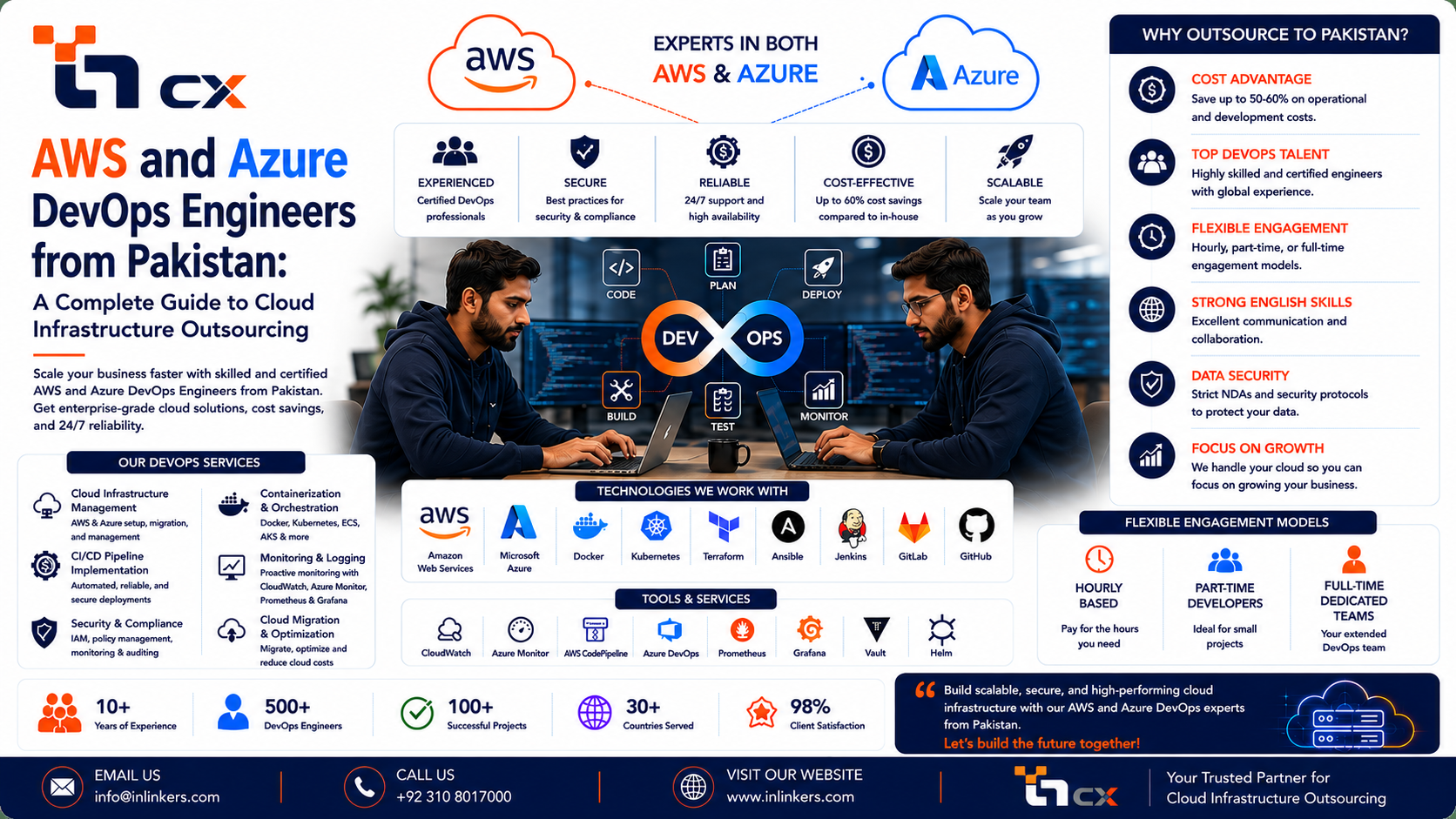
Cloud infrastructure has become a critical part of modern business operations. Companies rely on cloud platforms to host applications, store data, run databases, manage APIs, deploy software and support digital services. As cloud environments become more complex, businesses need experienced professionals who can manage infrastructure, automate deployments, improve security and control cloud spending.
This is where AWS-Azure DevOps engineers can provide significant value. These professionals combine cloud engineering, automation, infrastructure management, continuous integration and continuous delivery, monitoring, security and reliability practices to help businesses operate modern cloud environments.
For companies that do not want to build a large internal cloud engineering department, cloud infrastructure outsourcing can provide access to specialized professionals while offering greater staffing flexibility and potentially lower operating costs. InLinkers CX's current guide highlights dedicated AWS and Azure DevOps resources from Pakistan as a key component of its IT staffing and cloud engineering services.
What Are AWS and Azure DevOps Engineers?
AWS-Azure DevOps engineers are technology professionals who help businesses build, automate, maintain and optimize cloud infrastructure.
Depending on the project, their responsibilities may include:
-
Cloud infrastructure management
-
CI/CD pipeline development
-
Infrastructure as Code
-
Container management
-
Kubernetes administration
-
Cloud security
-
Monitoring and observability
-
Backup and disaster recovery
-
Cloud migration
-
Performance optimization
-
Cost management
-
Deployment automation
AWS and Azure have different services and architectures, but many DevOps principles apply across both environments.
Azure DevOps itself provides tools for planning, managing source code, building applications, testing and deploying software.
Why Businesses Need DevOps Engineers
Cloud infrastructure can become complicated as applications grow.
A startup may initially operate a simple application on a few virtual machines. As the company grows, it may add databases, containers, load balancers, APIs, monitoring systems, automated deployments, security controls and multiple environments.
Without proper engineering practices, this growth can lead to:
-
Manual deployments
-
Infrastructure inconsistencies
-
Unexpected cloud costs
-
Security weaknesses
-
Longer downtime
-
Difficult troubleshooting
-
Limited scalability
A DevOps engineer can help establish structured processes that make infrastructure more reliable and easier to manage.
AWS DevOps Engineering
Amazon Web Services provides a broad ecosystem of cloud services for computing, storage, networking, databases, containers, security, analytics and application development.
An AWS DevOps engineer may work with services such as:
-
Amazon EC2
-
Amazon S3
-
Amazon RDS
-
Amazon VPC
-
Amazon EKS
-
Amazon ECS
-
AWS Lambda
-
Amazon CloudFront
-
Amazon Route 53
-
AWS IAM
-
Amazon CloudWatch
-
AWS WAF
-
AWS Secrets Manager
The specific services required depend on the application's architecture.
AWS also provides tools that allow organizations to integrate AWS services into existing Azure DevOps workflows. For example, the AWS Toolkit for Azure DevOps supports deployment and infrastructure tasks involving services such as S3, CodeDeploy, Lambda and CloudFormation.
Azure DevOps Engineering
Microsoft Azure provides another major cloud ecosystem used by businesses worldwide.
Azure-focused DevOps engineers may work with:
-
Azure Virtual Machines
-
Azure Kubernetes Service
-
Azure DevOps
-
Azure Pipelines
-
Azure Repos
-
Azure Monitor
-
Azure Application Insights
-
Azure Storage
-
Azure SQL
-
Azure Functions
-
Azure Container Registry
-
Azure Virtual Network
Azure DevOps can support the complete development lifecycle, including planning, source control, build automation, testing and deployment.
A skilled Azure DevOps engineer can help businesses connect development and operations processes while improving deployment consistency.
What Is Cloud Infrastructure Outsourcing?
Cloud infrastructure outsourcing involves working with an external technology provider to manage selected cloud infrastructure and DevOps responsibilities.
Instead of recruiting an entire internal cloud operations team, a company can outsource functions such as:
-
Cloud administration
-
Infrastructure monitoring
-
CI/CD management
-
Cloud migration
-
Infrastructure automation
-
Kubernetes management
-
Security monitoring
-
Cloud cost optimization
-
Backup management
-
Incident response
The outsourcing model can be customized according to the organization's needs.
A company may outsource its entire cloud operations function or hire one dedicated engineer to work alongside its existing internal team.
Benefits of Cloud Infrastructure Outsourcing
1. Access to Specialized Talent
Cloud infrastructure requires specialized knowledge.
An outsourcing provider can give businesses access to professionals experienced with cloud platforms, DevOps tools, automation and infrastructure management.
2. Lower Staffing Overhead
Building an internal cloud engineering department can involve recruitment costs, salaries, benefits, training, equipment and management expenses.
Outsourcing can provide a more flexible approach to accessing specialized talent.
InLinkers CX currently lists Pakistan-based DevOps and cloud engineering roles at lower monthly rates than the fully loaded costs cited for comparable US roles. Actual costs vary according to seniority, specialization, scope and engagement model.
3. Faster Team Scaling
Cloud requirements can change quickly.
A business may need additional engineers during a migration or product launch and fewer resources after the project is stabilized.
An outsourcing model can make this adjustment easier.
4. 24/7 Monitoring Potential
Cloud applications operate continuously, so businesses may require monitoring outside standard working hours.
An outsourced team can provide extended coverage depending on the agreed service model.
5. Improved Automation
DevOps engineers can automate repetitive processes such as deployments, infrastructure provisioning, testing and environment configuration.
This can reduce manual errors and improve consistency.
Infrastructure as Code
Infrastructure as Code, commonly known as IaC, allows teams to define infrastructure through configuration files instead of creating resources manually.
Popular tools include:
-
Terraform
-
AWS CloudFormation
-
AWS CDK
-
Azure Bicep
-
ARM templates
-
Ansible
IaC can make infrastructure easier to reproduce, review, modify and manage.
For example, instead of manually configuring multiple cloud environments, engineers can use Terraform or another IaC solution to define infrastructure and deploy it consistently.
This is particularly valuable for organizations operating development, staging and production environments.
CI/CD Pipeline Management
Continuous integration and continuous delivery help development teams release software more efficiently.
DevOps engineers can build pipelines that automate:
-
Code submission
-
Automated testing
-
Build processes
-
Security checks
-
Deployment
-
Monitoring
Azure DevOps provides Azure Pipelines for building and deploying applications, while AWS offers multiple services and integrations for CI/CD workflows.
Automated pipelines reduce dependence on manual deployment processes and provide greater consistency.
Kubernetes and Container Management
Modern applications increasingly use containers to package applications and their dependencies.
Docker is commonly used for containerization, while Kubernetes provides orchestration capabilities.
Cloud platforms provide managed Kubernetes services such as:
-
Amazon EKS
-
Azure AKS
-
Google GKE
DevOps engineers can help manage clusters, deployments, scaling, networking, monitoring and upgrades.
Kubernetes expertise becomes particularly valuable when organizations operate multiple microservices or complex distributed applications.
Cloud Monitoring and Observability
Cloud infrastructure requires continuous monitoring.
DevOps engineers can establish systems that track:
-
CPU usage
-
Memory
-
Network traffic
-
Application performance
-
Error rates
-
Infrastructure health
-
Deployment activity
-
Security events
AWS environments may use CloudWatch, while Azure environments can use Azure Monitor and Application Insights.
More advanced environments may also use tools such as Prometheus, Grafana, Datadog, New Relic, or OpenTelemetry.
Good observability can help teams identify problems before they significantly affect customers.
Cloud Security and DevSecOps
Security should be integrated into cloud infrastructure rather than treated as an afterthought.
DevOps teams can implement:
-
Role-based access
-
Least-privilege permissions
-
Secrets management
-
Secure CI/CD pipelines
-
Vulnerability scanning
-
Network security
-
Encryption
-
Security monitoring
-
Automated compliance checks
AWS recommends avoiding the use of root credentials for automated AWS Toolkit tasks and instead using appropriate IAM credentials and permissions.
A strong DevSecOps approach integrates security throughout development and deployment.
Cloud Cost Optimization
Cloud spending can increase quickly when resources are not monitored properly.
Common sources of unnecessary cloud spending include:
-
Oversized virtual machines
-
Idle development environments
-
Unused storage
-
Unattached volumes
-
Excessive data transfer
-
Unoptimized databases
-
Incorrect purchasing commitments
A cloud engineer can review infrastructure usage and identify opportunities for rightsizing and optimization.
For businesses with substantial monthly cloud bills, cost optimization can become one of the most valuable services within a broader cloud infrastructure outsourcing engagement.
Why Pakistan for Cloud Engineering?
Pakistan has developed a growing technology workforce serving international clients in software development, IT outsourcing, cloud computing and DevOps.
Businesses looking at Pakistan can access professionals with experience in:
-
AWS
-
Azure
-
Kubernetes
-
Terraform
-
Docker
-
CI/CD
-
Linux
-
Python
-
Infrastructure automation
-
Cloud security
InLinkers CX's current cloud engineering guide highlights AWS, Azure, Kubernetes, Terraform, observability and DevSecOps capabilities among its Pakistan-based cloud resources.
Companies should nevertheless evaluate individual engineers based on their practical experience, certifications, communication skills, security knowledge and ability to work with the organization's existing technology environment.
Dedicated vs Outsourced Cloud Teams
Businesses can choose different engagement models.
Dedicated Engineer
A company can hire one dedicated DevOps engineer to work with its internal development team.
This can be suitable for organizations with an existing engineering department that needs additional cloud expertise.
Dedicated Team
A larger organization can establish a team consisting of:
-
AWS engineer
-
Azure engineer
-
DevOps engineer
-
Kubernetes specialist
-
Security engineer
-
Cloud architect
Managed Outsourcing
Businesses can also outsource specific cloud operations to a provider that manages agreed responsibilities under defined service levels.
The right model depends on infrastructure complexity and internal capabilities.
How to Select AWS and Azure DevOps Engineers
Before hiring, businesses should evaluate candidates carefully.
Technical Skills
Look for experience with the specific cloud platform and tools used by your company.
Certifications
Relevant certifications can provide additional evidence of technical training.
Production Experience
Ask candidates about real-world infrastructure they have designed or managed.
Troubleshooting
Use practical scenarios to evaluate how candidates respond to infrastructure failures.
Infrastructure as Code
Ask candidates to explain their experience with Terraform, CloudFormation, Bicep, or other IaC tools.
Security
Evaluate their understanding of IAM, secrets, access controls, network security and secure deployments.
Communication
Cloud engineers often work with developers, managers, security teams and business stakeholders, making communication important.
A Practical Outsourcing Process
A structured cloud infrastructure outsourcing engagement can follow several stages.
Step 1: Infrastructure Assessment
Review the existing architecture, cloud spending, deployment process, monitoring and security.
Step 2: Define Responsibilities
Determine which tasks will remain internal and which will be handled by the outsourced team.
Step 3: Select Engineers
Choose professionals according to the required AWS, Azure, DevOps, Kubernetes, security and automation skills.
Step 4: Establish Secure Access
Provide controlled access to the required cloud environments.
Step 5: Create an Improvement Plan
Identify priorities such as cost optimization, automation, security and monitoring.
Step 6: Implement Changes
The team gradually improves infrastructure while following change-management procedures.
Step 7: Monitor and Report
Regular reports can track cloud costs, uptime, incidents, deployments, security findings and other KPIs.
Why Choose InLinkers CX?
InLinkers CX provides IT staffing and outsourcing services from Pakistan, including cloud engineering and DevOps resources.
Its current cloud engineering offering includes DevOps engineers, AWS solutions architects, Azure DevOps engineers, SRE and cloud architects, Kubernetes engineers, cloud cost optimization and DevSecOps professionals.
Businesses can build dedicated cloud teams based on their existing infrastructure and technical requirements.
This approach can allow companies to add specialized cloud capabilities without immediately building a large internal engineering department.
Final Thoughts
Cloud infrastructure is now an essential part of modern digital operations. As organizations move more applications and workloads to AWS and Azure, managing these environments efficiently requires specialized expertise.
AWS-Azure DevOps engineers can help businesses automate infrastructure, manage deployments, improve monitoring, strengthen security, support Kubernetes environments and optimize cloud costs.
At the same time, cloud infrastructure outsourcing provides businesses with a flexible way to access specialized talent without handling every aspect of recruitment and team development internally.
Pakistan offers an increasingly established technology workforce with experience across AWS, Azure, DevOps, Kubernetes, Terraform, CI/CD and cloud security. With the right outsourcing partner, businesses can build dedicated cloud engineering capabilities around their specific requirements.
The most effective approach is to evaluate technical expertise, security practices, communication, scalability and long-term value rather than choosing a provider based only on price. A properly structured cloud engineering partnership can help businesses improve infrastructure reliability, automate operations, control cloud spending and support continued digital growth.

 English
 Arabic
 French
 Spanish
 Portuguese
 Deutsch
 Turkish
 Dutch
Dutch
 Italiano
 Russian
 Romaian
 Portuguese (Brazil)
