


Seafood market reaches USD 113.4 billion in 2026 and is projected to grow at 3.1% CAGR through 2036
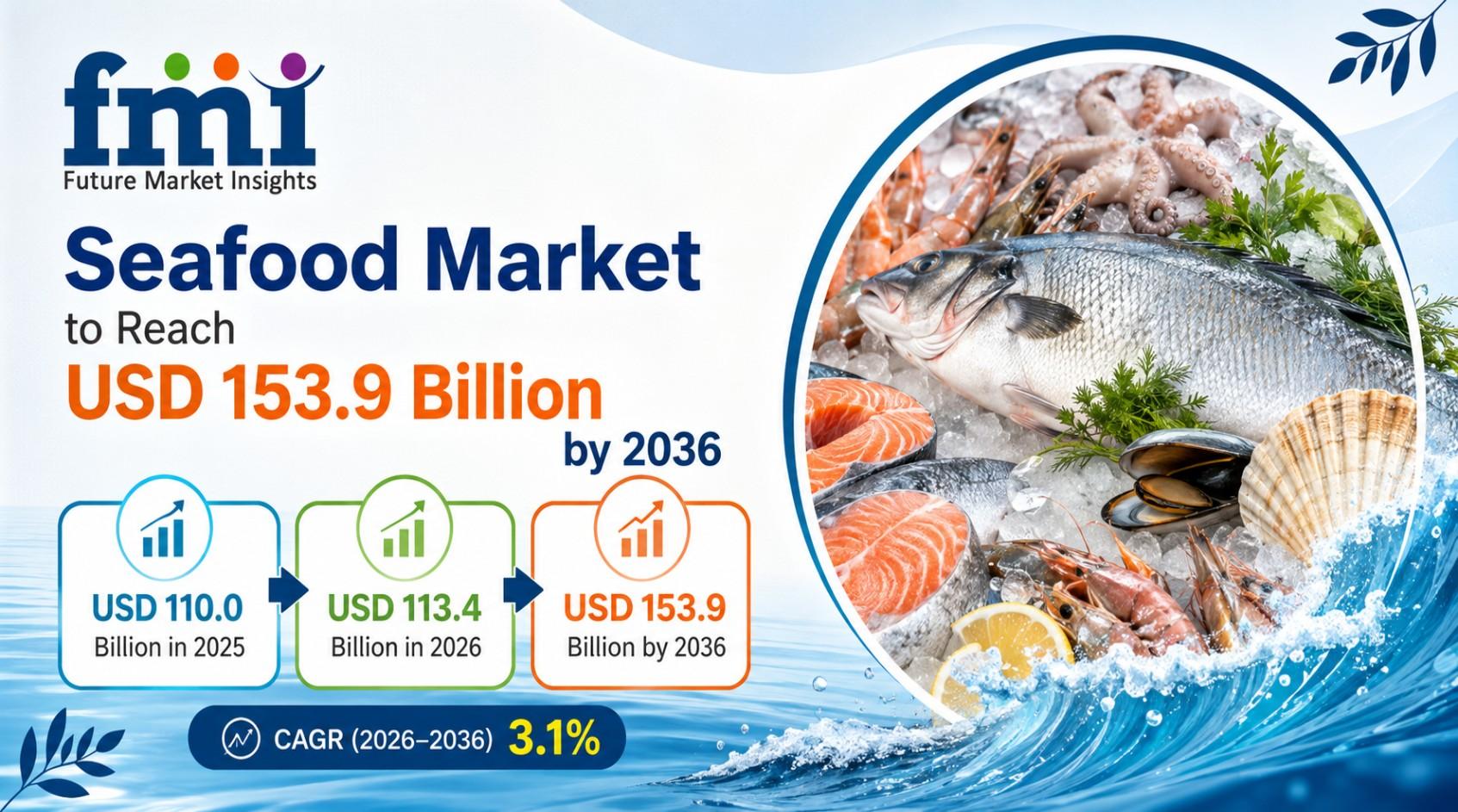
The global seafood market is projected to reach USD 153.9 billion by 2036, rising from USD 113.4 billion in 2026 at a 3.1% CAGR, according to latest insights by Future Market Insights. The market was valued at USD 110.0 billion in 2025 and represents an incremental opportunity of USD 40.49 billion over the forecast decade. Fish is expected to account for 55.0% of product category demand in 2026, while food consumption represents 65.0% of application sales.
The growth outlook answers a practical question for aquaculture operators, commercial processors, and retail buyers: where is demand concentrating? FMI data points to commercial aquaculture capacity expansion, cold-chain logistics unlocking inland consumption, omega-3 health awareness, and sustainability certifications (ASC and MSC). India is projected to be the fastest-growing country among primary markets, recording a 6.5% CAGR through 2036, followed by the United States at 5.7%.
Seafood Market Growth Reflects Aquaculture Scaling and Cold-Chain Expansion With capture fisheries increasingly constrained by ocean resource limits and strict government quotas, global protein supply relies on commercial aquaculture to meet escalating demand. Farmed salmon, shrimp, and tilapia now account for over 50% of global seafood consumption, delivering price predictability and harvest continuity that wild-catch operations cannot guarantee alone.
Direct food consumption remains the primary anchor of the global seafood market. Health-conscious households and foodservice operators are actively incorporating low-fat, omega-3-rich marine proteins into weekly diets, guided by medical recommendations and expanding restaurant menus. Food consumption is projected to hold a leading 65.0% application share in 2026.
Fresh seafood dominates physical formats. FMI estimates that fresh seafood will account for 55.0% share in 2026 because consumers consistently prioritize unprocessed whole fish and fresh fillets, translating into higher price realization per unit. Investing in refrigerated transport, cold storage infrastructure, and hygienic handling, however, remains a persistent operational requirement to reduce spoilage across extended inland distribution corridors.
“The seafood market is structurally constrained on the wild-catch side by fishery management quotas and ocean resource limits, making aquaculture capacity expansion the primary mechanism for meeting growing global protein demand.” Nandini Roy Choudhury, Principal Consultant, Future Market Insights. Nandini Roy Choudhury also underscores the commercial necessity of certification and quality compliance.
“Companies investing in aquaculture sustainability certification (ASC, BAP) and cold chain infrastructure for distribution in emerging markets will gain in premium and volume segments respectively,” Nandini Roy Choudhury noted in the supplied FMI analysis.
Future Market Insights is a market research firm that analyzes marine protein demand, species category splits, country growth rates, and competitive benchmarking across global food and agriculture sectors.
Fish Species and Offline Retail Counters Lead Market Segmentation
Fish leads product categories with a projected 55.0% share in 2026, supported by high procurement volumes of Atlantic salmon, tuna, cod, and tilapia across retail and dining channels. Shellfish (crustaceans like shrimp, crab, and lobster; mollusks like oysters and clams) forms the second-largest category, led by farmed shrimp production across Asia and Latin America.
By distribution channel, offline retail accounts for 70.0% of market sales in 2026, driven by supermarket wet counters, traditional fish markets, and specialty fishmongers. Household consumers represent 60.0% of end-use demand, while online fresh food delivery and app-based quick-commerce platforms gain rapid adoption in urban centers.
The competitive landscape features vertically integrated aquaculture giants and global seafood processors, led by Mowi ASA alongside Thai Union, Leroy Seafood Group, Austevoll Seafood ASA, Cooke Inc., American Seafoods Company, Dongwon F&B, Trident Seafoods, and High Liner Foods. Mowi maintains leading positioning through integrated Atlantic salmon farming, hatcheries, processing, and distribution facilities across Norway, Scotland, Canada, and Chile.
Strategic infrastructure investments continue to shape supply resilience: in 2025, Mowi ASA launched a large-scale post-smolt facility in Haukå, Norway, and expanded Scottish post-smolt output to mitigate biological risks, while Cooke Inc. strengthened its North American footprint by acquiring AquaBounty Canada’s Prince Edward Island facilities.
Request Exclusive Sample (Top Performing Strategies (Next 10 years):
https://www.futuremarketinsights.com/reports/sample/rep-gb-14911
India and the United States Show the Fastest Growth India is projected to record a 6.5% CAGR through 2036. Expanding inland shrimp and fish aquaculture in Andhra Pradesh, Gujarat, and West Bengal, combined with government-backed cold-chain investments (National Centre for Cold Chain Development), is enabling fresh seafood distribution into major landlocked cities.
The United States is forecast to expand at a 5.7% CAGR through 2036, driven by USDA Dietary Guidelines recommending weekly seafood intake, expanding restaurant menus, and strict retailer sourcing policies (such as Whole Foods and Costco) that demand certified sustainable origins.
China tracks at 4.2% CAGR as the world’s largest producer and consumer, where digital platforms like Hema Fresh scale live seafood delivery. Germany follows at 3.6% CAGR anchored by MSC/ASC certified retail mandates across Edeka and REWE while Brazil is projected to grow at 3.3%, the United Kingdom at 2.6%, and Japan at 2.3% through 2036.
Get More Insights from the Full Research Report:
https://www.futuremarketinsights.com/reports/seafood-market
Sustainability Certification and Traceability Standards Guide Category Margins Seafood procurement is increasingly governed by rigorous sustainability mandates. In North America and Western Europe, major retail and food-service buyers mandate certification from the Marine Stewardship Council (MSC) for wild catches and the Aquaculture Stewardship Council (ASC) for farmed products, commanding price premiums of 15% to 25% over non-certified alternatives.
At the same time, processors are deploying digital batch tracking and strict antibiotic-residue screening to comply with evolving import frameworks, such as NOAA's Seafood Import Monitoring Program (SIMP) in the US and EU Common Fisheries Policy rules. Suppliers capable of guaranteeing transparent provenance and unbroken cold-chain integrity are best positioned to capture long-term retail contracts.
FMI defines the market as commercially traded wild-caught and farm-raised fish, shellfish, and aquatic products sold for food consumption, processing, and industrial applications. The scope includes fresh, frozen, canned, smoked, and value-added prepared seafood across retail grocery, foodservice, and online channels. Aquarium/ornamental species, seafood-derived nutritional supplements (such as standalone fish oil capsules or marine collagen powders), and plant-based seafood substitutes are excluded.
About Future Market Insights Future Market Insights, Inc. is a market research and consulting firm providing syndicated and customized research across global industries. The company’s seafood market study covers product type, application, end use, distribution channel, form, and regional markets across 2026 to 2036. The Seafood Market report was published on May 28, 2026, and reviewed by Nandini Roy Choudhury. The study covers 324 pages and uses a hybrid bottom-up methodology cross-referenced against FAO global fishery statistics, national aquaculture production registries, and processor trade disclosures.
For Press & Corporate Inquiries
Rahul Singh AVP - Marketing and Growth Strategy
Future Market Insights,
Inc. +91 8600020075
For Sales - sales@futuremarketinsights.com
For Media - Rahul.singh@futuremarketinsights.com
For web - https://www.futuremarketinsights.com/
For Web - https://www.factmr.com/

 English
 Arabic
 French
 Spanish
 Portuguese
 Deutsch
 Turkish
 Italiano
 Russian
 Romaian
 Portuguese (Brazil)
 Greek
Greek
