


Marine collagen market reaches USD 1.0 billion in 2026 and is projected to grow at 7.1% CAGR through 2036
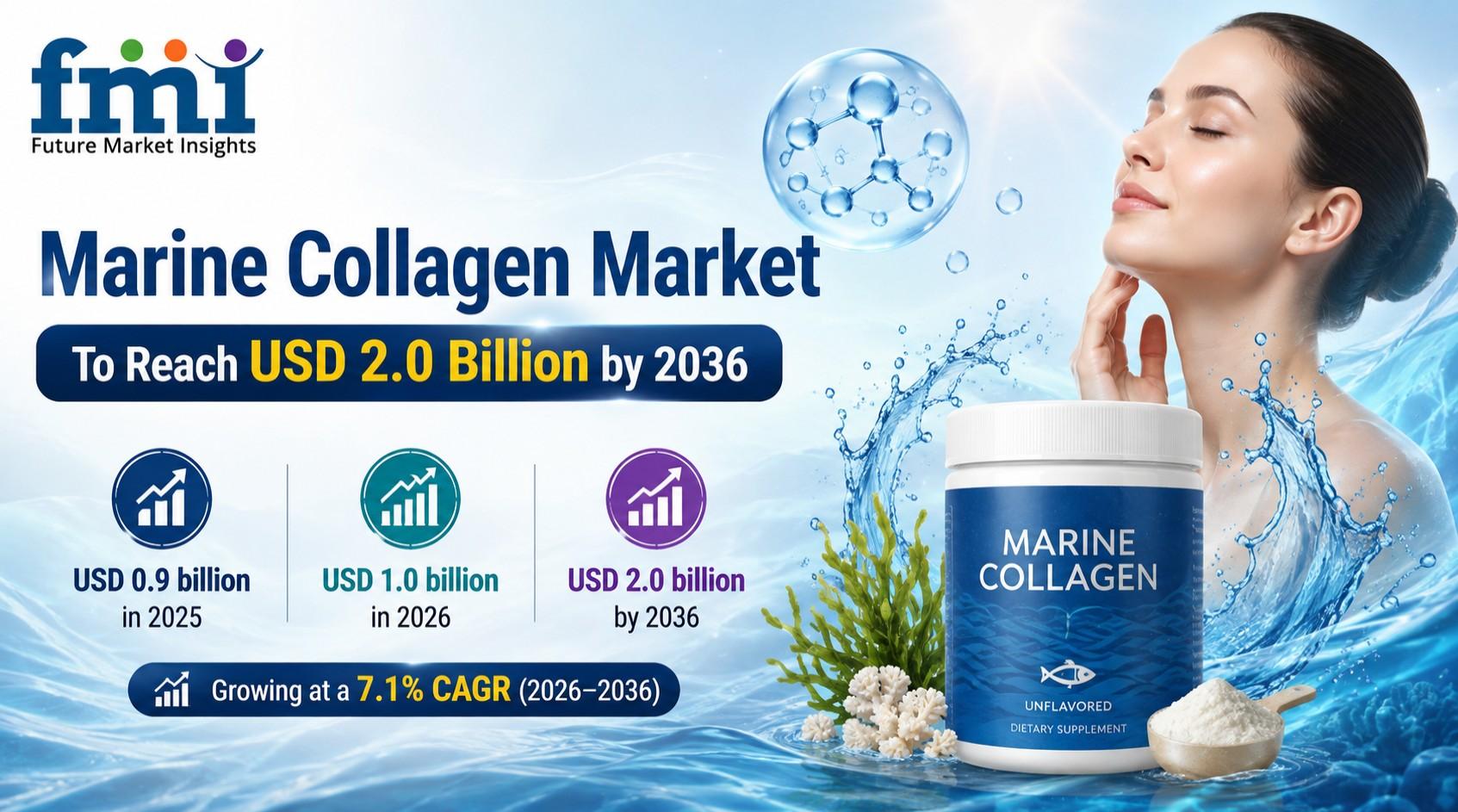
The global marine collagen market is projected to reach USD 2.0 billion by 2036, rising from USD 1.0 billion in 2026 at a 7.1% CAGR, according to latest insights by Future Market Insights. The market was valued at USD 0.9 billion in 2025 and represents an incremental opportunity of USD 1.0 billion over the forecast decade. Fish is expected to account for 71.0% of animal type sales in 2026, while bones and tendons represent 56.0% of source demand.
The growth outlook answers a practical question for nutricosmetic formulators, supplement manufacturers, and beauty brands: where is demand concentrating? FMI data points to fish-origin beauty-from-within formulations, clean-label alternatives to bovine and porcine collagen, low-dose tripeptide innovations, and sensory-neutral daily beverage powders. India is projected to be the fastest-growing country among primary markets, recording an 8.5% CAGR through 2036, followed by China at 8.2%.
Marine Collagen Market Growth Reflects Clean-Label Beauty Nutrition and Upcycled Sourcing Consumers are increasingly seeking ingestible skincare solutions that support skin hydration, elasticity, and anti-aging wellness without relying on mammal-derived proteins. Marine collagen provides a high-purity, bioavailable type-I collagen peptide profile derived from sustainably upcycled seafood processing side streams, offering an accessible, pescatarian-friendly option for consumers with religious, dietary, or environmental restrictions on bovine or porcine products.
Cosmetics and nutricosmetic applications remain the primary anchor of the global market. Topical skincare and ingestible beauty brands rely on marine collagen peptides to substantiate hydration, firmness, and dermal repair claims. Cosmetics and beauty formulations are projected to hold a leading 56.0% application share in 2026.
Fish sources dominate raw material categories. FMI estimates that fish-derived inputs will account for 71.0% share in 2026, with bones and tendons generating 56.0% of source recovery due to dense tissue yields from commercial seafood filleting operations. Overcoming fishy off-notes, ensuring consistent molecular weight distributions, and complying with stringent fish allergen labeling regulations (such as updated US FDA guidance), however, remain critical operational priorities for processors.
“Marine collagen is becoming a sourcing and formulation decision for wellness brands.” Nandini Roy Choudhury, Principal Consultant, Future Market Insights. Nandini Roy Choudhury also underscores the importance of provenance verification and sensory performance. “Suppliers able to prove raw material origin and odor control will be preferred by beauty nutrition brands. Peptide profile will support premium claims,” Nandini Roy Choudhury noted in the supplied FMI analysis.
Future Market Insights is a market research firm that analyzes bioactive peptide demand, source extraction splits, country growth rates, and competitive benchmarking across global nutraceutical and cosmetic ingredient sectors.
Fish Peptides and Powder Formats Lead Market Segmentation
Fish leads animal types with a projected 71.0% share in 2026, supported by established wild-catch and aquaculture filleting byproducts (cod, tilapia, salmon, and pangasius). Jellyfish and marine sponge sources constitute minor, specialized research tiers.
By form, dry powders command 64.0% share in 2026, favored for packaging in tubs, stick packs, and sachets for seamless blending into coffee, teas, and functional smoothies. Direct B2B ingredient supply leads sales channels with 58.0% share as multinational brands contract bulk certified peptide grades.
The competitive landscape features established gelatin and collagen processors alongside dedicated marine ingredient specialists, including Rousselot (Darling Ingredients), PB Leiner (Tessenderlo Group), Weishardt International, Nitta Gelatin, Nestlé Health Science (Vital Proteins), Seagarden AS, Titan Biotech Limited, Norland Products Inc., Ashland Inc., and Gelita AG.
Recent strategic moves highlight targeted clinical and sustainability differentiation: Weishardt launched Naticol x3Peptide in March 2025 featuring at least 25% tripeptides for concentrated 2.5 g daily dosing, Rousselot secured Upcycled Certified status for its Peptan range in April 2025, and Seagarden AS introduced Seacoll in May 2026 as its dedicated marine collagen portfolio brand. In finished retail, USANA introduced Marine Collagen Peptides in August 2025, while DolCas Biotech expanded its low-dose Morikol marine collagen hydrolysate into hot beverage applications.
Request Exclusive Sample (Top Performing Strategies (Next 10 years):
https://www.futuremarketinsights.com/reports/sample/rep-gb-11528
India and China Show the Fastest Growth India is projected to record an 8.5% CAGR through 2036. An expanding domestic seafood processing base, scaling nutraceutical contract manufacturing hubs, and surging urban consumer demand for ingestible beauty supplements anchor Indian market expansion.
China is forecast to expand at an 8.2% CAGR through 2036, driven by massive domestic aquaculture processing, high consumer familiarity with functional skincare drinks, and expanding wellness retail channels.
Japan tracks at 7.8% CAGR, supported by deep cultural integration of nutricosmetics and established daily collagen consumption habits. The United States follows at 7.3% CAGR driven by premium clean-label supplement brands like Vital Proteins and USANA while Germany records 6.4%, France 6.2%, and Norway 5.9% through 2036.
Get More Insights from the Full Research Report:
https://www.futuremarketinsights.com/reports/marine-collagen-market
Enzymatic Hydrolysis and Allergen Traceability Shape Category Margins Marine collagen processors are increasingly deploying targeted enzymatic hydrolysis to isolate specific low-molecular-weight tripeptides (Gly-Pro-Hyp). These precision fractions enhance gastrointestinal absorption, allowing brands to formulate lower daily active dosages in RTD beverages, gummies, and beauty shots without compromising clinical efficacy.
At the same time, strict adherence to heavy metal testing, species-specific DNA validation, and transparent fish allergen disclosures protects brands against regulatory scrutiny. Ingredient suppliers capable of guaranteeing fully deodorized, neutral-tasting powders backed by third-party upcycled certifications are best positioned to secure high-value long-term contracts with global beauty nutrition leaders.
FMI defines the market as commercially traded collagen proteins and hydrolyzed collagen peptides extracted from marine organisms for beauty nutrition, dietary supplements, cosmetics, medical devices, and functional food applications. The scope includes fish skin, scales, bones, cartilage, and jellyfish-derived extracts in powder, liquid, capsule, and gel forms across B2B, private label, and retail distribution channels. Bovine, porcine, poultry, and non-marine gelatin products, as well as marine oils (omega-3s) without collagen content, are excluded.
About Future Market Insights Future Market Insights, Inc. is a market research and consulting firm providing syndicated and customized research across global industries. The company’s marine collagen market study covers source, animal type, form, application, sales channel, and regional markets across 2026 to 2036. The Marine Collagen Market report was published on June 01, 2026, and reviewed by Nandini Roy Choudhury. The study covers 342 pages and uses a hybrid bottom-up and top-down methodology cross-referenced against global seafood processing yields, biotechnology extraction capacities, and retail nutricosmetic sales data.
For Press & Corporate Inquiries
Rahul Singh AVP - Marketing and Growth Strategy
Future Market Insights,
Inc. +91 8600020075
For Sales - sales@futuremarketinsights.com
For Media - Rahul.singh@futuremarketinsights.com
For web - https://www.futuremarketinsights.com/
For Web - https://www.factmr.com/

 English
 Arabic
 French
 Spanish
 Portuguese
 Deutsch
 Turkish
 Dutch
Dutch
 Italiano
 Russian
 Romaian
 Portuguese (Brazil)
