


RIBO Level 1 Exam: Requirements, Cost & Study Guide
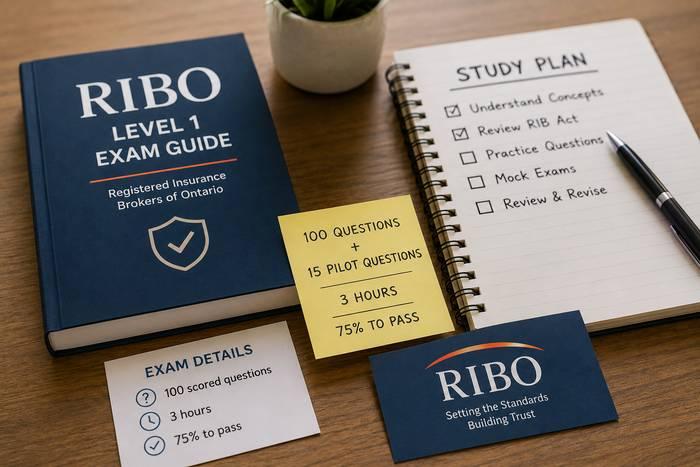
If you want to sell insurance in Ontario, the RIBO Level 1 exam is the first hurdle you need to clear. It's the entry-level licensing test administered on behalf of the Registered Insurance Brokers of Ontario (RIBO), and passing it is what allows you to legally advise clients on and sell general insurance products — home, auto, business, and travel coverage among them. This guide walks through what the exam covers, what it costs, and how to prepare so you can go in with a clear plan instead of guesswork.
What Is the RIBO Level 1 Exam?
The RIBO Level 1 exam is the mandatory qualifying test for anyone who wants to work as an entry-level insurance broker in Ontario. RIBO is the regulatory body that oversees insurance brokers in the province, and it requires every prospective broker to demonstrate baseline knowledge of insurance principles, policy wordings, and the regulatory framework before they can be licensed. Without a passing result on this exam, you cannot legally represent yourself as a broker or sell general insurance products to the public in Ontario.
The exam itself is built around foundational topics: introduction to insurance concepts, the RIB Act and its regulations, and the core policy types brokers deal with day to day, including auto, property, and liability coverage. It's a knowledge-check exam rather than a sales or negotiation test — it confirms you understand the rules and products well enough to advise clients responsibly.
RIBO Level 1 Exam Requirements
Before you can register for and write the exam, there are a few basic pieces you'll need in place:
- Enrollment with a sponsoring brokerage or an intent to work under one, since most candidates take the exam as part of onboarding with a firm.
- A study course or prep materials covering the exam syllabus — this isn't strictly mandatory, but very few candidates pass without structured preparation.
- Registration through the exam provider, since RIBO itself doesn't administer the test directly.
There's no formal education prerequisite like a diploma or degree to sit the RIBO Level 1 exam, which is part of why it's a popular entry point into the insurance industry for career changers.
Exam Format and Passing Score
The exam consists of multiple-choice questions plus 15 ungraded pilot questions that test future exam content without affecting your score, and these pilot questions are mixed in so they're indistinguishable from the graded ones during the exam. The RIBO 1 exam consists of 100 multiple-choice questions, and you need 75% to pass. You're given three hours to complete it.
That 75% threshold is firm — there's no partial credit or curve, so RIBO exam preparation needs to be thorough rather than surface-level. Recent pass rates hover in the mid-to-high 80s percentage range for well-prepared candidates, which suggests the bar is achievable with proper study but not something to walk into cold.
RIBO Level 1 Exam Cost
Budgeting for the exam involves two separate costs: the registration fee and your study materials.
Exam registration fee: RIBO exam registration fees run $300 for each of the three RIBO exam levels, paid directly to the exam providers — the Insurance Brokers Association of Ontario (IBAO) and the Insurance Institute. This fee is separate from any course you take to prepare.
Study materials and courses: Prep courses for the RIBO 1 exam vary widely in price, ranging from roughly $250 on the lower end to over $1,000 depending on the provider and how comprehensive the materials are. Cheaper options tend to be self-study notes and practice questions, while pricier packages often bundle live instruction, tutoring, or extended access.
Total out-of-pocket cost for most first-time candidates, once you factor in a mid-range course and the registration fee, typically lands somewhere between $500 and $800.
Important 2026 Licensing Changes
If you're researching RIBO licensing beyond Level 1, it's worth knowing that Level 2 exams for Commercial and Farm lines were eliminated as of January 1, 2026, with designations like CAIB, CIP, FCIP, ACIP, and CCIB now satisfying the Level 2 licence requirement instead. Candidates who hold a Level 1 licence can alternatively qualify for Level 2 by completing CAIB 1, 2, and 3, or CIP courses C130 and C131. A parallel change is coming for Level 3: the Level 3 Management exam will be eliminated as of January 1, 2027, after which the Level 3 Accelerated Management Exam becomes the required path to a Level 3 licence.
The good news for anyone just starting out is that none of this affects the entry point. The path to RIBO Level 1 hasn't changed — you'll still need to pass the RIBO 1 exam to get your entry-level license and start working in the industry. These upper-level changes are useful context for planning your longer-term career path, but they shouldn't affect how you prepare for Level 1 today.
How to Prepare: A Practical Study Approach
A structured RIBO exam study guide approach tends to work better than passive reading. Here's a practical sequence:
- Get the syllabus first. Know exactly which topics are tested — insurance fundamentals, the RIB Act and regulations, and the major policy types — before you start studying blindly.
- Use a dedicated prep course. Whether it's a paid course or free study notes, structured materials built specifically for this exam save time versus generic insurance textbooks.
- Work through practice questions repeatedly. Multiple-choice recall improves fastest with repetition, especially for terminology-heavy sections like policy definitions and regulatory language.
- Time yourself. Since you have three hours for 100-plus questions, practicing under time pressure helps you avoid getting stuck on any single question.
- Review your weak areas, not just your strong ones. It's tempting to keep re-reading what you already know; focus extra time on the sections where practice scores are lowest.
Most candidates spend anywhere from two to six weeks preparing, depending on whether they're studying part-time alongside a job or full-time before starting at a brokerage.
Final Thoughts
The RIBO Level 1 exam is a manageable but real barrier to entry — 100 questions, a 75% passing bar, and three hours to get it done. With the right prep course, a study plan that emphasizes practice questions and timed reviews, and a clear understanding of the current fee structure, most candidates pass on their first attempt. Treat it as the foundation for your broker career rather than a box to check, since the concepts tested here are ones you'll rely on daily once you're advising real clients.
Frequently Asked Questions
How many questions are on the RIBO Level 1 exam?
The exam includes 100 scored multiple-choice questions plus 15 additional ungraded pilot questions mixed in, though the pilot questions don't count toward your final score.
How much does it cost to write the RIBO Level 1 exam?
The exam registration fee is $300, paid directly to the exam provider. Study materials or prep courses are a separate cost and typically range from around $250 to over $1,000 depending on the provider.
What score do I need to pass the RIBO Level 1 exam?
You need to score at least 75% within the three-hour time limit to pass.

 English
 Arabic
 Spanish
 Portuguese
 Deutsch
 Turkish
 Dutch
Dutch
 Italiano
 Russian
 Romaian
 Portuguese (Brazil)
 Greek
Greek
