


AI Governance vs AI Risk Management: Understanding the Difference
As artificial intelligence becomes part of everyday business operations, organizations are facing an important question: how can they use AI responsibly without creating unacceptable risks?
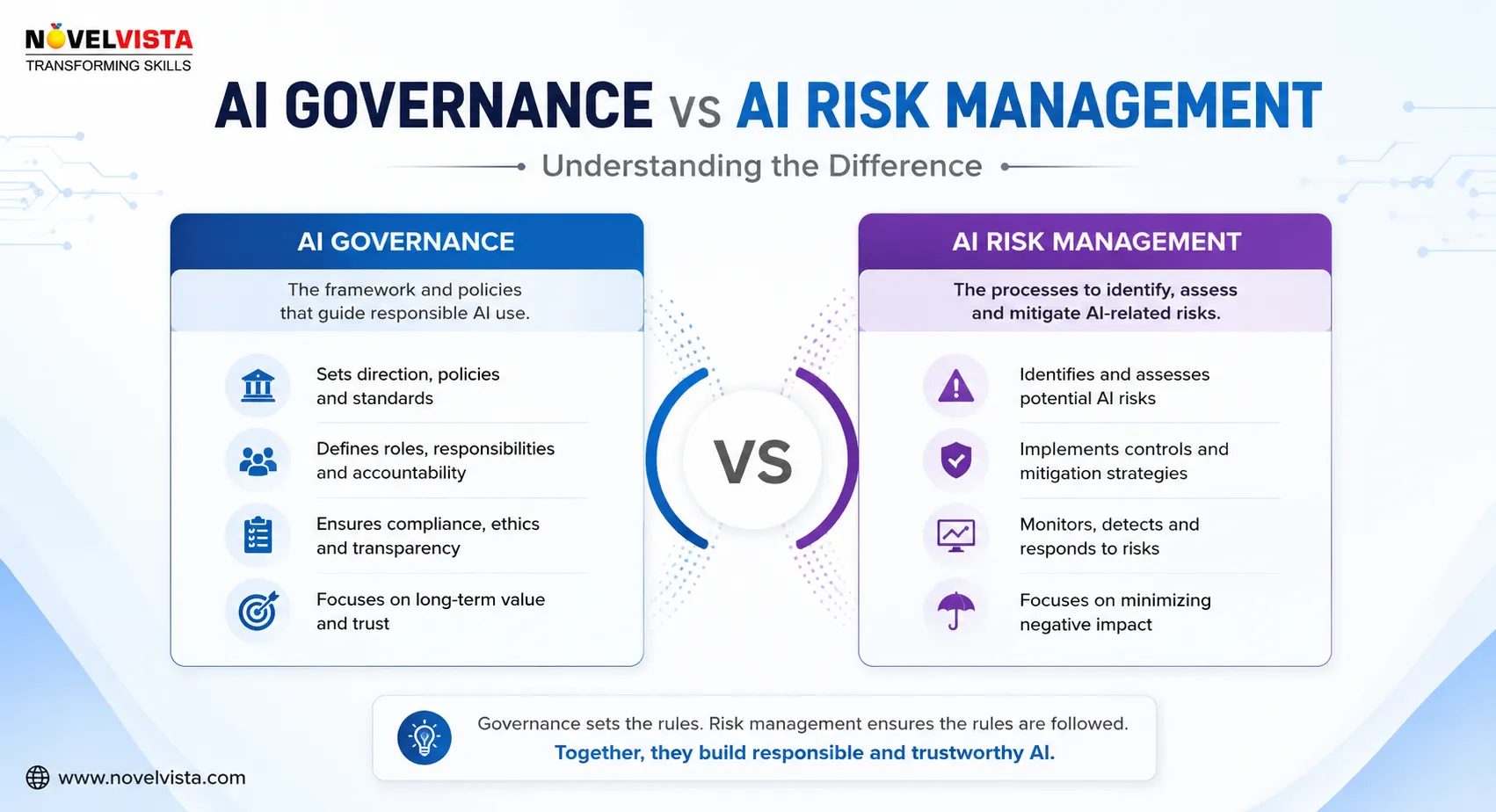
This conversation often introduces two related term AI governance and AI risk management. Although they are sometimes used interchangeably, they do not mean the same thing. AI governance establishes how an organization directs and controls its AI activities, while AI risk management focuses on identifying and reducing the risks created by individual AI systems.
Understanding the difference helps organizations build AI systems that are innovative, trustworthy and aligned with business expectations.
What Is AI Governance?
AI governance is the overall framework used to guide how an organization develops, purchases, deploys and monitors artificial intelligence. It defines the rules, responsibilities, decision-making structures and accountability mechanisms surrounding AI.
In practical terms, AI governance answers questions such as:
- Who is responsible for approving an AI system?
- What principles should guide AI development?
- Which AI applications are prohibited?
- How should employees use generative AI tools?
- What documentation must be maintained?
- Who is accountable when an AI system causes harm?
- How will compliance with internal policies and regulations be demonstrated?
An AI governance framework may include policies, oversight committees, approval processes, ethical principles, documentation standards, employee training and audit requirements. It ensures that AI is not implemented independently by different teams without coordination or supervision.
AI governance therefore operates at an organizational level. Its purpose is to create consistency across the complete AI lifecycle, from initial idea and data collection to deployment, monitoring and retirement.
What Is AI Risk Management?
AI risk management is a more focused discipline. It involves identifying, assessing, treating and monitoring the risks associated with an AI system or use case.
AI systems can introduce several types of risk. A recruitment model may discriminate against certain candidates. A customer-service chatbot may disclose confidential information. A generative AI application may produce inaccurate information, while a predictive model may perform poorly when real-world conditions change.
AI risk management helps organizations understand these possibilities before they become business incidents.
A typical AI risk-management process includes:
- Identifying potential risks and affected stakeholders.
- Estimating the likelihood and impact of each risk.
- Classifying the system according to its risk level.
- Selecting appropriate controls and safeguards.
- Testing whether those controls are effective.
- Monitoring the system after deployment.
- Reporting incidents and responding to unexpected outcomes.
The controls used may include human review, bias testing, access restrictions, data-quality checks, model validation, security testing, output filtering and continuous performance monitoring.
The Main Difference
The simplest way to understand the distinction is this:
AI governance creates the system of authority, while AI risk management handles the risks within that system.
Governance defines who must perform a risk assessment, when it must happen and who can accept the remaining risk. Risk management performs the actual assessment, documents the findings and recommends safeguards.
For example, an organization may introduce a governance policy requiring every high-impact AI system to receive approval from an AI oversight committee. When a team proposes an automated loan-decision model, the risk-management process evaluates possible discrimination, inaccurate decisions, privacy issues, cybersecurity threats and regulatory exposure.
The governance framework provides the rules and accountability. Risk management provides the analysis and treatment of risk.
Why Organizations Need Both
Governance without risk management can become a collection of policies that looks impressive but does little to prevent harm. An organization may have ethical principles and an AI committee, but those structures will not be effective unless individual systems are properly assessed and monitored.
Risk management without governance creates a different problem. Teams may perform detailed technical evaluations, but there may be no consistent standard, central oversight or clear authority to make final decisions. One department may accept a risk that another department would reject.
When governance and risk management work together, organizations gain a repeatable and defensible approach. Governance sets expectations across the enterprise, while risk management converts those expectations into practical controls for each system.
How They Work Together
Consider a company planning to deploy an AI-powered employee-performance tool.
The AI governance framework may require transparency, fairness, privacy protection, human oversight and formal approval. It will identify the people responsible for reviewing the system and establish the documentation required before deployment.
The AI risk-management process then examines the specific tool. It may test whether the model disadvantages certain employee groups, verify the quality of training data, evaluate privacy implications and determine whether managers can challenge the system’s recommendations.
If the remaining risk is too high, the governance authority may reject the system, request stronger controls or limit how it can be used.
Final Thoughts
AI governance and AI risk management are not competing approaches. They are complementary parts of responsible AI adoption.
AI governance provides direction, ownership and accountability. AI risk management identifies what could go wrong and determines how those problems should be controlled. One builds the operating framework; the other makes that framework work in practice.
Organizations that invest in both are better prepared to meet regulatory expectations, protect stakeholders and build confidence in their AI systems. More importantly, they can pursue AI innovation with a clear understanding of where responsibility sits and how risk will be managed throughout the AI lifecycle.

 English
 Arabic
 French
 Spanish
 Portuguese
 Deutsch
 Dutch
Dutch
 Italiano
 Russian
 Romaian
 Portuguese (Brazil)
 Greek
Greek
