


Cattle Feed Market to Reach USD 201.3 Billion by 2036
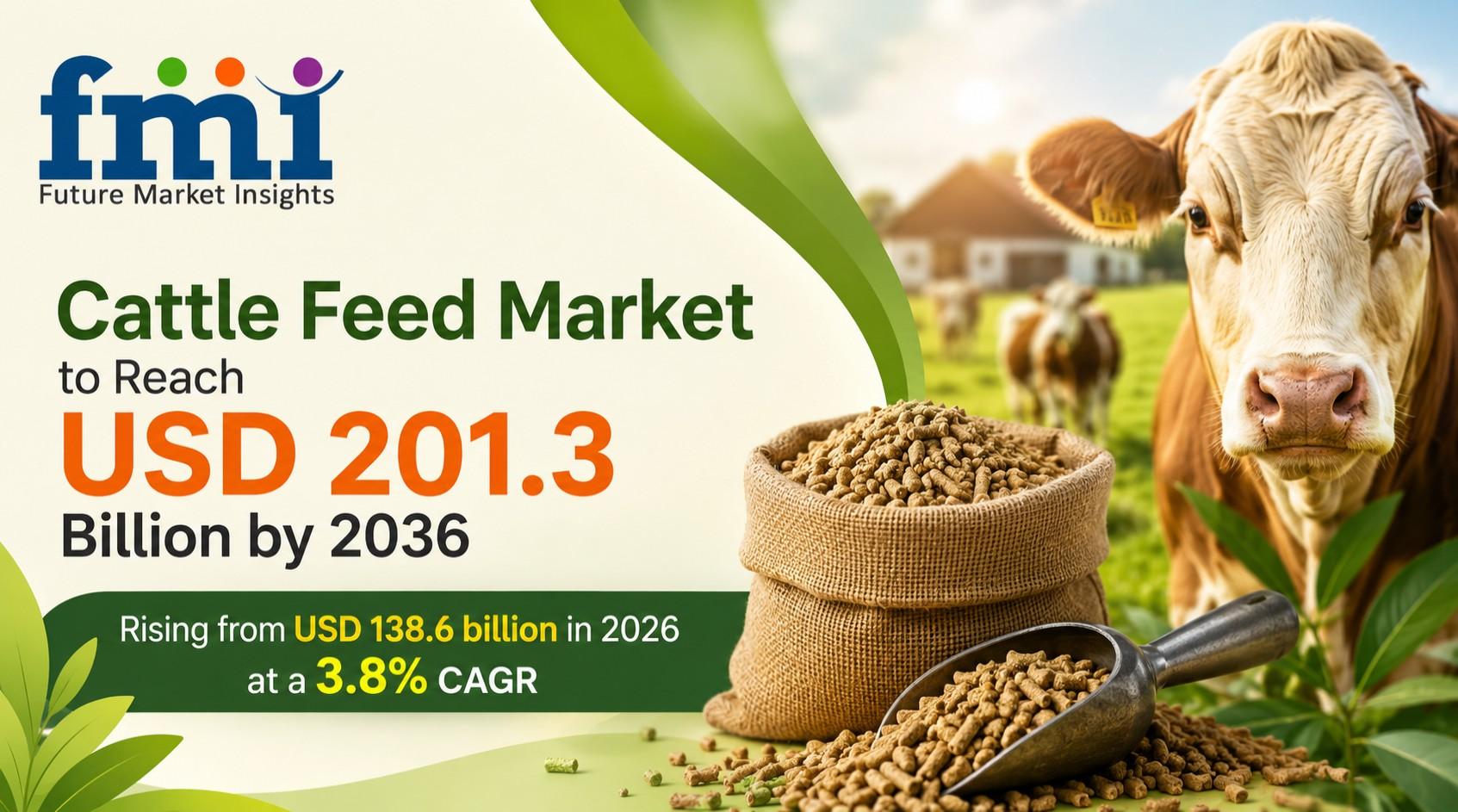
The global cattle feed market is projected to reach USD 201.3 billion by 2036, rising from USD 138.6 billion in 2026 at a 3.8% CAGR, according to latest insights by Future Market Insights. The market is shifting from traditional grazing practices toward structured, precision-formulated livestock nutrition. Concentrate foods are expected to account for 44.0% of product type demand in 2026, while pellets are projected to represent 34.0% of the form segment.
The growth outlook answers a practical question for dairy farmers, beef producers, and feed mills: where is demand concentrating? FMI data points to yield-enhancing concentrate feeds, pelletized intake consistency, and farm-level advisory programs designed to improve feed conversion ratios. India is projected to be the fastest-growing country, recording an 8.2% CAGR through 2036, followed by Japan at 4.3%.
Cattle Feed Market Growth Reflects Livestock Industrialization and Precision Nutrition
Rising worldwide consumption of dairy and meat products is prompting livestock operations to adopt nutritionally balanced, formulated feeds to maximize herd output. In commercial dairy and beef production, farm managers are implementing precision feeding regimens to optimize milk yield, improve average daily weight gain, and lower metabolic disease incidence across herd lifecycles.
Concentrate foods remain the primary nutritional engine of the market. Packed with balanced proteins, energy, vitamins, and minerals, concentrates complement roughages and forage to support high-performance lactation and fattening phases. Concentrate foods are projected to hold a leading 44.0% market share in 2026.
Pellets dominate physical delivery forms. FMI estimates that pelletized feeds will account for 34.0% share in 2026 because the pelleting process reduces selective feeding behavior, minimizes trough wastage, improves digestibility, and streamlines automated bulk storage and dispensing. Managing raw ingredient cost volatility across cereal grains and oilseed meals, however, remains a persistent operational challenge for feed compounders.
“The cattle feed market is moving toward nutrition programs that improve yield, feed efficiency, and animal health.” Nandini Roy Choudhury, Principal Consultant for Food and Beverage, Future Market Insights.
Nandini Roy Choudhury also highlights the importance of customized herd support. “Suppliers with balanced formulations and regional advisory support are likely to gain advantage as livestock producers seek better output from each herd,” Nandini Roy Choudhury noted in the supplied FMI analysis.
Future Market Insights is a market research firm that analyzes animal nutrition demand, feed chemistry splits, country growth rates, and competitive benchmarking across global agribusiness sectors.
Concentrate Feeds and Pellets Lead Market Segmentation
Concentrate foods lead product types with a projected 44.0% share in 2026, supported by high-density protein and energy delivery for commercial dairy and beef operations. Roughages (pasture, hay, silage, straw, and hulls) and feed additives (probiotics, enzymes, and amino acids) constitute the remaining product landscape.
By form, pellets command 34.0% share in 2026, followed by mash, extruded feeds, cubes, flakes, silage, and liquid feeds. Pelleted feeds ensure uniform nutrient dispersion and prevent cattle from sorting ingredients, directly enhancing feed conversion efficiency.
The competitive landscape includes Cargill Inc., Archer Daniels Midland (ADM), ForFarmers Inc., De Heus, and Land O'Lakes Inc. Major feed manufacturers compete on nutritional precision, regional forage-matching blends, integrated ingredient supply chains, and dedicated on-farm technical support services.
Feed innovation is increasingly centered on animal welfare and environmental sustainability: manufacturers are expanding antibiotic-free lines, formulating with digestible phytase enzymes, and integrating digital livestock management tools to track feed intake and optimize daily rationing.
Request Exclusive Sample (Top Performing Strategies (Next 10 years):
https://www.futuremarketinsights.com/reports/sample/rep-gb-14343
India and Japan Show Steady Expansion
India is projected to record an 8.2% CAGR through 2036. The country’s vast bovine population, expanding organized dairy cooperatives, rising consumer spending on milk products, and government support for scientific animal husbandry are accelerating commercial compound feed adoption.
Japan is forecast to expand at a 4.3% CAGR through 2036, driven by high-efficiency farming techniques and premium beef production standards that demand specialized, high-performance feed formulations.
The United Kingdom follows at 3.5% CAGR, supported by strict animal welfare and organic farming standards. South Korea is projected to grow at 3.4%, while Brazil tracks at 3.0% through 2036 as one of the world’s leading beef export hubs.
Get More Insights from the Full Research Report:
https://www.futuremarketinsights.com/reports/cattle-feed-market
Nutritional Optimization and Ingredient Traceability Guide Market Margins
Cattle feed millers are navigating fluctuating grain and protein meal prices by leveraging alternative feedstuffs and advanced digestive additives. Incorporating protected amino acids, organic trace minerals, and enzyme complexes allows formulators to reduce overall crude protein levels while maintaining animal performance and reducing nitrogen excretion.
At the same time, commercial cattle operations are demanding greater ingredient traceability and verified non-GMO or antibiotic-free credentials to meet downstream retailer standards for sustainable meat and dairy products. Feed producers capable of pairing balanced nutrition with farm-level data analytics are best positioned to defend long-term contract margins.
FMI defines the market as commercially manufactured and processed feed products formulated for beef cattle, dairy cattle, and calves. The scope includes concentrate feeds, roughages, and feed additives in pellet, mash, extruded, cubed, and liquid forms sold through commercial farm contracts, cooperatives, and agricultural retail channels. Unprocessed on-farm crop residues, pet foods, and non-bovine livestock feeds (such as poultry or swine feed) are excluded.
About Future Market Insights
Future Market Insights, Inc. is a market research and consulting firm providing syndicated and customized research across global industries. The company’s cattle feed market study covers product type, form, and regional markets across 2026 to 2036.
The Cattle Feed Market report was published on May 18, 2026, and reviewed by Nandini Roy Choudhury. The study covers 350 pages and uses a hybrid bottom-up and top-down methodology cross-referenced against global livestock census data, compound feed mill capacities, and grain trade statistics.
For Press & Corporate Inquiries
Rahul Singh
AVP - Marketing and Growth Strategy
Future Market Insights, Inc. +91 8600020075
For Sales - sales@futuremarketinsights.com
For Media - Rahul.singh@futuremarketinsights.com
For web - https://www.futuremarketinsights.com/
For Web - https://www.factmr.com/

 English
 Arabic
 French
 Spanish
 Portuguese
 Turkish
 Dutch
Dutch
 Italiano
 Russian
 Romaian
 Portuguese (Brazil)
 Greek
Greek
