


Planning Your Pilot Career in 2026: CPL Training, DGCA Preparation and Costs in India
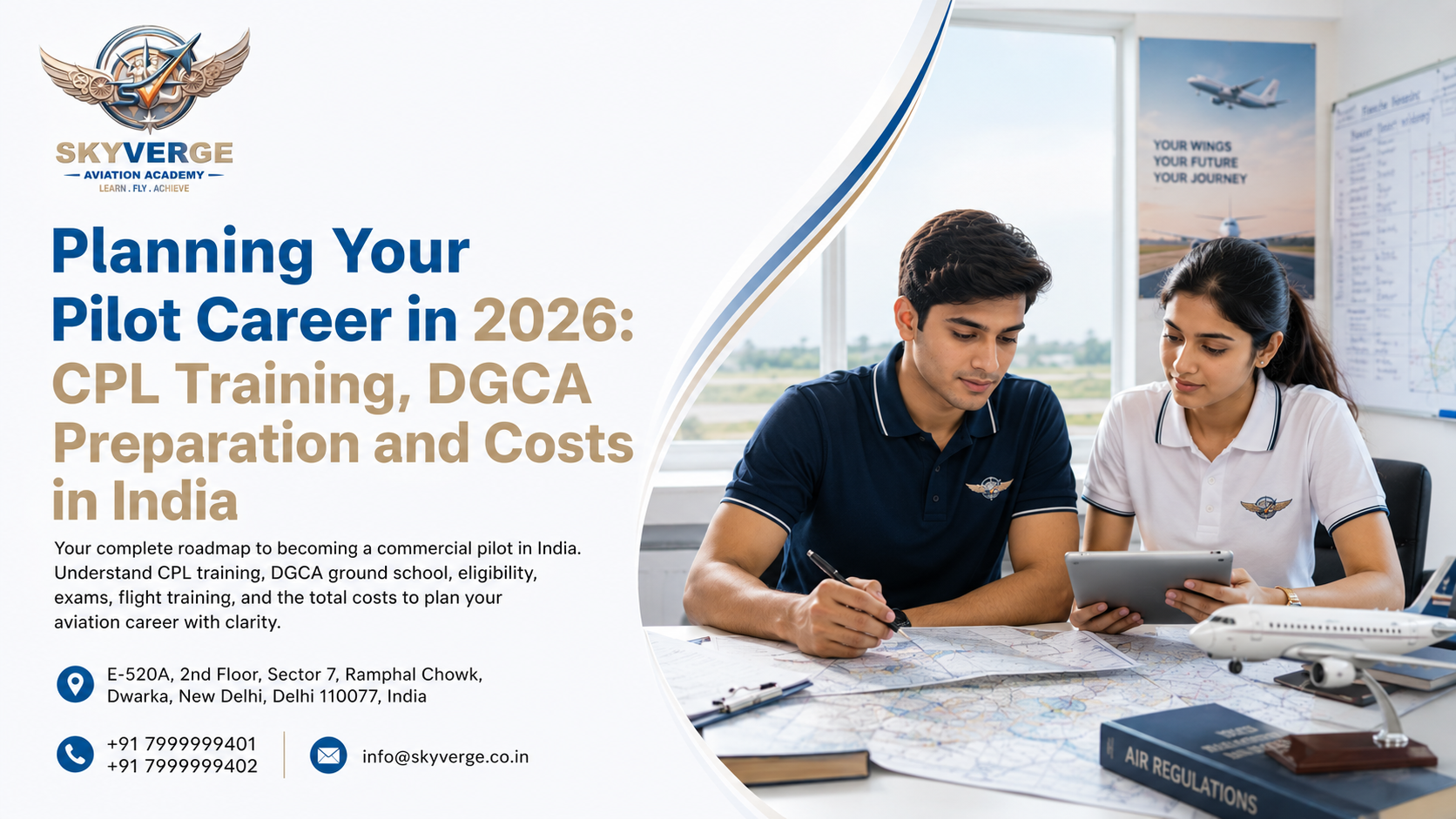
A career as a commercial pilot attracts students who enjoy aviation, technology, responsibility and the idea of working in a highly professional environment. But turning that ambition into a career requires careful planning. Students must understand the eligibility criteria, prepare for DGCA examinations, complete the required flight training and plan their finances before beginning the journey.
In 2026, aspiring pilots have access to a growing aviation education ecosystem in India, but they also need to make informed choices. Regulations, examination procedures and training requirements can change, so students should always verify the latest information through official Directorate General of Civil Aviation (DGCA) sources.
For students in Delhi NCR, SkyVerge Aviation Academy provides aviation education and preparation from its centre in Dwarka, New Delhi. The academy helps aspiring aviation students develop the theoretical foundation and preparation habits required for their professional journey.
This guide explains the major stages of pilot training, the CPL requirements in India, DGCA preparation, expected expenses and what students should consider before choosing a training institute.
Starting Your Journey Toward a Commercial Pilot Licence
Becoming a commercial pilot is a step-by-step process. Students cannot simply enrol in a short course and immediately begin working as professional pilots.
The journey involves academic eligibility, medical fitness, theoretical knowledge, examinations, practical flight training and licensing requirements.
A student should therefore begin by understanding the complete pathway.
The main areas to consider include:
- Educational qualifications
- Medical requirements
- DGCA examination preparation
- Ground-school education
- Practical flight training
- Required flying experience
- Licensing procedures
- Additional career preparation
Planning these stages in advance can help students avoid unnecessary delays and unexpected expenses.
Understanding the CPL Requirements in India
The first question many aspiring pilots ask is whether they are academically eligible to pursue professional pilot training.
The CPL requirements in India include specific educational and regulatory conditions. Under the applicable DGCA Aircraft Rules, the educational qualification for a Commercial Pilot Licence includes passing 10+2 or an equivalent examination with Physics and Mathematics from a recognised Board or university.
The official DGCA Pariksha portal also identifies 10+2 with Physics and Mathematics, or an equivalent qualification, for applicable flight-crew candidates other than PPL applicants.
However, educational eligibility represents only one part of the process.
Students must also understand the applicable medical requirements, examination requirements, practical flying requirements and licensing conditions.
Because aviation regulations can be updated, students should check current DGCA information before making decisions about their training.
Why Students Should Understand DGCA Requirements Early
Many students begin researching flight schools before understanding the examination and licensing process.
This can make the journey confusing later.
A better approach involves understanding the regulatory pathway before making major financial decisions.
Students should know:
- Which examinations apply to their intended licence
- What educational qualifications they need
- What medical assessment they require
- Which documents they need
- How DGCA examination registration works
- What practical training they must complete
- Which licensing conditions apply
The DGCA Pariksha portal provides information and services related to flight-crew examinations, including examination notices, schedules and candidate procedures.
Keeping track of official updates becomes particularly important because examination procedures and regulatory requirements can change over time.
The Role of Ground Training in Pilot Education
Flying an aircraft requires practical skills, but pilots also need a strong theoretical understanding of aviation.
Before students can make professional decisions in an aircraft, they need to understand the principles behind those decisions.
Ground training introduces students to important areas such as:
Air Regulations
Students learn about aviation rules, responsibilities, operating procedures and the regulatory environment in which pilots work.
Air Navigation
Navigation develops the knowledge required to understand charts, routes, calculations, aircraft position and flight planning.
Aviation Meteorology
Weather has a direct influence on flight safety. Students learn how atmospheric conditions affect aviation operations.
Aircraft and Engines
Students develop knowledge of aircraft systems, engines, instruments and the technical principles behind aircraft operation.
Human Performance
Pilots must understand how human factors can influence performance, decision-making and safety.
Operational Knowledge
Students learn concepts associated with planning and conducting flights safely and efficiently.
The exact subjects and examination requirements should always be checked against the latest DGCA syllabus and applicable regulations.
Why DGCA Ground Classes for CPL Can Help
Self-study has an important role in pilot education, but many students benefit from structured classroom preparation.
Well-organised DGCA ground classes for CPL can help students follow a consistent study plan rather than preparing randomly.
A structured classroom environment can provide:
- Concept-based explanations
- Regular revision
- Practice questions
- Mock examinations
- Doubt-solving sessions
- Study schedules
- Examination-focused preparation
- Guidance on difficult topics
The purpose of ground classes should not simply be to help students memorise answers.
Students should understand the concepts behind the questions because aviation knowledge remains important after examinations.
How to Make Your DGCA Preparation More Effective
Students can improve their preparation by following a consistent routine.
Study Every Day
Regular study is generally more effective than attempting to cover an entire subject immediately before an examination.
Understand Before Memorising
Technical aviation subjects become easier when students understand the principles first.
Maintain Revision Notes
Short notes can help students revise formulas, definitions, regulations and important concepts.
Practise Questions
Question practice helps students recognise the types of concepts they need to apply during examinations.
Take Mock Tests
Mock tests help students improve time management and identify subjects that need additional preparation.
Follow Official Updates
Students should check official DGCA notifications and examination information instead of relying exclusively on old preparation material.
Choosing the Right Aviation Academy
Students searching for the Best pilot training institute in India will find many options online.
However, choosing the right academy should involve more than reading promotional claims.
A student should evaluate an institution based on practical factors.
Faculty
Look at the qualifications, aviation knowledge and teaching experience of the faculty.
Course Structure
A clear programme should explain how the subjects are organised and how students progress through their preparation.
Learning Resources
Ask whether the academy provides structured study material, practice questions and mock tests.
Student Support
Students may need assistance understanding examination procedures, documentation and their next training steps.
Transparency
The academy should clearly explain what its programme includes and what students need to arrange separately.
Location
A convenient location can make regular attendance easier, particularly for students who live in Delhi NCR.
SkyVerge Aviation Academy in Dwarka
SkyVerge Aviation Academy provides aviation education and preparation for aspiring pilots from its centre in Dwarka, New Delhi.
The academy focuses on helping students develop their aviation knowledge and prepare systematically for the academic side of their pilot-training journey.
For a student beginning this career path, the objective should not simply be to pass examinations. Strong preparation should build confidence in subjects that students will continue to encounter during practical flight training and their professional careers.
SkyVerge Aviation Academy provides students with an environment where they can focus on structured aviation education while working toward their long-term career goals.
Planning the Pilot Course Cost in India
Financial planning is another major part of becoming a pilot.
The pilot course cost in India does not remain identical for every student because several factors influence the total expenditure.
Students may need to budget for:
- Ground-school training
- Flight training
- Aircraft-related charges
- Instructor fees
- Simulator training
- Examination fees
- Medical assessments
- Licensing expenses
- Accommodation
- Food
- Local transportation
- Study material
- Additional training, if required
The final cost depends heavily on the student's selected training organisation and the structure of the programme.
Students should therefore request a detailed estimate before committing to a training pathway.
Understanding Commercial Pilot Course Fees
When students compare commercial pilot course fees, they should avoid comparing only the advertised headline price.
Different training organisations may include different components in their packages.
For example, one programme may quote academic training separately from flight training. Another may provide a combined package. Some expenses may also remain outside the advertised amount.
Before enrolling, students should ask:
- What does the quoted fee include?
- Are flying hours included?
- Are instructor charges included?
- Are simulator sessions included?
- What examination expenses should I pay separately?
- Are accommodation expenses included?
- What happens if additional flying hours become necessary?
- What payment schedule does the institution follow?
- Are there any additional administrative charges?
A written fee structure can help students and parents plan their finances more accurately.
Why Financial Planning Should Begin Before Training
Pilot training requires a significant financial commitment, so students should prepare a realistic budget.
Instead of considering only tuition or flying charges, create a complete estimate that covers the entire training period.
For example:
Training expenses + examination expenses + medical expenses + accommodation + daily living + travel + possible additional training
This approach gives families a more realistic picture of the overall investment.
Students should also keep an emergency financial buffer because training duration and expenses can vary depending on individual progress and circumstances.
Practical Flight Training: Turning Knowledge into Skill
Ground preparation provides theoretical knowledge, while flight training allows students to apply that knowledge in practical situations.
During practical training, students progressively develop skills under qualified instruction.
The training environment teaches students how to:
- Handle an aircraft
- Follow standard procedures
- Communicate effectively
- Monitor instruments
- Navigate
- Respond to changing conditions
- Make appropriate operational decisions
- Maintain situational awareness
Students should approach every flight as a learning opportunity rather than simply counting flying hours.
The objective is to develop safe and consistent flying skills.
What Happens After Completing CPL Training?
Obtaining a Commercial Pilot Licence represents an important achievement, but students should understand that it is not necessarily the final stage of an airline career.
Depending on their career objectives, graduates may need additional qualifications, ratings, experience and airline-specific preparation.
Potential career pathways can include:
- Airline operations
- Charter aviation
- General aviation
- Flight instruction
- Corporate aviation
- Other commercial flying opportunities
Each employer may have its own requirements, so students should research their preferred career path well before completing their training.
Skills That Future Pilots Should Develop
Technical knowledge is only one part of becoming a professional pilot.
Students should also develop:
Communication
Pilots communicate with instructors, air traffic controllers, crew members and other aviation professionals.
Decision-Making
Aviation requires pilots to evaluate information and make appropriate decisions.
Discipline
Pilots must follow procedures consistently.
Time Management
Training and aviation operations require punctuality and preparation.
Situational Awareness
Pilots need to understand what is happening around the aircraft and anticipate how conditions may develop.
Continuous Learning
Aviation is a continuously evolving industry. Professional pilots must continue learning throughout their careers.
Common Mistakes to Avoid During Pilot Preparation
Selecting a Course Only Because It Is Cheap
The cheapest option does not automatically provide the best overall value.
Ignoring Medical Eligibility
Students should understand applicable medical requirements early.
Using Outdated DGCA Information
Always verify regulatory and examination information through current official sources.
Depending Entirely on Memorisation
Understanding aviation concepts provides stronger preparation than memorising answers alone.
Failing to Plan the Complete Budget
Students should consider all expenses rather than focusing only on tuition or flying charges.
Assuming CPL Automatically Means an Airline Job
A licence provides a foundation, but airline recruitment can involve additional qualifications and selection requirements.
5 Questions Aspiring Pilots Should Ask
1. What educational qualification do I need for CPL training?
For the applicable CPL pathway, DGCA rules require 10+2 or an equivalent qualification with Physics and Mathematics. Students should verify the latest applicable requirements before beginning training.
2. Are DGCA ground classes useful for CPL preparation?
Yes. Structured ground education can help students understand aviation subjects, practise examination questions and maintain a consistent preparation routine.
3. How much is the pilot course cost in India?
The total cost varies depending on the flight-training organisation, flying programme, location, accommodation and additional expenses. Students should request a detailed cost estimate.
4. How should I compare commercial pilot training programmes?
Compare course structure, faculty, training resources, student support, transparency, location and the complete cost rather than focusing on one advertised price.
5. What should I check before selecting a pilot-training academy?
Check the academy's educational approach, faculty, course structure, learning resources, student support and transparency. Also verify that the training pathway you select meets the applicable DGCA requirements.
Begin with Preparation, Not Assumptions
Aviation rewards preparation.
Students who understand the regulatory pathway, study consistently and plan their finances carefully can approach pilot training with greater confidence.
From researching Commercial Pilot Training in India to understanding CPL requirements in India, preparing through DGCA ground classes for CPL, comparing commercial pilot course fees and estimating the overall pilot course cost in India, every decision can influence the quality and efficiency of the training journey.
Students looking for a structured aviation education environment in Delhi can explore SkyVerge Aviation Academy in Dwarka, New Delhi.
The goal is not simply to start flying. It is to build the knowledge, discipline and professional attitude required for a long-term aviation career.
SkyVerge Aviation Academy
Address:
E-520A, 2nd Floor, Sector 7, Ramphal Chowk,
Dwarka, New Delhi, Delhi 110077, India
Phone: +91 7999999401
Phone: +91 7999999402
Email: info@skyverge.co.in
SkyVerge Aviation Academy — Prepare with Purpose. Build Your Future in Aviation.

 English
 Arabic
 Spanish
 Portuguese
 Deutsch
 Turkish
 Dutch
Dutch
 Italiano
 Russian
 Romaian
 Portuguese (Brazil)
 Greek
Greek
