


How to Build an RWA Tokenization Platform: A Step-by-Step Guide
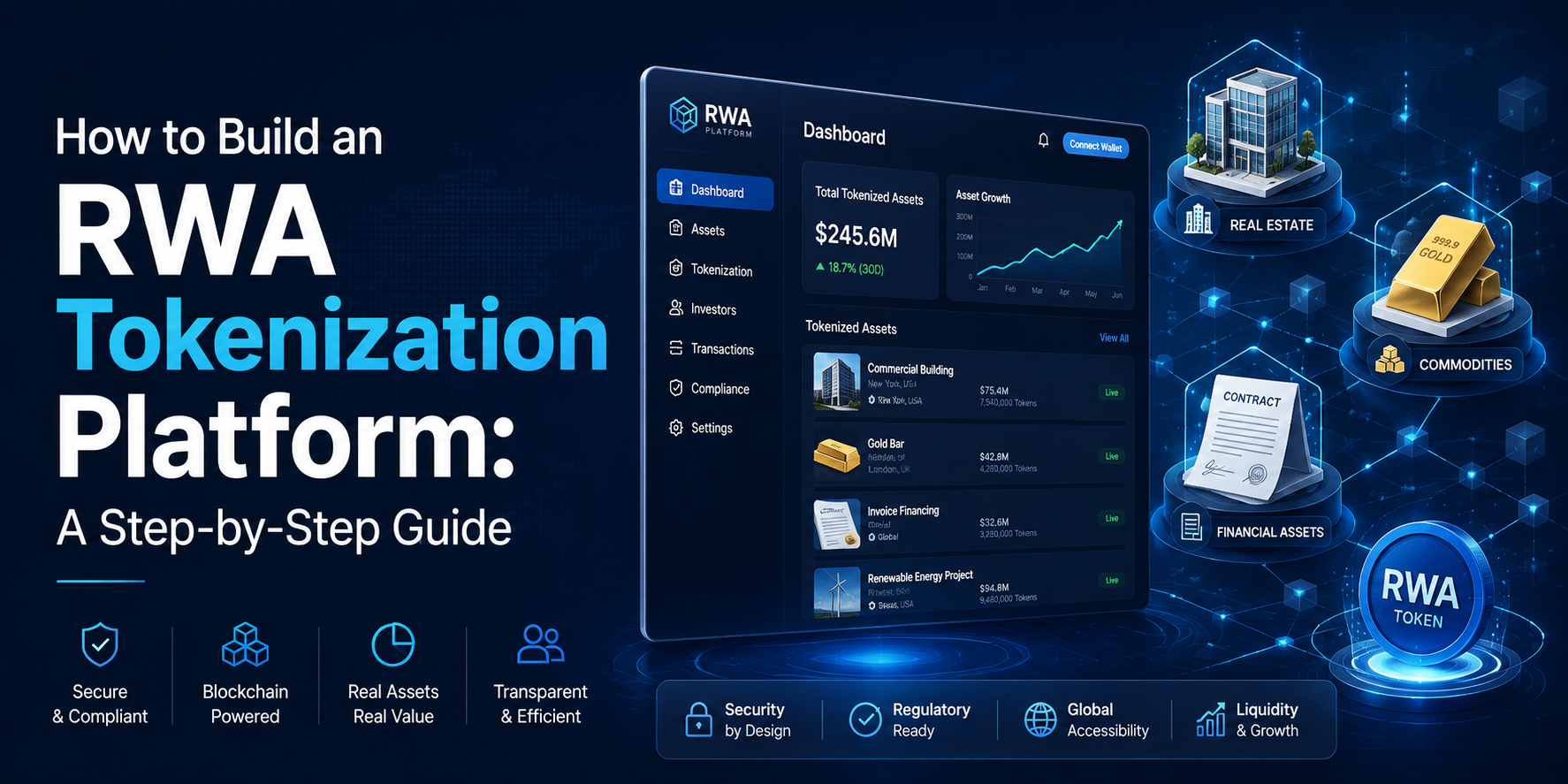
Real-world asset (RWA) tokenization is becoming an important application of blockchain technology because it connects traditionally illiquid or difficult-to-transfer assets with programmable digital infrastructure. Real estate, government bonds, private credit, commodities, funds, art, and other assets can be represented digitally through blockchain-based tokens, creating new possibilities for ownership, settlement, distribution, and secondary-market trading.
The concept is moving beyond experimentation. For example, BlackRock's BUIDL tokenized fund, launched with Securitize in 2024, surpassed $1 billion in assets under management in March 2025. The Bank for International Settlements (BIS) has also described tokenization as a process that can combine information about assets with programmable rules and transfer logic, potentially changing how financial transactions are organized.
For entrepreneurs and financial businesses, this creates an opportunity to build platforms that do more than simply issue blockchain tokens. A successful RWA tokenization platform needs to connect legal ownership, asset verification, compliance, smart contracts, investor onboarding, custody, payments, and potentially secondary trading into one coherent ecosystem.
What Is an RWA Tokenization Platform?
An RWA tokenization platform is a blockchain-based infrastructure system that enables businesses to convert rights or interests associated with physical or financial assets into digital tokens.
The important distinction is that tokenization does not magically place the physical asset itself on a blockchain. Instead, the blockchain records a digital representation of a legally defined claim, ownership interest, entitlement, or economic right connected to the underlying asset.
For example, suppose a company owns a commercial property worth $10 million. Instead of requiring one investor to purchase the entire property, the company could establish a legally appropriate ownership structure and issue 1 million digital tokens representing defined interests in that structure. Investors could potentially purchase smaller portions, subject to applicable securities, property, tax, KYC and other regulations.
This model can provide fractional ownership, automated administration, transparent transaction records and programmable transfer restrictions. However, the technology is only one part of the solution. BIS research emphasizes that tokenization can improve efficiency and create new use cases, but sound governance and risk management remain essential.
Step 1: Define the Asset and Business Model
The first stage in building an RWA tokenization platform is deciding what will be tokenized and why.
Different assets require completely different legal, financial and technical structures. A platform designed for tokenized real estate may require property valuation, title documentation, property-management integrations and rental-income distribution. A tokenized Treasury platform may instead require fund administration, securities compliance, custody and institutional settlement infrastructure.
Common RWA categories include:
- Real estate and rental properties
- Government bonds and Treasury products
- Private equity and venture capital funds
- Private credit and loans
- Commodities
- Art and collectibles
- Infrastructure assets
- Carbon credits
- Intellectual property and royalties
The business model should also be established early. The platform could generate revenue through issuance fees, transaction fees, asset-servicing fees, marketplace fees, custody-related services or subscription plans.
The key question should not simply be, "Can this asset be tokenized?" Instead, it should be, "Does tokenization solve a meaningful problem for this asset class?"
That distinction is important because tokenization introduces additional infrastructure and compliance requirements. If an asset already has efficient digital ownership, deep liquidity and low transaction friction, blockchain may add limited value.
Step 2: Design the Legal and Regulatory Framework
Regulatory architecture should be established before writing the core smart contracts.
Depending on the jurisdiction and asset type, a token may represent a security, fund interest, debt instrument, property-related interest, commodity interest or another regulated claim. The platform therefore needs a legal structure that clearly establishes what investors actually own and what rights the token provides.
For example, a real estate platform might create a special-purpose vehicle (SPV) that owns a property. Investors then acquire legally defined interests in that SPV, while blockchain tokens represent those interests under the platform's legal framework.
The platform should address:
- Investor eligibility
- KYC and AML procedures
- Securities regulations
- Transfer restrictions
- Ownership rights
- Tax considerations
- Custody arrangements
- Data protection
- Jurisdictional restrictions
- Dispute resolution
- Redemption and exit mechanisms
This is one of the most important differences between ordinary cryptocurrency token development and RWA tokenization. The token needs to correspond to an enforceable real-world claim.
The BIS has noted that tokenization can alter financial-market structures and potentially reduce transaction costs, but its benefits depend on appropriate governance, risk management and regulatory arrangements.
Step 3: Conduct Asset Due Diligence and Verification
Once the legal structure is defined, the underlying asset needs to be verified.
For a property, this could involve confirming title ownership, valuation, liens, mortgages, insurance, property condition, rental agreements and other relevant documentation. For a private-credit asset, the platform may need borrower information, repayment schedules, collateral documentation and credit assessments.
This creates an important off-chain-to-on-chain trust problem.
Blockchain can provide strong guarantees about what happens to information once it is recorded on-chain, but it cannot independently determine whether an off-chain property valuation or legal document is accurate.
Therefore, the platform may require trusted third parties such as:
- Auditors
- Property valuers
- Legal firms
- Custodians
- Fund administrators
- Oracles
- Asset managers
- Compliance providers
This layer is fundamental because the value of a tokenized asset ultimately depends on the credibility of the underlying asset and the legal rights associated with it.
Step 4: Choose the Blockchain Infrastructure
The next step is selecting an appropriate blockchain network.
There is no universally correct blockchain for every RWA platform. Developers need to evaluate transaction costs, scalability, security, ecosystem maturity, smart-contract capabilities, interoperability and regulatory requirements.
A platform may use Ethereum, Polygon, Avalanche, Arbitrum, Optimism, Solana or another suitable network depending on its requirements. Some institutional platforms also support multiple networks.
BlackRock's BUIDL provides a useful example. After initially launching on Ethereum, its tokenized fund expanded to additional networks, including Solana. By March 2025, BUIDL was available across seven blockchains.
For a new platform, however, launching on multiple chains immediately may create unnecessary complexity. A better approach can be to begin with one suitable network and design the architecture for future interoperability.
Step 5: Develop the Token Architecture
The token itself needs to be designed around the legal and financial characteristics of the asset.
Unlike a typical utility token, an RWA token may require sophisticated controls governing who can hold, transfer, redeem or receive the token.
Important functions can include:
- Whitelisting approved investors
- KYC/AML verification
- Transfer restrictions
- Token minting and burning
- Ownership tracking
- Dividend or income distribution
- Redemption mechanisms
- Role-based administration
- Emergency pause functionality
- Compliance reporting
For example, if an asset is available only to verified investors in certain jurisdictions, the smart contract should prevent unauthorized wallets from receiving or transferring the tokens.
This is where smart-contract development becomes particularly important. The code must accurately implement the legal and economic rules established during the earlier stages.
Step 6: Build Investor Onboarding and Compliance
An RWA platform cannot treat investor onboarding like a conventional cryptocurrency wallet.
A regulated tokenization platform may require users to create accounts, submit identity information, complete KYC checks, undergo AML screening and satisfy investor eligibility requirements before purchasing tokens.
The onboarding system can be integrated with third-party compliance providers while maintaining the necessary connection between verified identities and blockchain addresses.
A typical workflow might look like:
Registration → Identity Verification → KYC/AML Screening → Investor Approval → Wallet Verification → Token Purchase → Token Allocation
The system should also support ongoing compliance rather than treating KYC as a one-time event.
This becomes particularly important when tokens are designed to trade on secondary markets. Transfer rules need to remain enforceable even after the initial issuance.
Step 7: Integrate Oracles and Off-Chain Data
RWA platforms frequently depend on information that exists outside the blockchain.
Examples include:
- Asset valuations
- Interest rates
- Property rental income
- NAV calculations
- Commodity prices
- Corporate actions
- Loan repayments
- Ownership records
Oracles can connect verified external information with blockchain-based smart contracts.
For instance, a tokenized property-income platform could use an off-chain accounting system to calculate rental distributions and then trigger blockchain-based payments according to predefined rules.
However, oracle design deserves careful attention because incorrect external data can produce incorrect on-chain outcomes. Multiple data sources, validation mechanisms and administrative controls may therefore be necessary depending on the asset.
Step 8: Build the Marketplace and Secondary Trading Layer
Issuing tokens is only one part of the platform. Investors also need a practical mechanism for purchasing, holding, transferring or potentially selling them.
The platform can include a marketplace where eligible investors can view available assets, review documentation, evaluate pricing and submit orders.
A strong marketplace should provide transparent information such as:
- Asset valuation
- Token price
- Available supply
- Historical performance
- Distribution information
- Risk disclosures
- Ownership structure
- Transaction history
- Investor eligibility requirements
Secondary trading can potentially improve liquidity, but liquidity should never be assumed simply because an asset has been tokenized.
A 2025 BIS study of tokenized real estate found that trading activity increased during certain liquidity shocks, but the effect depended on platform features such as buyback mechanisms, which can themselves introduce solvency risks.
This illustrates an important principle: tokenization can improve market infrastructure, but it does not automatically create a liquid market.
Step 9: Integrate Payments, Custody and Asset Servicing
The next layer involves the financial infrastructure surrounding the token.
Users need reliable methods to fund purchases and receive proceeds. Depending on the jurisdiction and business model, the platform could integrate bank transfers, regulated payment providers, stablecoins or other approved settlement mechanisms.
Custody is equally important. Investors need secure methods of storing and managing their tokenized assets.
The platform may support:
- Self-custody
- Institutional custody
- Multi-signature wallets
- Hardware security
- MPC-based custody
- Role-based wallet administration
Asset servicing should also be considered. Tokenized assets may generate dividends, rent, interest or other cash flows. The platform needs mechanisms for calculating and distributing these proceeds accurately.
BUIDL is an example of how tokenization can connect asset ownership with ongoing financial services. Securitize reported that the fund provides daily accrued dividends and supports transfers among approved investors.
Step 10: Audit, Test and Launch the Platform
Security testing should happen throughout development rather than only immediately before launch.
Smart contracts should undergo extensive testing and independent auditing to identify vulnerabilities such as unauthorized minting, access-control failures, reentrancy issues, incorrect transfer restrictions and logic errors.
The broader platform should also be tested for:
- API vulnerabilities
- Authentication weaknesses
- Database security
- Wallet security
- Oracle manipulation
- Compliance bypasses
- Front-end attacks
- Data leakage
- Denial-of-service scenarios
After testing, a controlled launch is generally preferable to immediately opening the platform to a large user base. A phased rollout allows the team to monitor transaction flows, compliance processes, smart-contract behavior and user experience before expanding.
Key Features of a Modern RWA Tokenization Platform
A comprehensive platform may combine the following components:
| Component | Purpose |
|---|---|
| Asset onboarding | Adds and verifies real-world assets |
| Token issuance | Creates blockchain-based representations |
| Smart contracts | Automates ownership and transfer rules |
| KYC/AML | Verifies eligible investors |
| Investor dashboard | Displays holdings and asset information |
| Marketplace | Enables eligible asset transactions |
| Oracle infrastructure | Connects verified off-chain data |
| Payment integration | Handles investment and distributions |
| Custody | Protects digital assets |
| Compliance engine | Enforces regulatory requirements |
| Analytics | Tracks transactions and asset performance |
| Administration | Manages platform roles and permissions |
Real-World Example: BlackRock BUIDL
BlackRock's BUIDL demonstrates how institutional asset tokenization can move beyond a proof of concept.
Launched in March 2024 with Securitize, BUIDL is a tokenized fund that provides qualified investors with on-chain access to a fund investing in cash, U.S. Treasury bills and repurchase agreements. Securitize announced that the fund surpassed $1 billion in assets under management in March 2025.
The significance of BUIDL is not simply its size. Its development illustrates how an RWA platform can connect regulated investment products with blockchain infrastructure, flexible custody, on-chain transfers and broader financial-market applications.
The World Economic Forum's 2025 work on asset tokenization similarly identifies programmable ledgers, shared systems of record, fractionalization, flexible custody and composability as important differentiators of tokenized financial markets.
Challenges to Consider Before Building
The biggest challenge in RWA tokenization is not blockchain development itself. It is coordinating technology with law, finance, compliance and real-world asset administration.
Regulatory uncertainty can make the same token structure appropriate in one jurisdiction but unsuitable in another. Liquidity can also be difficult because tokenized assets still depend on sufficient buyers and sellers. Custody, oracle reliability, asset valuation and cybersecurity create additional operational risks.
BIS research cautions that tokenization's potential benefits—including efficiency, lower costs, transparency and broader access—are accompanied by trade-offs such as operational complexity, liquidity pressures and regulatory uncertainty.
Therefore, businesses should approach RWA tokenization as an end-to-end financial infrastructure project, rather than simply creating an ERC-20 token and connecting it to a website.
How Much Does It Cost to Build an RWA Tokenization Platform?
The development cost depends heavily on the platform's scope. A basic asset issuance system with investor onboarding may require substantially less investment than a multi-chain platform incorporating marketplaces, institutional custody, compliance automation, complex smart contracts and secondary trading.
Major cost factors include:
- Legal and regulatory structuring
- Smart-contract development
- Blockchain infrastructure
- Front-end and backend development
- KYC/AML integrations
- Oracle infrastructure
- Wallet and custody integrations
- Marketplace development
- Security audits
- Payment integrations
- Ongoing maintenance
Consequently, businesses should define the asset class, target jurisdiction, investor type and required features before estimating development costs.
Conclusion
Building an RWA tokenization platform requires much more than putting physical assets on a blockchain; it requires a carefully coordinated ecosystem covering legal ownership, asset verification, compliance, smart contracts, investor onboarding, custody, payments, data infrastructure and potentially secondary trading. As institutional initiatives such as BlackRock's BUIDL demonstrate, tokenization is increasingly being applied to real financial products, while research from the BIS and World Economic Forum highlights its potential to improve efficiency, transparency, programmability and market accessibility when supported by appropriate governance. Businesses planning to enter this market should therefore prioritize regulatory clarity, secure architecture and a strong connection between on-chain tokens and enforceable real-world rights. For organizations looking to turn this concept into a scalable product, Blockchain App Factory provides best RWA tokenization development services, helping businesses build secure and scalable tokenization ecosystems tailored to their asset and business requirements.

 English
 Arabic
 French
 Spanish
 Portuguese
 Deutsch
 Dutch
Dutch
 Italiano
 Russian
 Romaian
 Portuguese (Brazil)
 Greek
Greek
