


Reading a Log Periodic Datasheet: Making Sense of VSWR, Gain and Bandwidth
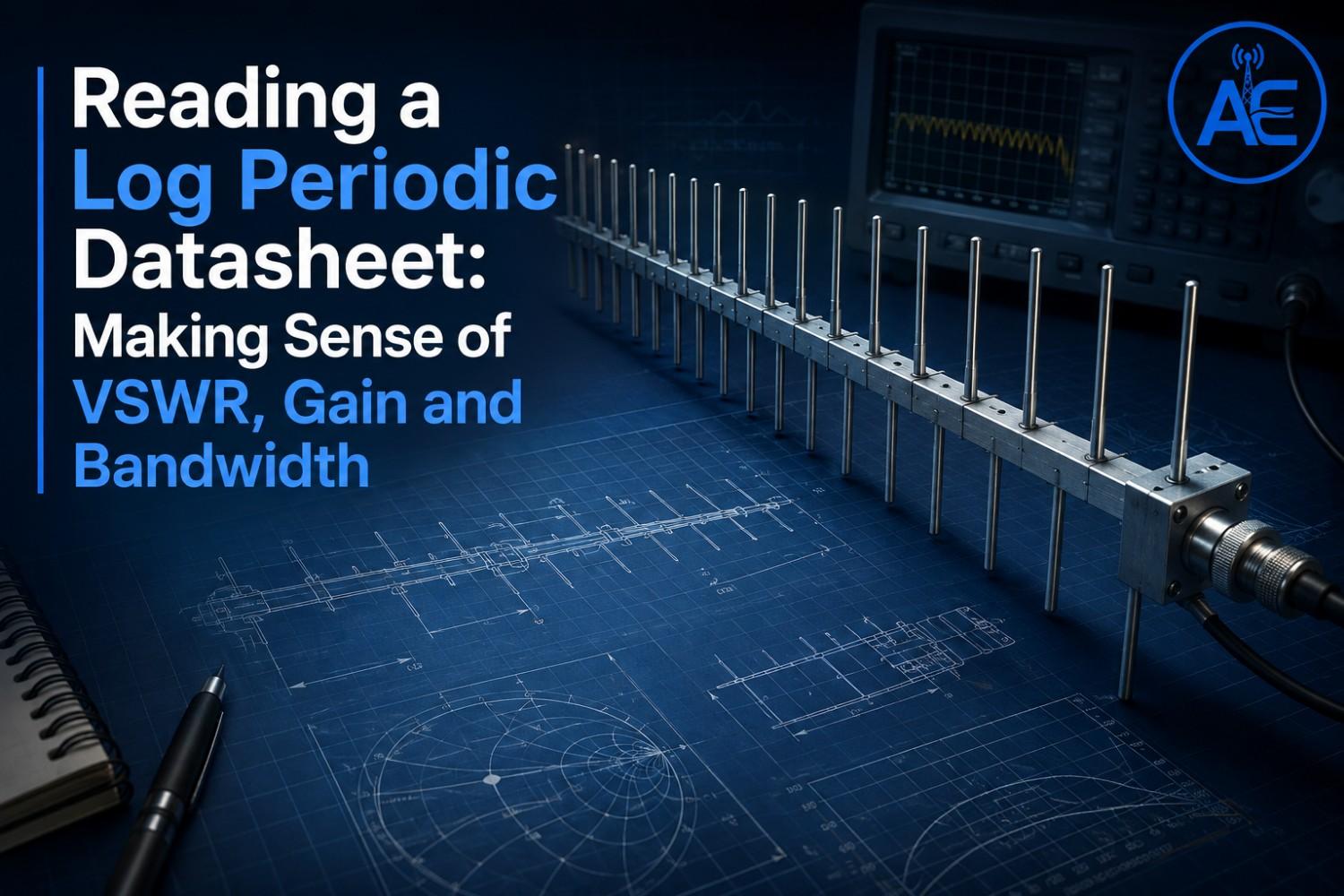
Selecting a wideband antenna is not simply about choosing the widest frequency range or highest gain. A datasheet contains several specifications, and each affects real RF performance.
An antenna may cover the required range but have different gain and VSWR values. This guide explains how to read a Military Log Periodic Dipole Antenna datasheet and understand VSWR, return loss, gain, bandwidth, radiation patterns, polarization, and power handling.
What LPDA Datasheet Specifications Mean for RF System Performance
An LPDA datasheet usually provides frequency range, gain, VSWR, polarization, impedance, power handling, connector type, radiation pattern, dimensions, and weight.
These specifications should be reviewed together. Frequency range shows where it operates, gain indicates RF concentration, VSWR shows system matching, and radiation patterns show where energy is transmitted or received.
Physical specifications also matter because size, weight, connectors, and mounting must fit the installation.
Understanding Antenna VSWR vs. Return Loss: What Is Acceptable?
VSWR, or Voltage Standing Wave Ratio, indicates how well the antenna is matched to the transmission line or RF system. A good match allows more RF power toward the antenna, while a poor match causes some power to reflect.
Return loss is another measure of reflected power. In general, lower VSWR indicates better impedance matching.
There is no single VSWR value that is correct for every application. The acceptable level depends on system requirements, operating frequency, transmitter characteristics, and intended use.
When reviewing antenna VSWR gain bandwidth, check whether the VSWR is:
-
A maximum value across the complete frequency range
-
A typical measured value
-
A value measured only at selected frequencies
Review the VSWR-versus-frequency graph when available.
Comparing Peak Gain vs. Gain Across the Operating Band
Gain is often one of the first specifications engineers compare, but peak gain may not represent performance across the complete frequency range.
A datasheet may provide peak, typical, or minimum gain. For a wideband antenna, gain can change with frequency.
When comparing a Military Log Periodic Dipole Antenna, check for a gain-versus-frequency graph and look for minimum or guaranteed gain where available. This can be more useful than the highest advertised value.
Select gain according to the actual system requirement.
How Log Periodic Bandwidth Ratios and Element Designs Work
Bandwidth describes the frequency range over which an antenna operates within its specified performance limits. The datasheet normally provides lower and upper frequency limits.
A log periodic antenna achieves wideband operation through multiple elements with different lengths and spacing.
Gain, VSWR, and radiation patterns can change across the band, so confirm performance at important operating frequencies.
How to Read LPDA Radiation Patterns and Beamwidth Specifications
A radiation pattern shows how an antenna transmits or receives RF energy in different directions.
For a directional log periodic antenna, the main beam shows strongest performance. Beamwidth describes its width, side lobes show smaller areas outside it, and front-to-back ratio compares front and rear performance.
Check radiation patterns at multiple frequencies, especially for spectrum monitoring, signal intelligence, and electronic warfare applications.
Evaluating RF Power Handling Ratings and Connector Limitations
Power handling indicates how much RF power an antenna can handle under specified conditions. Frequency, duty cycle, connector type, and cable limitations can affect the actual limit.
Before selection, define expected transmit power and operating conditions and confirm that the complete RF path is suitable.
Dual-Polarized LPDA vs. Discone Antennas: Which Is Right for Your System?
A Dual Polarized Log Periodic Antenna may be useful when an RF system needs to work with or receive signals in more than one polarization. It provides flexibility where polarization is not fixed or multiple polarization requirements must be addressed.
A standard LPDA is generally suitable when directional coverage and gain are important.
A Military Broadband Discone Antenna serves a different purpose and is generally used where wideband omnidirectional coverage is required.
At a high level:
-
LPDA: Wideband directional coverage
-
Dual-polarized LPDA: Directional coverage with multiple polarization capabilities
-
Discone antenna: Wideband omnidirectional coverage
The choice depends on directionality, polarization, coverage, and system requirements.
Step-by-Step Checklist for Comparing Two Log Periodic Antenna Datasheets
Do not compare two log periodic antennas only by highest gain or widest frequency range. Compare the same parameters under similar conditions:
-
Required frequency range
-
Gain across the operating band
-
Maximum and typical VSWR
-
Radiation patterns at relevant frequencies
-
Polarization
-
Power handling
-
Connector and mounting interfaces
-
Size and weight
-
Environmental requirements
-
Typical versus guaranteed specifications
Compare like-for-like data rather than one headline number.
Military Log Periodic Antenna Solutions from Antenna Experts
Antenna Experts supports customers looking for wideband and defence antenna solutions, including Military Log Periodic Dipole Antenna requirements.
Selection can begin with operating frequency, gain, polarization, installation conditions, and other technical requirements. Antenna Experts can also support specification review, custom frequency requirements, mounting considerations, and testing requirements.
Conclusion
A log periodic antenna datasheet should be read as a complete set of performance requirements, not as a list of individual numbers. Maximum gain alone does not define antenna performance, and VSWR should be reviewed across the frequencies that matter to the system.
The right Military Log Periodic Dipole Antenna depends on frequency range, coverage, polarization, RF performance, and installation conditions. Contact Antenna Experts to discuss selection or custom requirements.
Frequently Asked Questions
What VSWR is acceptable for a log periodic antenna?
Acceptable VSWR depends on the RF system and application. Consider frequency range, transmitter characteristics, matching requirements, and whether the value applies across the complete band.
Does gain stay constant across the band?
No. Gain can vary across the operating frequency range. Review gain-versus-frequency graphs instead of relying only on peak gain.
How do I compare two antenna datasheets?
Compare frequency range, gain, VSWR, radiation patterns, polarization, power handling, connectors, dimensions, weight, and environmental requirements. Check whether specifications are typical or guaranteed.
When is a discone better than an LPDA?
A discone may suit wideband omnidirectional coverage, while an LPDA generally suits directional coverage and gain. The choice depends on system requirements.
What should I check first in an LPDA datasheet?
Start with the required frequency range. Then review gain and VSWR across that range. After that, check polarization, radiation patterns, power handling, connector type, mounting requirements, and physical dimensions.

 English
 Arabic
 French
 Spanish
 Portuguese
 Deutsch
 Turkish
 Dutch
Dutch
 Italiano
 Russian
 Portuguese (Brazil)
 Greek
Greek
