


Gut Health Case Khapli Flour Multigrain Atta India
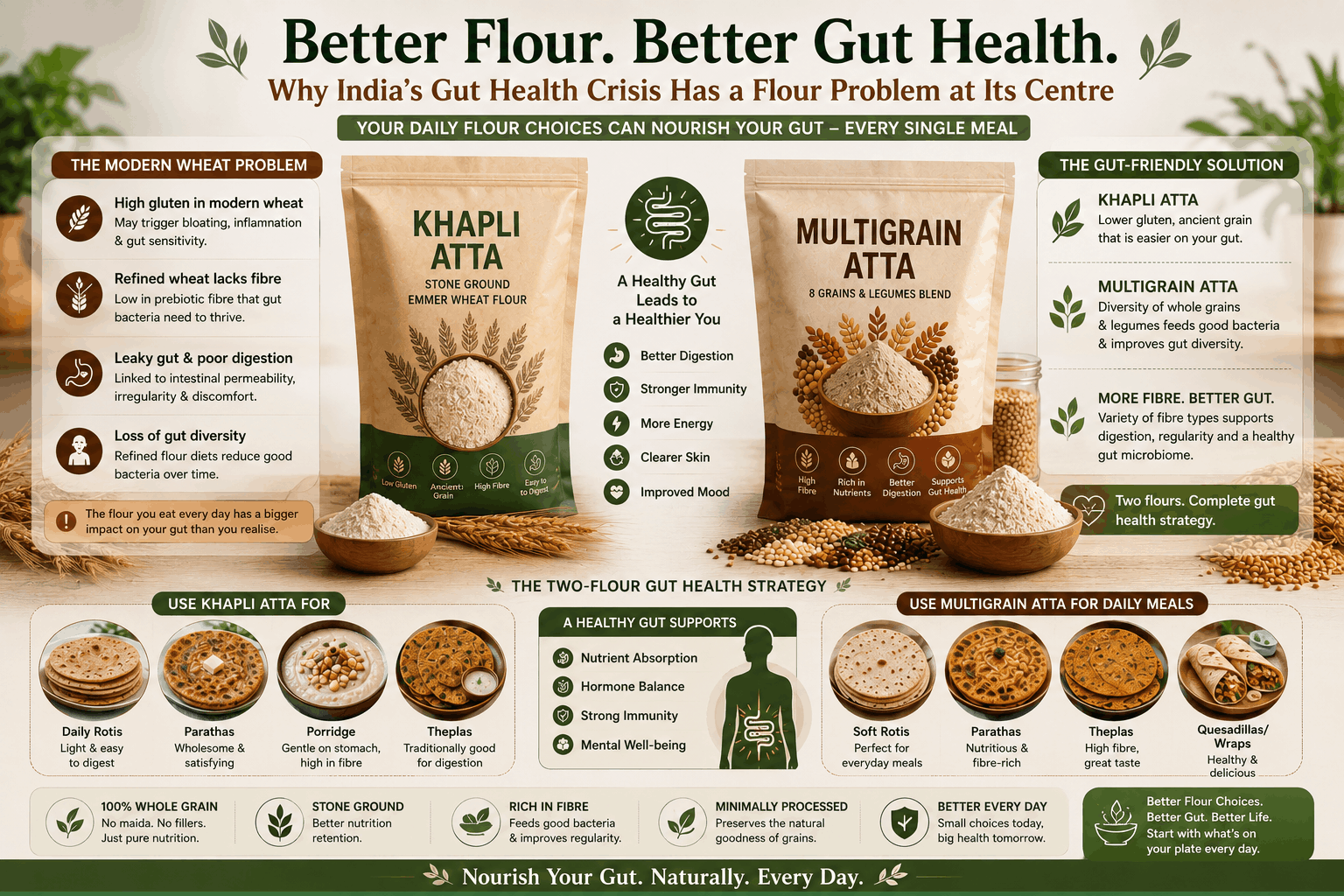
Why India's Gut Health Crisis Has a Flour Problem at Its Centre
Digestive complaints have become so common in urban India that they've achieved a kind of normalcy — bloating after meals, irregular bowel habits, persistent heaviness, and the general digestive discomfort that many adults manage as a background condition rather than a problem worth addressing. These symptoms are discussed casually, managed with antacids and occasional dietary adjustments, and rarely connected to the single most consistent dietary input in the daily routine.
The flour.
The shift in Indian kitchens from traditional whole grain cooking to refined commercial wheat flour — a shift that accelerated through the 1980s and 1990s as commercial milling scaled and packaged atta became the urban default — has had consequences for gut health that are only now being understood with the clarity that nutrition science has developed around the gut microbiome over the last decade. The grain choices made daily, at every meal, are among the most significant determinants of gut health outcomes. And most urban Indian households are making those choices with refined wheat flour that is among the least gut-supportive options currently available in Indian grocery markets.
What Modern Wheat Has Done to Indian Digestive Systems
Modern commercial wheat is a product of decades of selective breeding that prioritised yield and gluten content over nutritional density and digestive compatibility. The high-gluten structure of modern wheat varieties — significantly higher than the ancient wheat varieties that Indian and global agricultural communities ate for most of recorded history — creates digestive challenges that the older grain varieties simply didn't produce at the same prevalence.
The gliadin fraction of modern wheat gluten has been specifically implicated in increased intestinal permeability — the condition colloquially called "leaky gut" — in a growing body of research. This effect occurs not only in people with celiac disease but in a broader population of individuals with varying degrees of gluten sensitivity who don't meet the diagnostic threshold for celiac disease. The prevalence of this subclinical sensitivity is significantly underestimated because most people experiencing its symptoms — bloating, irregular digestion, inflammation — don't connect those symptoms to their daily flour consumption.
The refining process compounds the problem. Commercial wheat atta removes the bran and germ layers that contain the prebiotic fibre that gut bacteria require to maintain the microbial diversity associated with healthy digestive function. The result is a flour that simultaneously introduces a gut-disrupting protein complex and removes the fibre that would support the gut microbiome's resilience against that disruption.
How Khapli Flour Addresses the Modern Wheat Problem
Khapli flour — ground from emmer wheat, a pre-modern wheat variety with a fundamentally different grain structure from commercial wheat — addresses the modern wheat gut health problem at both dimensions.
The gluten content of emmer wheat is significantly lower than modern commercial wheat, and its gluten structure is compositionally different — containing proportionally less of the gliadin fraction specifically associated with intestinal permeability effects. For people experiencing digestive sensitivity to commercial wheat, the shift to khapli flour often produces noticeable improvement in digestive comfort within two to three weeks of consistent use — a response time consistent with the gut's capacity to recover from chronic low-level inflammatory input once that input is reduced.
The grain's intact bran — preserved in a minimally processed khapli flour — retains the fibre that commercial wheat milling removes. This fibre feeds gut bacteria directly, supporting the microbial diversity that healthy digestive function depends on. The difference between a roti made from refined commercial wheat atta and a roti made from whole grain khapli flour, from the perspective of gut microbiome nutrition, is substantial — one provides minimal prebiotic substrate while the other provides meaningful fibre that reaches the colon to feed beneficial bacteria.
The slower starch digestion of khapli flour — a consequence of the grain's ancient structure rather than any active nutritional engineering — produces a more gradual glucose release and a digestive transit pattern that the gut manages more comfortably than the rapid starch processing of refined wheat.
How Multigrain Atta Extends the Gut Health Benefit
Where khapli flour addresses the gut health problem through a better wheat choice — lower gluten, higher fibre, ancient grain structure — multigrain atta addresses it through fibre type diversity and prebiotic breadth.
A quality multigrain atta 10 kg blend incorporates multiple whole grain sources that each contribute different types of dietary fibre. The oat component provides beta-glucan — a specific soluble fibre with the strongest evidence base for supporting beneficial gut bacteria and reducing gut inflammation. The jowar and bajra components provide insoluble fibre that supports intestinal motility and reduces constipation. The chickpea component provides resistant starch — a fibre type that the gut microbiome specifically ferments to produce short-chain fatty acids associated with gut lining integrity and reduced inflammatory signalling.
No single grain provides all of these fibre types. The multigrain blend's diversity of grain sources produces a fibre profile that feeds the gut microbiome's diverse bacterial populations across multiple metabolic pathways simultaneously — a more comprehensive prebiotic effect than any single grain provides regardless of how fibre-rich that grain might be.
The Two-Flour Gut Health Strategy
The combination of khapli flour and multigrain atta addresses the gut health problem from two complementary directions — khapli reducing the modern wheat gluten load that contributes to intestinal permeability and digestive inflammation, multigrain atta providing the fibre diversity that feeds and maintains the gut microbiome's functional breadth.
Practically, these two products serve different meal occasions naturally. Khapli flour is well-suited for households where specific family members — those with more pronounced wheat sensitivity or more active gut health concerns — use it for their rotis, while the multigrain blend handles the household's daily staple roti production with its broader prebiotic fibre benefit.
The household that incorporates both isn't following a complicated dietary protocol — it's making two flour choices that address the gut health problem at its most consistent dietary input point, through the same roti format that was already in daily use.
Why Flour Quality Matters for Gut Health Outcomes
The gut health benefit of both khapli flour and multigrain atta depends on the processing integrity of each product. Khapli flour that has been over-milled loses the bran that carries both the fibre and the grain's distinctive starch structure. Multigrain atta that uses refined rather than whole grain versions of its ingredients loses the prebiotic fibre diversity that makes the blend gut-health-supportive rather than just nutritionally labelled.
10on10 foods processes both its khapli flour and its multigrain atta to the whole grain standard that preserves the gut health relevant properties — bran intact, minimal processing, grain character preserved in forms that the gut microbiome can work with rather than refined forms that provide calories without the substrate the microbiome needs.
The Gut Health Dividend of Consistent Daily Use
Gut health improvement through dietary change is a cumulative process — not a single meal's benefit but an accumulated response to consistent daily fibre input and reduced dietary gut stress. The household that makes both flour choices consistently, across weeks and months, provides the gut microbiome with the sustained nutritional environment that supports the recovery of microbial diversity that refined wheat diets have progressively reduced.
This consistency is exactly what 10on10 foods' product range supports — grain products available in forms and quantities that make year-round, daily use practical rather than dependent on specialty sourcing or seasonal availability.

 English
 French
 Spanish
 Portuguese
 Deutsch
 Turkish
 Dutch
Dutch
 Italiano
 Russian
 Romaian
 Portuguese (Brazil)
 Greek
Greek
