


Understanding IDF vs MDF Telecom Room Basics for Reliable Network Design
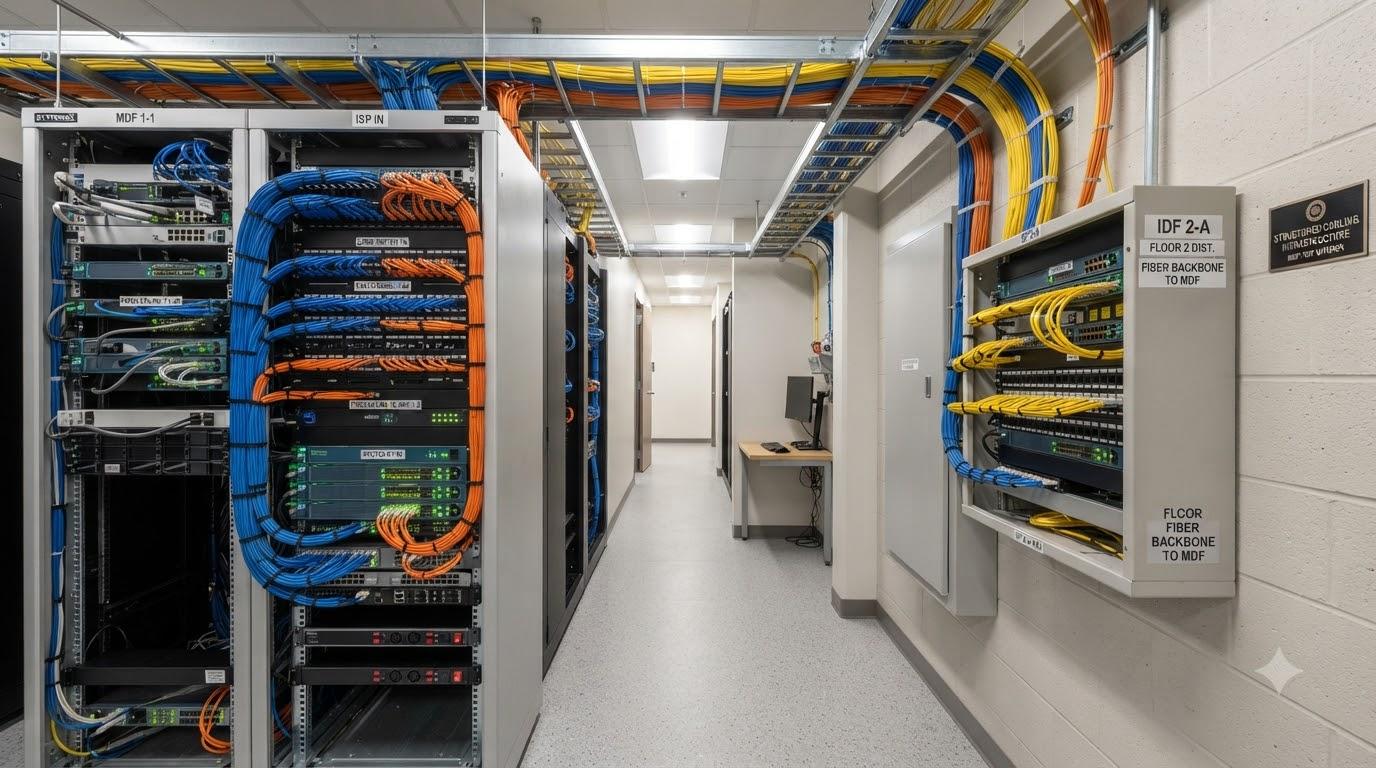
Understanding IDF vs MDF telecom room basics is the absolute foundation of designing a reliable commercial network infrastructure. Structuring your facility’s wiring properly ensures maximum data speed, simplifies future hardware upgrades, and localizes outages so a single faulty switch doesn't take down your entire company.
Core Differences at a Glance
| Feature | MDF (Main Distribution Frame) | IDF (Intermediate Distribution Frame) |
| Primary Function | Central hub connecting the building to the outside ISP. | Local hub connecting end-user devices to the main network. |
| Typical Location | Ground floor or basement near the building's telecom entrance. | Distributed across individual floors or specific building wings. |
| Hardware Housed | Core routers, enterprise firewalls, main PBX, massive UPS systems. | Edge/access switches, localized PoE hardware, smaller UPS backups. |
| Cable Connections | External ISP fiber, internal backbone fiber linking to IDFs. | Backbone fiber (to MDF) and copper Ethernet (to local workstations). |
| Impact of Failure | Total building network and internet blackout. | Localized outage affecting only one specific floor or department. |
The Role of the Main Distribution Frame (MDF)
The MDF acts as the central nervous system of your building. This is the primary point of entry where external service providers drop their public connections, demarcating the line between the ISP’s responsibility and your private enterprise network. All data flowing in and out of your corporate environment must pass through this single, critical room. Because of its massive responsibility, the MDF houses your most expensive, heavy-duty routing and security hardware. It requires stringent environmental controls, including dedicated HVAC systems to dissipate massive heat generation, fire suppression systems that won't destroy electronics, and industrial-grade backup generators to ensure core network survivability during municipal power grid failures.
The Role of the Intermediate Distribution Frame (IDF)
If the MDF is the central nervous system, the IDFs are the nerve endings reaching into every corner of the facility. An IDF is a secondary telecom closet designed to bypass the physical distance limitations of standard copper cabling. Because standard Cat6 or Cat6a Ethernet cables lose data integrity after 100 meters (328 feet), running wires from a 10th-floor desk all the way down to a basement MDF is impossible. IDFs solve this by acting as local distribution points. End-user hardware like computers, VoIP phones, and Wi-Fi access points connect via short copper horizontal cables to the local IDF, which then bridges the gap to the MDF via high-speed connections.
Bridging the Gap: Backbone vs. Horizontal Cabling
The physical relationship between these rooms dictates the speed and reliability of your daily operations. The MDF connects to the various IDFs using vertical backbone cabling. Because these backbone links must traverse long distances and carry aggregated data traffic from hundreds of users simultaneously, network engineers rely almost exclusively on multi-mode or single-mode Fiber Optic cables. Fiber is immune to electrical interference and easily handles multi-gigabit speeds. Conversely, the connection from the IDF out to the individual office desks is known as horizontal cabling. This relies on standard copper Ethernet, which is highly cost-effective, easy to terminate, and capable of delivering both data and electrical power (PoE) directly to ceiling-mounted devices.
Design and Security Best Practices
-
Strict Access Control: The MDF should be heavily restricted, requiring biometric or keycard access limited only to senior IT personnel. IDFs also require locks, but access might be granted to a slightly broader group of local technicians.
-
Future-Proof Spatial Planning: Never build an MDF or IDF sized exactly for your current hardware. Always mandate 30% to 50% empty rack space and spare conduit pathways to accommodate future business expansion, additional server racks, and upgraded backbone fiber.
-
Dedicated Power Grids: Never share the electrical circuits powering an MDF or IDF with standard office outlets. Heavy machinery, industrial vacuums, or space heaters plugged into a shared circuit can easily trip a breaker and instantly sever your entire network connection.
-
Proactive Environmental Monitoring: Both MDF and IDF environments must be outfitted with smart environmental sensors. These instantly alert IT staff via SMS or email if a localized HVAC unit fails, water leaks are detected, or rack temperatures cross safe operational thresholds.
Are you currently struggling with network latency on specific floors, or are you planning a ground-up telecom room design for a new commercial space?

 English
 Arabic
 Spanish
 Portuguese
 Deutsch
 Turkish
 Dutch
Dutch
 Italiano
 Russian
 Romaian
 Portuguese (Brazil)
 Greek
Greek
