


Business Intelligence and Analytics Platforms: The Road Ahead for Enterprise Data and Analytics
In today’s data-driven business environment, organizations are increasingly relying on data to improve operational efficiency, identify emerging opportunities, manage risks, and make faster strategic decisions. As enterprise data continues to grow across applications, cloud environments, and business functions, Business Intelligence and Analytics (BIA) platforms have become essential technologies for converting complex data into actionable business insights.
QKS Group’s Business Intelligence and Analytics Platforms market research provides a comprehensive assessment of the global market, covering emerging technology trends, market dynamics, competitive developments, and the future market outlook. The research helps technology vendors understand evolving customer requirements and strengthen their growth strategies, while enabling enterprises to evaluate vendors based on capabilities, competitive differentiation, and market positioning.
What Are Business Intelligence and Analytics Platforms?
Business Intelligence and Analytics platforms provide organizations with tools to collect, integrate, process, analyze, visualize, and interpret enterprise data. These platforms enable business users and data professionals to transform raw information into meaningful insights that support operational and strategic decision-making.
According to Senior Analyst at QKS Group, “Business Intelligence & Analytics (BIA) platforms offers tools that helps organizations collect, process, analyze, and visualize data to support decision-making.”
Modern BIA platforms extend beyond traditional reporting and dashboards. They increasingly incorporate advanced analytics, artificial intelligence, machine learning, natural language interaction, predictive analytics, automated insights, and self-service capabilities.
Why the BIA Platforms Market Is Gaining Momentum
The growing volume, variety, and velocity of enterprise data are among the key factors driving demand for business intelligence and analytics platforms. Organizations need to derive value from data generated across customer interactions, financial systems, supply chains, marketing applications, operational technologies, and digital channels.
At the same time, business users increasingly expect direct access to data and insights without depending entirely on specialized data teams. Self-service BI, intuitive visualization, natural language querying, and automated analytics are therefore becoming important capabilities in enterprise analytics environments.
Key Technology Trends Shaping Business Intelligence and Analytics
Several technology trends are redefining the capabilities of BIA platforms.
AI-powered analytics is emerging as a major area of innovation. AI can help automate data preparation, generate insights, identify anomalies, summarize analytical findings, and recommend relevant visualizations.
Generative AI and natural language analytics are making analytics more accessible. Users can increasingly interact with enterprise data using conversational queries, reducing the technical expertise required to explore datasets and generate insights.
Augmented analytics combines AI and machine learning with traditional BI capabilities to automate parts of the analytics lifecycle. This enables users to discover patterns and relationships that may otherwise be difficult to identify manually.
SPARK Matrix™: Evaluating the Competitive Landscape
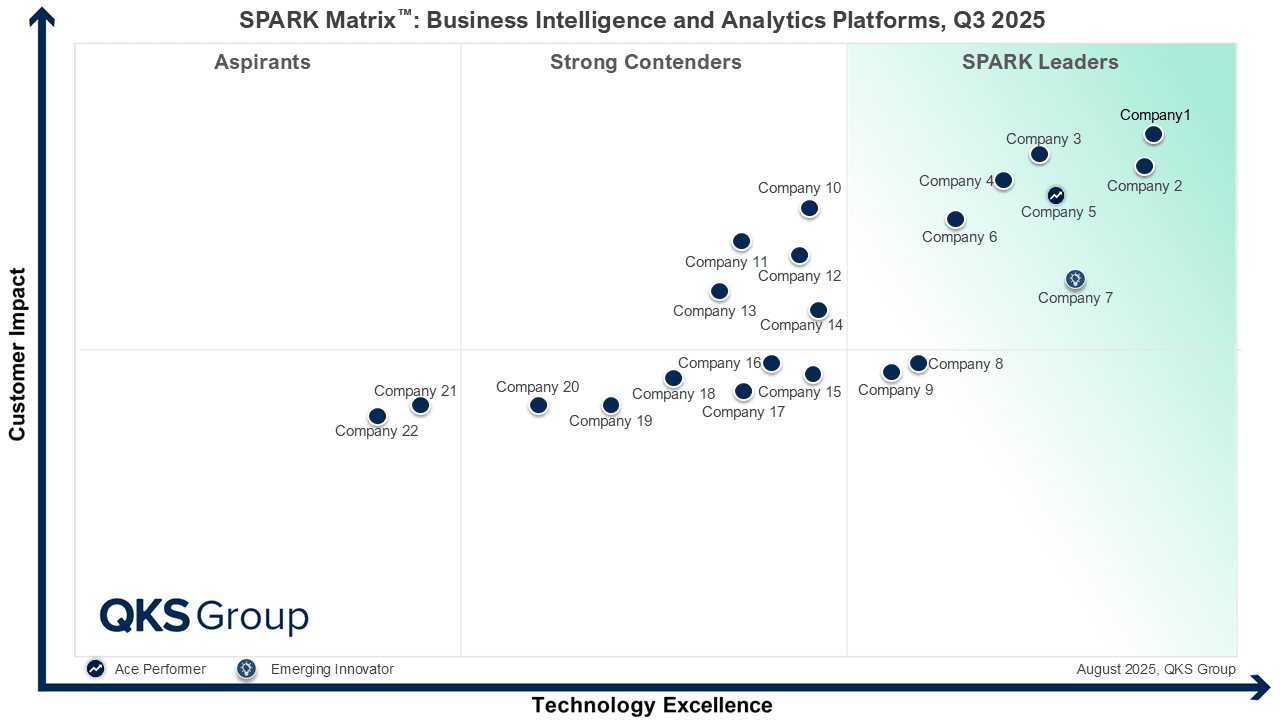
QKS Group’s research includes a detailed competition analysis and vendor evaluation using its proprietary SPARK Matrix™ analysis. The SPARK Matrix evaluates leading vendors based on their technological capabilities, market presence, and competitive positioning, helping enterprises better understand the evolving Business Intelligence and Analytics Platforms market.
The assessment includes prominent vendors such as AWS, Board, Domo, GoodData, Google, IBM, Incorta, insightsoftware, Microsoft, Oracle, Pyramid Analytics, Qlik, Salesforce, SAP, SAS, Sigma, Sisense, Strategy, Tellius, ThoughtSpot, Yellowfin, and Zoho.
Business Value of Modern BIA Platforms
The adoption of BIA platforms can deliver value across multiple areas of the enterprise. Executives can use analytics to monitor key performance indicators and support strategic planning.
Operations teams can use analytics to identify bottlenecks, monitor performance, and optimize processes. Supply chain organizations can analyze demand patterns and inventory levels, while customer-facing teams can use data-driven insights to improve customer experiences.
Future Outlook for Business Intelligence and Analytics Platforms
The future of the BIA platforms market will increasingly revolve around the convergence of BI, advanced analytics, artificial intelligence, and natural language interaction. Rather than functioning solely as reporting systems, next-generation platforms are expected to become intelligent decision-support environments capable of proactively surfacing insights and assisting users throughout the analytical process.
As enterprises continue investing in AI and modern data infrastructure, interoperability, data governance, security, explainability, and trustworthy AI will also become increasingly important considerations when selecting analytics platforms.
Conclusion
Business Intelligence and Analytics Platforms are evolving from conventional reporting solutions into intelligent, AI-enabled platforms that help organizations understand data, uncover opportunities, and make informed decisions.
QKS Group’s Business Intelligence and Analytics Platforms market research provides strategic insights into these developments, helping technology providers understand market evolution while enabling enterprises to evaluate leading vendors and identify solutions aligned with their business and analytics priorities.

 English
 Arabic
 French
 Spanish
 Portuguese
 Turkish
 Dutch
Dutch
 Italiano
 Russian
 Romaian
 Portuguese (Brazil)
 Greek
Greek
