


Collagen Market to Reach USD 10.8 Billion by 2036 supported by peptide-based nutrition formats and expanding supplement use
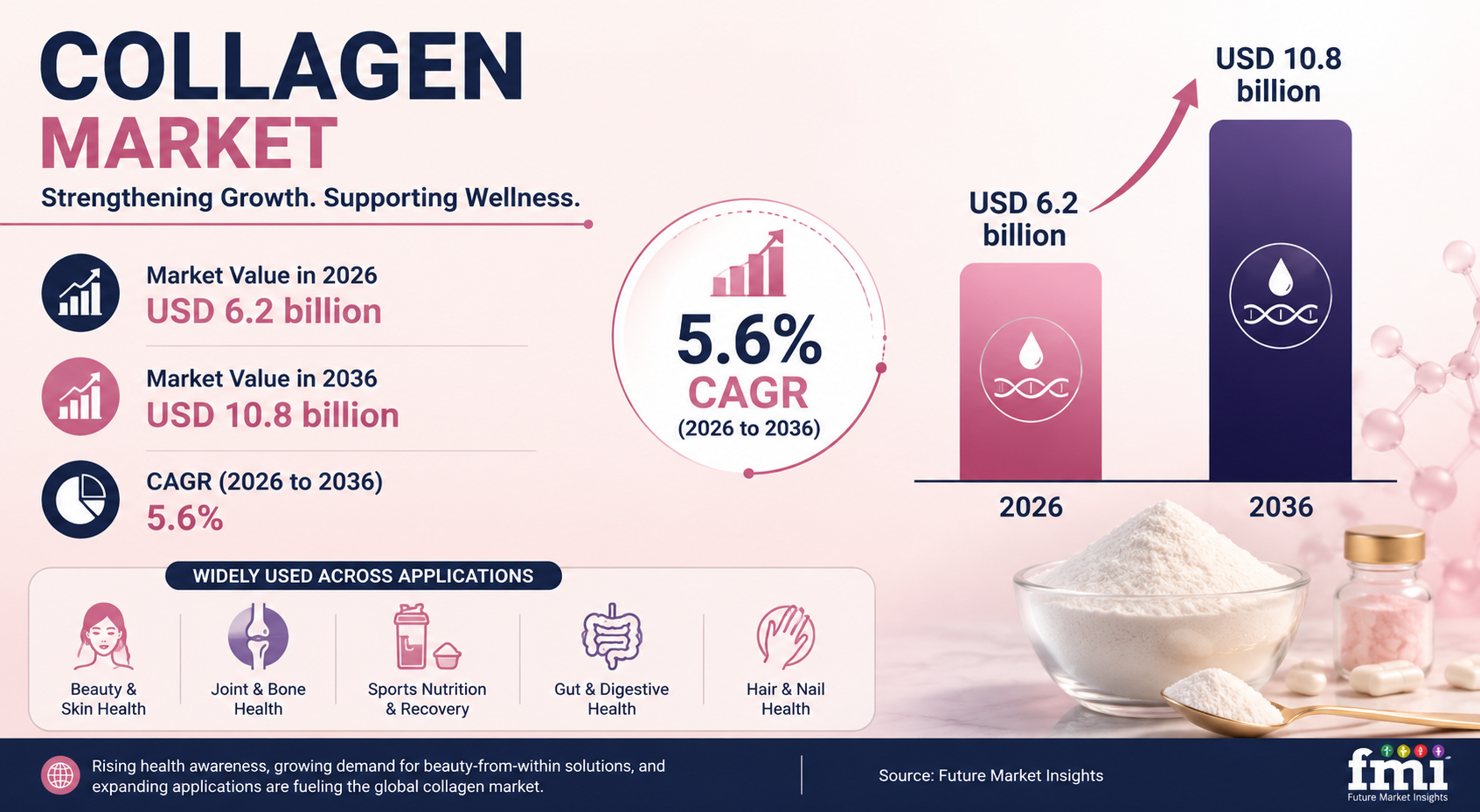
The Collagen Market is projected to increase from USD 6.2 billion in 2026 to USD 10.8 billion by 2036, advancing at a 5.6% CAGR, according to Future Market Insights. The market is benefiting from collagen peptides being incorporated into familiar dietary supplement formats, while rising consumer interest in protein-based nutrition is widening the potential audience.
IFIC reported in July 2025 that 70% of Americans were trying to consume protein. The figure measures protein interest rather than collagen purchasing, but it provides a clear context for collagen powders positioned within daily nutrition routines. Regulatory requirements, ingredient documentation and regional claims rules continue to determine how quickly consumer interest converts into commercial launches.
Get detailed market forecasts, competitive benchmarking, and pricing trends: https://www.futuremarketinsights.com/reports/sample/rep-gb-22730
What is driving the Collagen Market?
Supplement manufacturers are extending collagen peptides into powder, tablet, liquid and gummy formats. These formats allow brands to integrate defined peptide doses into established purchasing routines.
By form, nutraceuticals are estimated to account for 24.6% of the market in 2026, supported by flexible dosing options and established supplement manufacturing routes. The UK Food Standards Agency stated in January 2026 that millions of people regularly take food supplements, providing a broad purchasing context for collagen-based products.
The market's ingredient structure also favors hydrolyzed peptides. Collagen hydrolysate peptides are projected to represent 66.7% of the ingredient type segment in 2026, driven by solubility and broad formulation compatibility across powders and liquids.
By collagen type, animal-based collagen is expected to hold 41.1% share in 2026. Bovine and porcine feedstocks support commercial-scale extraction and processing, while marine sources provide an additional route for manufacturers seeking different raw-material origins.
Which collagen segment holds the largest share?
Animal-based collagen remains central to commercial processing because bovine, porcine and fish raw materials can move through established extraction and hydrolysis systems.
Darling Ingredients Inc. announced on April 24, 2025, that Rousselot's Peptan peptides received Upcycled Certified status for bovine and porcine production. The certification provides a documented sourcing attribute that manufacturers can consider during ingredient qualification.
Business-to-business sales are forecast to represent 35.0% of the market in 2026, reflecting direct specification work and repeat ingredient contracts. Ingredient buyers assess source identity, solubility, sensory performance and documentation before committing to recurring production.
“Collagen economics depend on source identity and peptide behavior surviving formulation review before a brand books production. A specification that clears solubility plus documentation review can transfer between powder and gummy programs with less repeat qualification.”
— Nandini Roy Choudhury, Principal Consultant, Future Market Insights
Why are documentation and claims becoming commercial issues?
Manufacturing records can determine whether a collagen program moves from formulation to repeat production. In February 2026, the FDA warned Hearthy Foods that its collagen supplements lacked required finished-product and component specifications, along with complete manufacturing records.
The issue illustrates a practical restraint for manufacturers. A formula can perform successfully during development and still face delays when supporting specifications or production records are incomplete.
Japan presents another documentation challenge. In October 2025, Japan's Consumer Affairs Agency reviewed analytical methods for 98 Foods with Function Claims filings and requested additional material for 69. For collagen manufacturers supporting function-claim products, analytical-method documentation therefore becomes part of commercial preparation.
Which countries offer the strongest growth opportunities?
Germany is projected to record the highest country CAGR at 7.4%, followed by Japan at 6.7% and the USA at 6.2%.
- Germany: 7.4% CAGR
- Japan: 6.7% CAGR
- USA: 6.2% CAGR
- Netherlands: 5.7% CAGR
- UK: 5.1% CAGR
- Australia: 4.4% CAGR
- South Korea: 4.0% CAGR
Germany combines pharmacy and online retail channels with broad supplement use. Destatis reported in March 2025 that 21% of Germans aged 16 to 74 bought medicines or supplements online during 2024, compared with 16% in 2021.
Japan's market is shaped by function-claim evidence and analytical review. In June 2026, the Consumer Affairs Agency reported that 11 of 500 sampled functional foods fell below filed ingredient levels, with five withdrawn nationally.
The USA benefits from mature supplement retail and private-label manufacturing. A documented example comes from the NIH Dietary Supplement Label Database, which listed an on-market bovine collagen peptide powder with a 20 gram serving and 18 grams of protein per daily serving.
The Netherlands is growing at 5.7% CAGR, although regulatory enforcement remains relevant. In August 2025, NVWA found that 25 of 30 collagen-supplement websites used unlawful health or medical claims.
Australia is projected at 4.4% CAGR, supported by established supplement consumption. ABS reported in September 2025 that 33.6% of Australians used a dietary supplement during 2023, representing 8.5 million people.
South Korea is forecast to grow at 4.0% CAGR. MFDS reported in November 2025 that low-molecular collagen peptide functionality gained approval during a committee review covering ten agenda items.
What is the competitive landscape?
The Collagen Market includes integrated collagen and gelatin producers, health-ingredient platforms and recombinant collagen specialists.
Collagen Market is a global ingredient category that supplies collagen peptides, gelatin and related materials for nutraceutical, food and beverage, cosmetics, personal care and biomedical applications.
Key companies include Darling Ingredients Inc., GELITA AG, Nitta Gelatin Inc., Symrise AG, dsm-firmenich, PB Leiner, Lapi Gelatine S.p.A., and CollPlant Biotechnologies Ltd.
Darling Ingredients Inc., GELITA AG and Nitta Gelatin Inc. maintain broad collagen and gelatin portfolios. Symrise AG and dsm-firmenich operate across nutrition and beauty applications, while PB Leiner and Lapi Gelatine S.p.A. serve international ingredient customers. CollPlant Biotechnologies Ltd. focuses on recombinant collagen for biomedical development.
“The commercial question is not only whether a collagen peptide works in a prototype. Source records, analytical methods and finished-product specifications have to stay aligned when production moves forward.”
— Nandini Roy Choudhury, Principal Consultant, Future Market Insights
What developments are shaping the market?
Several company developments illustrate the range of collagen applications. In February 2026, CollPlant Biotechnologies Ltd. launched BioFlex, a ready-to-print rhCollagen kit for Digital Light Processing 3D bioprinting applications.
In September 2025, Darling Ingredients Inc. announced patents in Europe, Japan and China for Rousselot's Colartix collagen peptide and chondroitin sulfate matrix. In February 2025, Symrise AG partnered with Hofseth BioCare to extend salmon proteins and collagens into human-health and pet-nutrition channels.
Access the full report for detailed market trends: https://www.futuremarketinsights.com/reports/collagen-market
Some Other Insights from FMI:

 Arabic
 French
 Spanish
 Portuguese
 Deutsch
 Turkish
 Dutch
Dutch
 Italiano
 Russian
 Romaian
 Portuguese (Brazil)
 Greek
Greek
