


How Website Development Helps Businesses Build Websites Around User Intent?
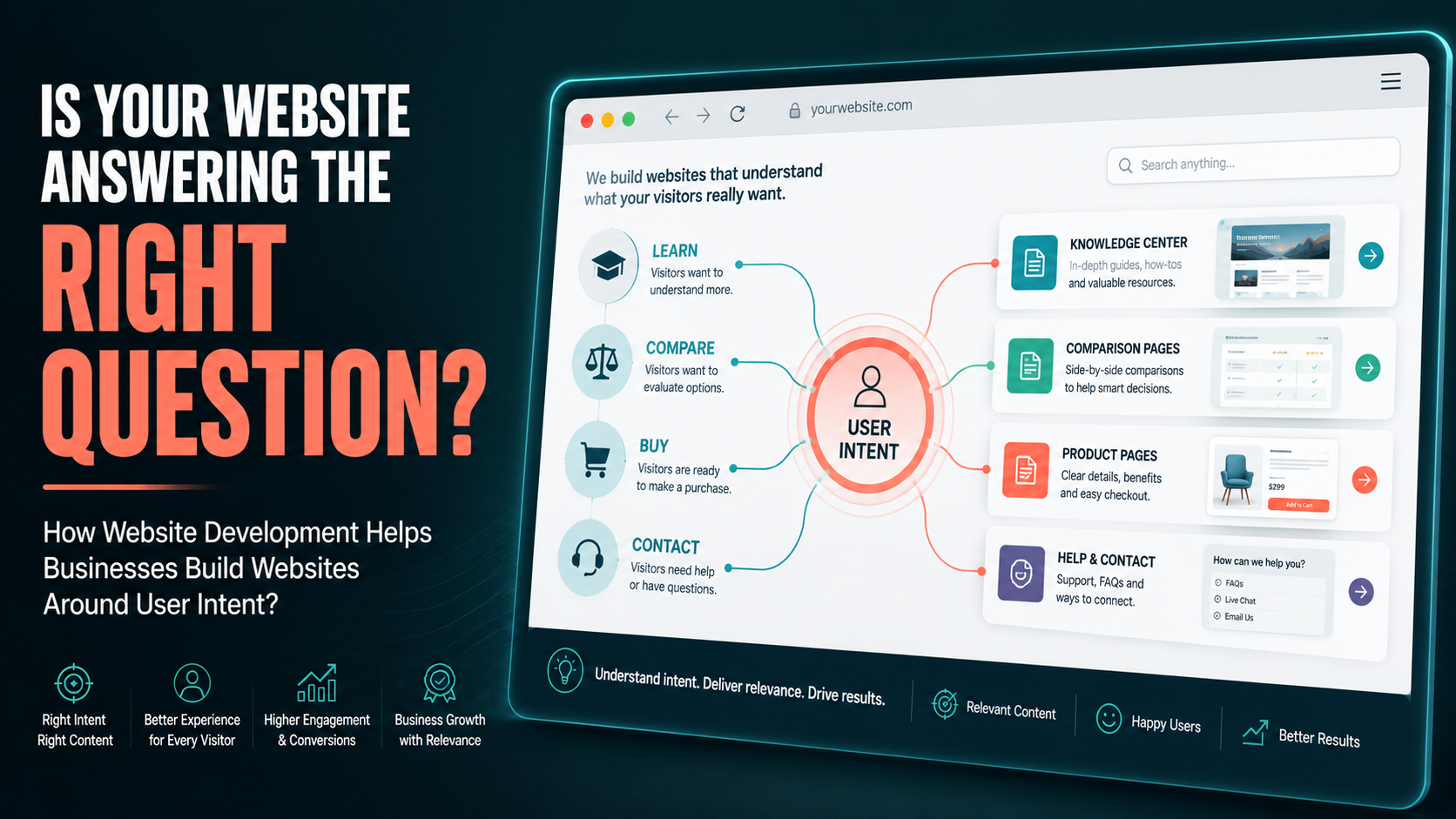
A website can attract visitors and still fail to generate meaningful business results if it does not help users accomplish what they came to do. Someone searching for a service may want pricing, another visitor may need to compare options, while an existing customer may simply want to complete a booking or access an account. Treating all visitors the same creates unnecessary friction.
Effective Website Development can build digital experiences around what users are actually trying to accomplish. This means considering search behaviour, customer journeys, navigation, content structure, functionality, device usage, and conversion paths during development. Instead of starting with the question "What pages should the website have?", businesses can start with "What does the user need to achieve?"
What Is User Intent?
User intent describes the underlying goal behind a user's interaction with a website.
Common intent types include:
-
Informational: Looking for an answer or explanation
-
Commercial: Comparing products or services
-
Transactional: Ready to purchase or book
-
Navigational: Trying to find a specific page or business
-
Support-oriented: Trying to solve an existing customer problem
Understanding these different goals can influence how a website should be structured.
Why Should Website Development Consider User Intent?
A technically functional website can still provide a poor experience if its structure does not match user expectations.
For example, a visitor searching for a specific service should not have to navigate through several unrelated pages before finding basic information.
User-intent-focused development can help businesses create:
-
More relevant navigation
-
Clearer content
-
Faster journeys
-
Better functionality
-
More useful calls to action
How Does Search Behaviour Reveal User Intent?
Search queries often provide clues about what users want.
For example:
"How does X work?" suggests informational intent.
"X pricing UK" suggests commercial or transactional intent.
"Buy X online" indicates stronger transactional intent.
Businesses can use these patterns to understand what information and functionality different visitors may expect.
How Does User Intent Influence Website Architecture?
Website architecture determines how information is organised.
Instead of arranging pages purely around internal business departments, businesses can structure information around customer needs.
For example:
User Need → Relevant Information → Supporting Evidence → Action
This can make it easier for visitors to find the information required to move forward.
How Should Navigation Reflect User Intent?
Navigation should help users reach important destinations without unnecessary steps.
A business may prioritise:
-
Services
-
Products
-
Pricing
-
Locations
-
Resources
-
Contact
-
Customer accounts
The exact structure should reflect the most important user journeys rather than simply displaying every available page.
How Does Website Development Support Different User Journeys?
Different users can enter the same website with completely different objectives.
For example:
New visitor:
Discover → Learn → Compare → Enquire
Returning customer:
Login → Manage account → Complete task
Buyer:
Product → Details → Cart → Checkout
Website development can create functionality and navigation that support these distinct journeys.
Why Is Content Structure Important for User Intent?
Content should answer the questions users actually have.
A service page might need to address:
-
What the service is
-
Who it is for
-
How it works
-
What it costs
-
What users can expect
-
How to get started
Good content structure reduces the effort required to find relevant information.
How Do Calls to Action Support User Intent?
A call to action should correspond with what the user is likely to do next.
Examples include:
-
Request a quote
-
Book a consultation
-
Buy now
-
Download guide
-
Contact support
-
Create an account
A visitor looking for information should not necessarily be pushed immediately into a purchase.
The next action should match the user's stage and objective.
How Does Website Search Help With User Intent?
Internal search becomes increasingly important as websites grow.
Users may search for:
-
Products
-
Services
-
Articles
-
FAQs
-
Documents
-
Locations
An effective search experience can help users reach relevant information without navigating through multiple menus.
Advanced websites may also use filters, autocomplete, categories, and relevance-based results.
How Does Personalisation Support User Intent?
Personalisation can help present relevant information based on appropriate user signals.
For example, an e-commerce website could display:
-
Previously viewed products
-
Relevant recommendations
-
Appropriate categories
-
Suggested services
However, personalisation should provide genuine value and should not become unnecessarily intrusive.
How Does Location Affect User Intent?
Location can influence what a visitor needs.
For example, someone searching for a service in London may require different information from someone looking for the same service in Manchester.
Location-aware functionality can support:
-
Nearby branches
-
Local availability
-
Regional services
-
Delivery options
-
Local contact information
Businesses should use location data responsibly and only where it improves the experience.
Why Does Mobile Intent Matter?
Users on mobile devices may have different immediate objectives.
A mobile visitor may want to:
-
Call the business
-
Find an address
-
Check opening information
-
Make a booking
-
Track an order
-
Complete a purchase
Mobile development should make these high-value actions easy to access.
How Does Website Speed Affect User Intent?
Users generally do not want to wait for basic information or actions.
Slow pages can interrupt journeys before users reach the information they need.
Website development can support performance through:
-
Image optimisation
-
Efficient code
-
Caching
-
Optimised databases
-
Efficient API requests
Fast performance helps remove technical friction from user journeys.
How Does Accessibility Support User Intent?
Users should be able to accomplish their goals regardless of how they interact with the website.
Developers can consider:
-
Keyboard navigation
-
Screen-reader compatibility
-
Readable typography
-
Clear labels
-
Sufficient contrast
-
Accessible forms
Accessibility is therefore part of designing around user needs.
How Does User Intent Influence Forms?
Forms should collect information that is genuinely necessary for the intended action.
For example, an enquiry form may need:
-
Name
-
Email
-
Phone number
-
Enquiry details
Adding unnecessary fields can increase friction.
The development team should therefore balance business information requirements with the user's motivation to complete the form.
How Does User Intent Affect E-Commerce Development?
E-commerce users may have several stages of intent.
They might:
-
Discover a product
-
Research its features
-
Compare alternatives
-
Check pricing
-
Add the product to a cart
-
Complete checkout
Website functionality should support each stage without creating unnecessary obstacles.
How Can Websites Support Informational Intent?
Visitors looking for information need clear answers.
Businesses can support this through:
-
Educational content
-
FAQs
-
Guides
-
Product explanations
-
Comparison information
-
Tutorials
Content should be easy to scan and organised around the questions users are actually asking.
How Can Websites Support Transactional Intent?
Users with strong transactional intent generally need an efficient path to completion.
Depending on the business, this could mean:
-
Clear pricing
-
Product availability
-
Booking functionality
-
Secure checkout
-
Simple forms
-
Immediate confirmation
The fewer unnecessary obstacles between intent and action, the more efficient the journey can become.
How Does Analytics Help Understand User Intent?
Analytics can provide evidence about how users interact with a website.
Businesses can analyse:
-
Search terms
-
Page journeys
-
Exit points
-
Conversion paths
-
Form activity
-
Feature usage
These insights can reveal where the website fails to satisfy user needs.
How Does Testing Validate User-Intent-Focused Design?
Testing should involve real-world scenarios.
For example:
"Find a service and request a quote."
or:
"Find a product, compare options, and complete checkout."
Testing these complete journeys can reveal problems that individual page testing may miss.
Can AI Help Websites Respond to User Intent?
AI can support more intelligent interactions.
Potential applications include:
-
Conversational search
-
Intelligent recommendations
-
Question answering
-
Personalised content
-
AI customer support
For example, an AI-powered search experience could interpret a natural-language question and help users locate relevant information.
AI should still operate within appropriate data, security, and accuracy controls.
What Mistakes Should Businesses Avoid?
Businesses should avoid:
-
Designing only around internal departments
-
Creating complicated navigation
-
Hiding important information
-
Using generic calls to action
-
Overloading users with options
-
Ignoring mobile journeys
-
Collecting unnecessary form information
-
Assuming every visitor has the same objective
The website should reflect how users actually behave.
How Should Businesses Build Around User Intent?
A practical process is:
-
Identify key audiences
-
Understand their objectives
-
Map major user journeys
-
Identify required information
-
Design appropriate navigation
-
Build relevant functionality
-
Test complete journeys
-
Analyse behaviour
-
Improve based on evidence
This creates a continuous improvement cycle rather than a one-time design exercise.
Why User Intent Matters for Websites in 2026?
Users increasingly expect websites to provide immediate and relevant answers rather than forcing them through generic navigation.
Search engines, AI-powered interfaces, personalised experiences, mobile usage, and digital self-service are changing how people interact with businesses online.
Websites therefore need to understand the purpose behind user actions, not simply display information.
Conclusion
Website development helps businesses build around user intent by translating customer goals into practical navigation, content structures, functionality, forms, search experiences, personalisation, and conversion paths. The most effective websites are designed around what users need to accomplish rather than simply around what the business wants to display.
The process should begin by identifying different user intents and mapping the journeys associated with them. Development can then create the technical functionality required to make those journeys simple, accessible, fast, and reliable.
Businesses should also use analytics and real-world testing to validate whether the website actually satisfies user needs. User intent is not a one-time assumption; it should continually inform website improvements as customer behaviour changes.
Businesses looking to make user-focused digital experiences more intelligent can explore AI Integration Services to add AI-powered search, personalised experiences, customer assistance, and automated workflows to digital platforms.
Frequently Asked Questions
What does user intent mean in website development?
User intent refers to the goal a visitor has when interacting with a website, such as finding information, comparing options, making a purchase, booking a service, or getting customer support.
Why should websites be designed around user intent?
Designing around user intent helps businesses create clearer navigation, more relevant content, simpler journeys, and functionality that matches what visitors actually need to accomplish.
How can businesses identify user intent?
Businesses can analyse search behaviour, customer questions, website analytics, conversion journeys, support requests, and user research to identify common objectives.
Can website development improve conversion by focusing on user intent?
It can reduce unnecessary friction by providing relevant information and appropriate next actions for different stages of the customer journey.
Can AI help websites understand user intent?
Yes. AI can support conversational search, recommendations, question answering, personalisation, and customer assistance, provided the system has appropriate data and controls.

 English
 Arabic
 French
 Spanish
 Deutsch
 Turkish
 Dutch
Dutch
 Italiano
 Russian
 Romaian
 Portuguese (Brazil)
 Greek
Greek
