


Plant-based Tuna Market to Reach USD 2.3 Billion by 2036
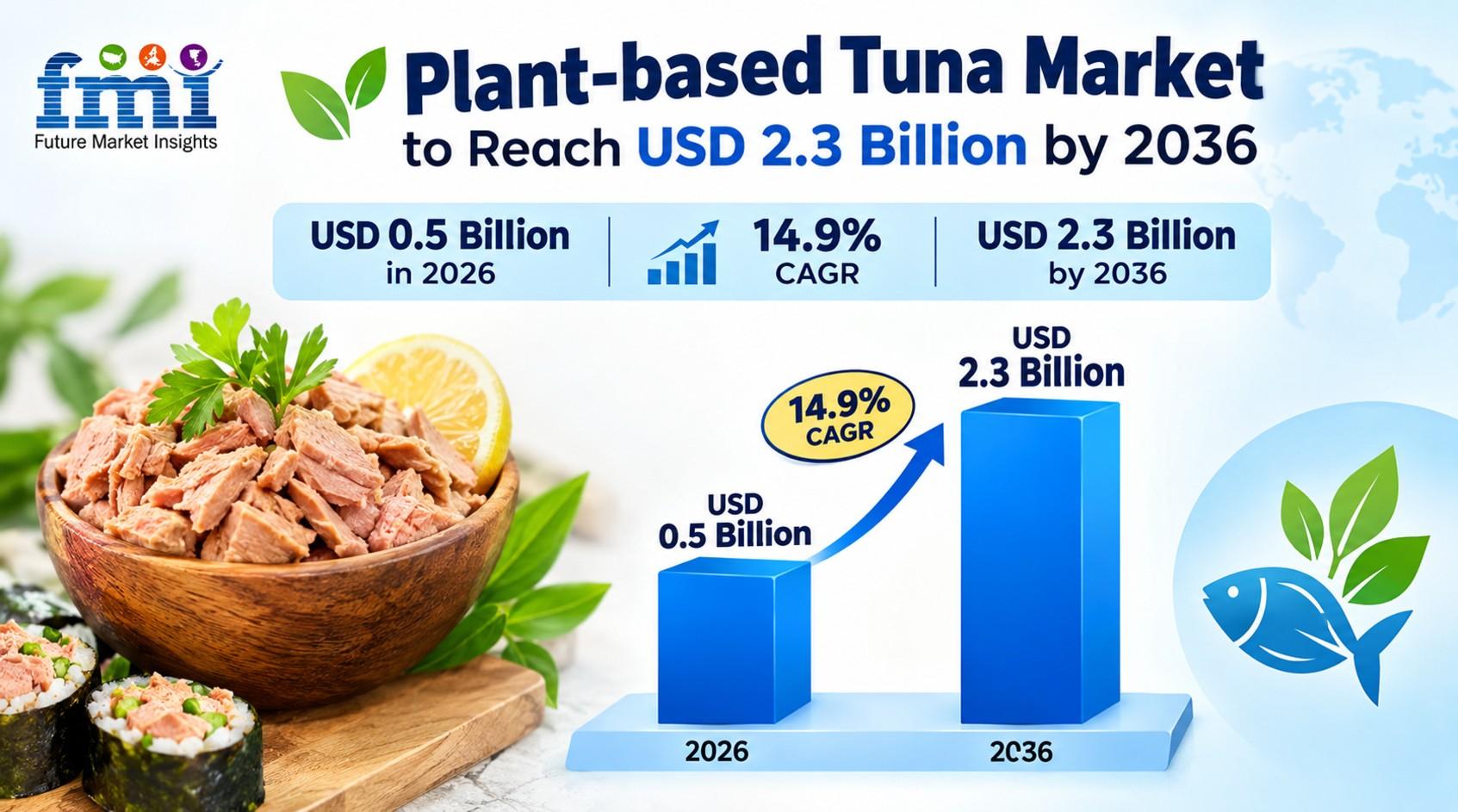
The global plant-based tuna market is projected to reach USD 2.3 billion by 2036, rising from USD 0.5 billion in 2026 at a 14.9% CAGR, according to latest insights by Future Market Insights. The sector is shifting from novelty seafood alternatives into an everyday pantry protein category. Shelf-stable tuna alternatives are expected to account for 30.0% of product type demand in 2026, while retail and supermarkets are projected to represent 28.0% of end-use consumption.
The growth outlook answers a practical question for alt-protein manufacturers and grocery buyers: where is demand concentrating? FMI data points to familiar ambient canned formats, lunch and salad integrations, and multi-channel grocery merchandising that places alternative seafood beside conventional canned proteins. India is projected to be the fastest-growing country, recording a 15.5% CAGR through 2036, followed by China at 15.0%.
Plant-based Tuna Market Growth Reflects Transition to Everyday Pantry Staples Flexitarian and sustainability-driven shoppers are increasingly adopting fish-free proteins for routine sandwiches, wraps, salads, and quick-prep meals without altering traditional cooking habits. Industry data highlights that retail velocity accelerates when alternative proteins match conventional storage and handling expectations, allowing consumers to stock ambient packs without refrigeration constraints.
Retail and supermarkets remain central to the plant-based tuna market. Physical grocery aisles allow shoppers to compare price points, nutritional profiles, and usage cues directly against traditional canned tuna. Retail and supermarkets are projected to hold a 28.0% end-use share in 2026, while mainstream retail distribution channels capture 26.0% of total revenue.
Shelf-stable alternatives lead product formats. FMI estimates that shelf-stable tuna alternatives will account for 30.0% share in 2026 because ambient pouch and can packaging align with existing pantry replenishment habits. Delivering flake-like texture integrity and neutral, authentic flavor profiles without fishy aftertaste, however, remains a core technical requirement for repeat purchases.
“The plant-based tuna market is moving toward formats that can work inside normal household meals.” Nandini Roy Choudhury, Principal Consultant for Food and Beverage, Future Market Insights. Nandini Roy Choudhury also identifies texture retention and pantry convenience as pivotal buying gates. “Brands that combine pantry convenience, stable texture, and clear usage cues are likely to gain advantage as shoppers move from trial to repeat purchase,” Nandini Roy Choudhury emphasized in the supplied FMI analysis.
Future Market Insights is a market research firm that analyzes alternative seafood demand, product format splits, country growth rates, and competitive benchmarking across global plant-based food sectors.
Shelf-Stable Formats and Mainstream Retail Lead Market Segmentation
Shelf-stable tuna alternatives lead the product segment with a projected 30.0% share in 2026, driven by ambient convenience and seamless fit into lunchbox staples. Chilled, frozen, sushi-style, and high-protein clean-label variants form the secondary tier, addressing premium ready-to-eat and foodservice applications.
Retail and supermarkets lead end-use demand with a 28.0% share in 2026, supported by high shelf visibility and impulse comparison. Foodservice channels, prepared-meal integrations, and direct-to-consumer routes provide incremental volume by exposing consumers to plant-based tuna in salads and grab-and-go bowls.
The competitive landscape remains fragmented, with Good Catch leading company share at 12.0%, alongside active competitors including Nestlé, Vgarden, OmniFoods, Wicked Kitchen, Revo Foods, and Konscious Foods. Leading players compete on flaking texture technology, legume-blend protein bases, and expanding distribution into mainstream retail grocery chains.
Innovation is also expanding into specialized culinary formats: European and Asian innovators are rolling out 3D-structured and algae-derived sushi-grade tuna alternatives, while domestic brands focus on pre-seasoned pouches to capture high-protein convenience snacking occasions.
Request Exclusive Sample (Top Performing Strategies (Next 10 years):
https://www.futuremarketinsights.com/reports/sample/rep-gb-12830
India and China Show the Fastest Growth India is projected to record a 15.5% CAGR through 2036. Expanding modern trade retail, quick-commerce delivery penetration in major metros like Mumbai and Bengaluru, and increasing urban consumer interest in packaged plant proteins are driving rapid category adoption.
China is forecast to expand at a 15.0% CAGR through 2036, supported by extensive food manufacturing infrastructure, domestic plant-protein innovation, and multi-format integration across convenience store ready meals and foodservice menus.
The United States is projected to grow at a 13.5% CAGR through 2036, anchored by broad retail shelf presence, flexitarian demographics, and established alt-protein comparison habits. The United Kingdom follows at 11.4%, Germany at 11.0%, South Korea at 10.8%, and Japan at 9.2%.
Get More Insights from the Full Research Report: https://www.futuremarketinsights.com/reports/plant-based-tuna-market
Texture Science and Merchandising Adjacency Shape Brand Velocity Plant-based tuna producers are focusing on advanced protein extrusion and microalgae oil fortification to replicate the flaking texture, moisture retention, and omega-3 fatty acid profile of wild-caught tuna. Overcoming consumer skepticism around mouthfeel remains the primary hurdle to converting first-time trial into routine basket inclusion.
Merchandising placement is equally decisive. Brands that secure dual placement both in the dedicated plant-based aisle and adjacent to conventional canned seafood benefit from significantly higher velocity by capturing flexitarian shoppers seeking mercury-free and ocean-friendly protein alternatives.
FMI defines the market as commercially produced, fish-free tuna alternatives formulated for household consumption, prepared meals, and foodservice menus. The scope includes shelf-stable, chilled, frozen, flavoured, high-protein, clean-label, and sushi-style alternatives sold across retail, modern trade, online, and direct channels. Conventional wild-caught or farmed tuna, generic non-tuna plant seafood substitutes, and marine animal feed are excluded.
About Future Market
Insights Future Market Insights, Inc. is a market research and consulting firm providing syndicated and customized research across global industries. The company’s plant-based tuna market study covers product type, end use, distribution channel, and regional markets across 2026 to 2036. The Plant-based Tuna Market report was published on May 15, 2026, and reviewed by Nandini Roy Choudhury. The study covers 345 pages and uses a hybrid bottom-up and top-down methodology cross-referenced against retail scanner data, alternative protein processing capacities, and regional grocery replenishment trends.
For Press & Corporate Inquiries
Rahul Singh AVP - Marketing and Growth Strategy
Future Market Insights,
Inc. +91 8600020075
For Sales - sales@futuremarketinsights.com
For Media - Rahul.singh@futuremarketinsights.com
For web - https://www.futuremarketinsights.com/
For Web - https://www.factmr.com/

 English
 Arabic
 French
 Portuguese
 Deutsch
 Turkish
 Dutch
Dutch
 Italiano
 Russian
 Romaian
 Portuguese (Brazil)
 Greek
Greek
