


Infant Formula Market to Reach USD 136.4 Million by 2036
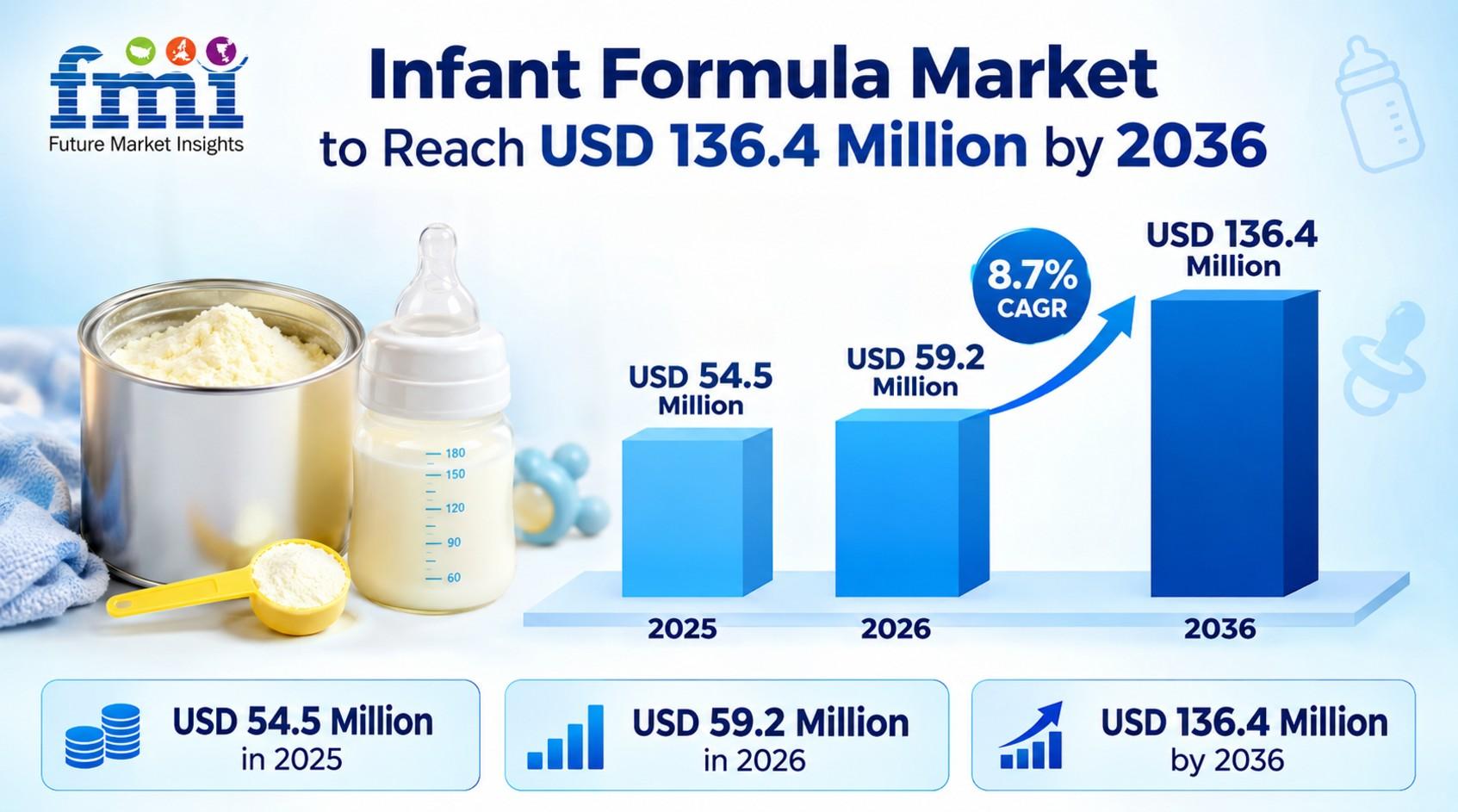
The global infant formula market is projected to reach USD 136.4 million by 2036, rising from USD 59.2 million in 2026 at an 8.7% CAGR, according to latest insights by Future Market Insights. The market was valued at USD 54.5 million in 2025. Powder formula is expected to account for 75.0% of formulation demand in 2026, while household consumers are projected to represent 70.0% of end-user consumption.
The growth outlook answers a practical question for pediatric nutrition manufacturers and healthcare retailers: where is demand concentrating? FMI data points to age-stage product adoption, hypoallergenic and digestive medical nutrition formats, and offline retail shelf depth. India is projected to be the fastest-growing country, recording a 10.9% CAGR through 2036, followed by Germany at 10.0%.
Infant Formula Market Growth Reflects Structured Early-Life Feeding Routines Working-parent routines are accelerating the adoption of measured, age-stage packaged nutrition to support daily feeding schedules safely. The United States Department of Agriculture Economic Research Service recorded that infant formula rebates totaled approximately USD 1.6 billion in fiscal 2024 under the Women, Infants, and Children (WIC) program, covering benefits for an average of 1.2 million participants monthly and illustrating the massive, recurring volume generated by household feeding programs.
Household consumers remain central to the infant formula market. Families rely on recurring monthly purchases across standard and follow-on stages outside clinical settings. Household consumers are projected to hold a 70.0% share in 2026.
Powder packaging is another dominant segment. FMI estimates that powder formula will account for 75.0% share in 2026 because spray-dried and instant powders offer longer storage stability and reduced handling costs for retailers. Regulatory sanitation standards and contamination controls, however, remain a critical priority for dry blending facilities.
“I see parents comparing trust signals before price in infant formula. Families first check age stage and safety records.” Nandini Roy Choudhury, Principal Consultant for Food and Beverages, Future Market Insights. Nandini Roy Choudhury also identifies retail trust and supply consistency as pivotal buying drivers. “Pediatric advice then shapes medical nutrition choices for allergy and reflux needs. Retailers keep a strong role as many caregivers want a visible pack and quick guidance. Suppliers able to prove clean sourcing and steady powder availability should gain repeat orders during the forecast decade,” Nandini Roy Choudhury noted in the supplied FMI analysis.
Future Market Insights is a market research firm that analyzes infant formula demand, segment shares, country growth rates, and competitive activity across specialized food markets.
Routine Nutrition and Powder Formats Lead Market Segmentation
Routine nutrition is projected to represent 60.0% share in 2026, supported by everyday household bottle-feeding needs. Standard infant formula leads the product categories with a 50.0% share, sustained by milk-based and soy-based recipes.
Offline retail is estimated to account for 65.0% share in 2026, with pharmacies, drugstores, and supermarkets providing direct packaging inspection and pharmacist consultation. Powder formulations are expected to hold 75.0% share, reflecting stable ambient shelf life across global grocery distribution.
The competitive landscape includes Nestlé, Groupe Danone, Abbott Nutrition, Mead Johnson Nutrition, The Kraft Heinz Company, Synutra International Inc., Beingmate Baby & Child Food Co. Ltd., FrieslandCampina, Meiji Holdings Co. Ltd., and Pfizer Inc. Nestlé expanded its premium portfolio with NAN Sinergity in June 2025, combining probiotics with six human milk oligosaccharides (HMOs), while Danone introduced its Dairy & Plants Blend baby formula to address plant-based early nutrition.
Abbott highlighted clinical trial results in August 2025 for Similac 360 Total Care featuring five HMOs to reinforce pediatric recommendation channels. On the regulatory side, the US FDA issued draft guidance in January 2025 for low-moisture ready-to-eat foods to tighten environmental pathogen monitoring across powdered formula manufacturing lines.
Request Exclusive Sample (Top Performing Strategies (Next 10 years):
https://www.futuremarketinsights.com/reports/sample/rep-gb-838
India and Germany Show the Fastest Growth India is projected to record a 10.9% CAGR through 2036. Urban working families and expanding modern pharmacy distribution are broadening access to packaged early-life nutrition across Indian metropolitan and tier-2 hubs.
Germany is forecast to expand at a 10.0% CAGR through 2036. Tightly regulated retail environments and high consumer trust in certified pharmacy channels continue to support premium routine and hypoallergenic medical nutrition lines.
Brazil follows at a 9.1% CAGR, while China is projected to grow at 6.8%. Japan is forecast at 6.5%, the United States at 4.0%, and the United Kingdom at 2.3% through 2036.
Get More Insights from the Full Research Report:
https://www.futuremarketinsights.com/reports/infant-formula-market
Regulatory Oversight and Safety Compliance Guide Market Economics Infant formula manufacturing remains subject to stringent safety mandates and raw material tracing. In May 2025, the US FDA initiated a comprehensive nutrient review under Operation Stork Speed to re-evaluate minimum nutrient requirements, while December 2024 guidance required mandatory reporting of supply chain disruptions to protect national inventory levels.
These compliance requirements place operational focus on supplier hazard control plans, dry-plant hygiene, and protein sourcing. While premium HMO-fortified and organic formulations command higher price points in retail, standard milk-based powder lines face tight cost expectations and rebate discipline under large-scale institutional supply agreements.
FMI defines the market as commercially manufactured nutrition products formulated for babies and young children. The scope includes standard infant formula, follow-on formula, and specialty formula sold in powder, ready-to-feed liquid, and liquid concentrate forms. Adult nutrition products, general milk powders, toddler snacks without formula claims, and non-infant medical enteral nutrition are excluded.
About Future Market
Insights Future Market Insights, Inc. is a market research and consulting firm providing syndicated and customized research across global industries. The company’s infant formula market study covers product type, application, end use, distribution channel, formulation type, and regional markets across 2026 to 2036. The Infant Formula Market report was published on May 12, 2026, and reviewed by Nandini Roy Choudhury. The study covers 350 pages and uses a hybrid bottom-up and top-down methodology cross-referenced against global birth demographics, healthcare distribution channels, and retail inventory movements.
For Press & Corporate Inquiries
Rahul Singh AVP - Marketing and Growth Strategy
Future Market Insights,
Inc. +91 8600020075
For Sales - sales@futuremarketinsights.com
For Media - Rahul.singh@futuremarketinsights.com
For web - https://www.futuremarketinsights.com/
For Web - https://www.factmr.com/

 English
 French
 Spanish
 Portuguese
 Deutsch
 Turkish
 Dutch
Dutch
 Italiano
 Russian
 Romaian
 Portuguese (Brazil)
 Greek
Greek
