


Ready-to-eat Food Market to Reach USD 563.2 Billion by 2036
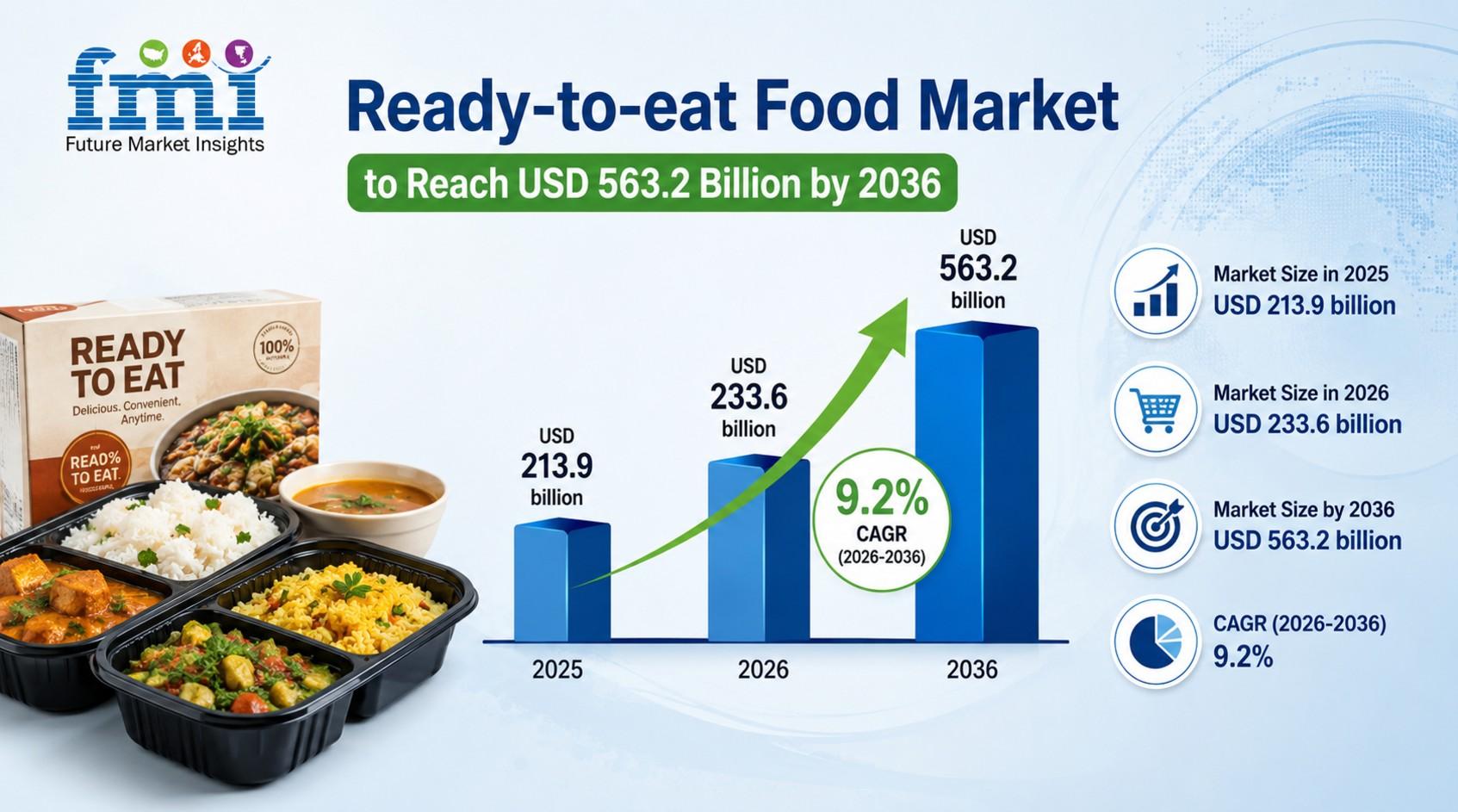
The global ready-to-eat food market is projected to reach USD 563.2 billion by 2036, rising from USD 233.6 billion in 2026 at a 9.2% CAGR, according to latest insights by Future Market Insights. The market was valued at USD 213.9 billion in 2025. Retail is expected to account for 64.0% of distribution channel demand in 2026, while snacks and baked goods and confectioneries are projected to represent 55.0% of frequent snack buying sales.
The growth outlook answers a practical question for food manufacturers and retailers: where is demand concentrating? FMI data points to retail access, frozen formats and products designed around shorter preparation times. India is projected to be the fastest-growing country, recording an 11.8% CAGR through 2036, followed by China at 10.2%.
Ready-to-eat Food Market Growth Reflects Changing Meal Routines
Busy work routines are supporting packaged meals and snackable portions in weekly shopping baskets. The USA Bureau of Labor Statistics recorded 0.67 hours per day spent on food preparation and cleanup in 2024, providing a specific measure of the time constraint addressed by convenience-oriented food formats.
Retail remains central to the ready-to-eat food market. Supermarkets, hypermarkets and online grocery platforms provide broad access to chilled meals, frozen packs and snack assortments. Retail is projected to hold 64.0% share in 2026.
Frozen packaging is another important segment. FMI estimates that frozen packaging will account for 41.0% share in 2026 because frozen meals require longer storage and controlled distribution. Cold-chain costs, however, remain a restraint where freezer logistics and storage capacity are limited.
“Ready-to-eat food is becoming a weekly planning product instead of an occasional convenience item.” Nandini Roy Choudhury, Principal Consultant for Food and Beverages, Future Market Insights
Nandini Roy Choudhury also identifies purchase reliability as a factor shaping repeat demand. “Buyers compare flavor trust and heating reliability before repeat purchase,” Nandini Roy Choudhury said in the supplied FMI analysis.
Future Market Insights is a market research firm that analyzes ready-to-eat food demand, segment shares, country growth rates and competitive activity across food markets.
Retail and Snacking Lead Market Segmentation
Snacks and baked goods and confectioneries are projected to represent 55.0% share in 2026, supported by high purchase frequency for cookies and bakery snacks. Retail follows with 64.0% share, reflecting supermarket and online grocery reach.
Direct sales are estimated to account for 48.0% share in 2026, with large retail chains and foodservice buyers seeking supply control and private-label support. Non-vegetarian products are expected to hold 46.0% share, reflecting continued use of chicken and meat-based meals.
The competitive picture includes Nestlé, Conagra Brands, Campbell Soup Company, McCain Foods, Dr. Oetker, Nomad Foods and MTR Foods. Nestlé is positioned across frozen meals and prepared foods, while Conagra Brands introduced more than 50 new frozen foods in June 2025.
Campbell completed its acquisition of Sovos Brands in March 2024 for USD 2.7 billion enterprise value. McCain Foods announced a BRL 1.8 billion expansion of its Araxá facility in October 2025, adding frozen storage capacity.
Request Exclusive Sample (Top Performing Strategies (Next 10 years) :
https://www.futuremarketinsights.com/reports/sample/rep-gb-491
India and China Show the Fastest Growth
India is projected to record an 11.8% CAGR through 2036. USDA Foreign Agricultural Service data placed Indian food and grocery retail sales at USD 778 billion in 2025, while food processing sales are projected to rise from USD 355 billion in 2024 to about USD 535 billion by fiscal year 2026.
Quick-commerce platforms and modern retail are widening access to packaged meals in Indian cities. Smaller packs and regional flavors are expected to support repeat purchases beyond major metropolitan areas.
China is forecast to expand at a 10.2% CAGR through 2036. A 2025 USDA Foreign Agricultural Service guide placed China's ready-to-eat meals market at USD 72 billion in 2023, with 23.1% year-on-year expansion. Instant retail channels delivering groceries within 30 to 60 minutes support low-preparation meal purchases in dense urban households.
Germany follows at a 10.1% CAGR, while Brazil is projected to grow at 9.2%. The United States is forecast at 7.5%, the United Kingdom at 7.0%, and Japan at 6.6% through 2036.
Get More Insights from the Full Research Report :
https://www.futuremarketinsights.com/reports/ready-to-eat-food-market
Pricing and Product Format Remain Critical
Ready-to-eat food pricing remains sensitive to ingredient costs and competition from foodservice. United States food prices were 2.7% higher in March 2026 than in March 2025. USDA data also showed wholesale beef prices were 19.7% higher, while farm-level vegetable prices increased 49.0% over the same period.
These figures place pressure on manufacturers of meat-based frozen meals and vegetable-heavy bowls. Single-serve bowls and premium snacks can command higher unit prices through portion control and convenience, while family packs and private-label meals face tighter value expectations.
FMI defines the market as packaged food sold for immediate eating or simple heating. The scope includes snacks, baked goods and confectioneries, frozen meals, chilled ready meals, shelf-stable meals and prepared meat products. Raw ingredients, uncut produce, made-to-order restaurant meals and beverages outside finished meal kits are excluded.
About Future Market Insights
Future Market Insights, Inc. is a market research and consulting firm providing syndicated and customized research across global industries. The company’s ready-to-eat food market study covers product type, sales channel, packaging type, distribution channel, diet type and regional markets across 2026 to 2036.
The Ready-to-eat Food Market report was published on May 08, 2026, and reviewed by Nandini Roy Choudhury. The study covers 350 pages and uses a bottom-up channel review supported by retail and food-processing cross-checks.
For Press & Corporate Inquiries
Rahul Singh
AVP - Marketing and Growth Strategy
Future Market Insights, Inc. +91 8600020075
For Sales - sales@futuremarketinsights.com
For Media - Rahul.singh@futuremarketinsights.com
For web - https://www.futuremarketinsights.com/
For Web - https://www.factmr.com/

 English
 Arabic
 French
 Portuguese
 Deutsch
 Turkish
 Dutch
Dutch
 Italiano
 Russian
 Romaian
 Portuguese (Brazil)
 Greek
Greek
