


PCB Water-Based Ink Market Set to Hit USD 1,320 Million by 2034 at 5.6% CAGR
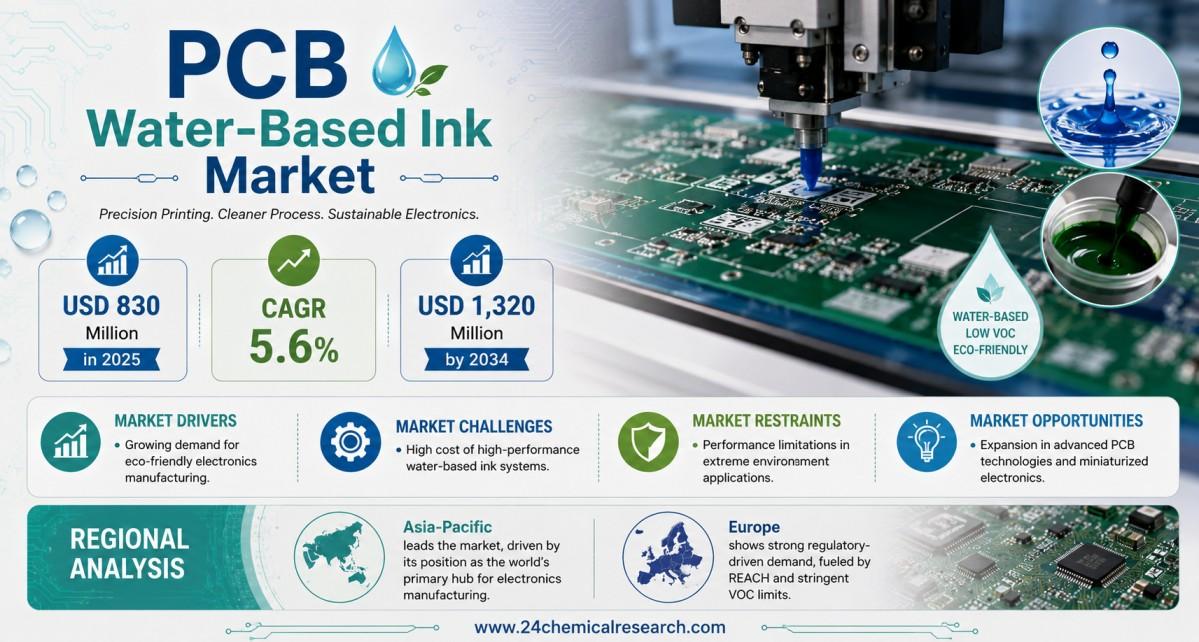
According to 24ChemicalResearch latest industry analysis, the global PCB Water-Based Ink market was valued at USD 830 Million in 2025 and is projected to reach USD 1,320 Million by 2034, growing at a compound annual growth rate (CAGR) of 5.6% during the forecast period. The market's expansion is fueled by environmental compliance pressures, technological compatibility, and the expansion of the electronics manufacturing sector.
View the complete report: https://www.24chemicalresearch.com/reports/305552/pcb-waterbased-ink-market
PCB water‑based ink is a viscous fluid substance classified within the electronic chemicals segment of fine chemical products. Its formulation comprises resins, monomers, solvents, inorganic fillers, photoinitiators, and various additives, delivering a lower VOC footprint and superior environmental compatibility for circuit patterns, solder masks, and component identification on printed circuit boards. This transition not only reduces hazardous emissions but also aligns with tightening RoHS and REACH directives.
What Is Driving the PCB Water-Based Ink Market?
The market is primarily driven by environmental compliance pressures, technological compatibility, and the expansion of the electronics manufacturing sector.
Environmental Compliance Pressures
Environmental compliance forces manufacturers to replace traditional solvent‑based inks that emit volatile organic compounds. Water‑based formulations, recognised for minimal emissions, fit well with tightening regulations in the EU, Asia‑Pacific and North America. Reports show that insulation and PCB manufacturers are prioritising greener solutions, partly because client specifications increasingly include eco‑labelling and because non‑compliant production incurs penalties or forced shutdowns. Additionally, corporate sustainability commitments encourage adoption when water‑based inks demonstrate comparable dielectric properties and corrosion resistance; the convergence of regulatory pressure and brand image considerations accelerates the shift toward cleaner ink technologies.
Technological Compatibility
Production cycles long under conventional inks hinge on drying times, solvent recovery and waste handling. The water‑based formulations cut curing time by up to 30% when coupled with infrared or UV‑assist technology, allowing printers to achieve higher throughput without compromising the integrity of fine‑pitch traces. The associated energy savings translate into operating cost reductions that are especially compelling for SMEs operating on tight margins. Recent breakthroughs in pigment stability mean that water‑based inks now deliver contrasts comparable to solvent‑based counterparts—a critical attribute for certifications demanding low resistivity and high reliability.
Expansion of the Electronics Manufacturing Sector
The global proliferation of consumer electronics, telecommunications infrastructure, and automotive electronics is fueling a consistent demand for printed circuit boards (PCBs). As the backbone of these devices, PCBs require reliable and efficient inks for the printing process. The shift towards water‑based inks is significantly driven by this overarching industry growth, compelling manufacturers to adopt higher-volume, more sustainable production methods. The global market for water‑based PCB inks is projected to grow at a CAGR of 5.8% over the next five years, largely propelled by these environmental mandates.
Market Segmentation Insights
The PCB water-based ink market is diverse, with segmentation by type, application, end user, technology, and performance requirement revealing distinct growth drivers and competitive dynamics. Solder Resist Ink drives the overall market, while Consumer Electronics is the largest and most dynamic application.
By Product Type
The market is segmented into Circuit Ink, Solder Resist Ink, and Character Ink. Solder Resist Ink often drives the overall market due to its essential role in protecting printed boards from environmental stress and suppressing solder bridging. These inks are prized for their halogen‑free, flexible formulations, and their capacity to maintain adhesion and dielectric strength even as design densities increase. As manufacturers seek reliable long‑term performance with greener solutions, the evolution of solder resists has become central to competitive differentiation.
By Application
The primary application segments are Communication, Consumer Electronics, Computer, Vehicle Electronics, Medical, Industrial Automation Control, Aerospace, and Others. Consumer Electronics is the largest and most dynamic application, driven by perpetual demand for smartphones, wearables and home automation. The trend toward ultra‑thin, high‑density interconnects necessitates inks that deliver fine resolution and strong adhesion on flexible or rigid substrates, shaping development priorities for ink chemists and printers alike.
By End User
The market is segmented into PCB Manufacturers (EMS/OEM), Original Design Manufacturers (ODMs), and Specialty and High‑Reliability Manufacturers. PCB Manufacturers (EMS/OEM) remain the primary volume customer, tailoring ink choices to balance cost, throughput and quality. They prioritize inks that can readily integrate into existing line‑rate production without major equipment upgrades, while still meeting tightening print‑resolution and reliability standards.
By Technology
The market is segmented into Screen Printing, Inkjet Printing, and Curtain Coating. Screen Printing dominates due to its capacity to deposit thick, uniform film with high throughput, supporting large‑batch PCBs. Conversely, inkjet technology is gaining traction for rapid prototyping and short‑run high‑resolution assemblies, enabling design‑to‑fab cycles that reduce time‑to‑market.
By Performance Requirement
The market is segmented into Standard Performance, High‑Temperature Resistance, and Flexible/Circular Board Compatibility. High‑Temperature Resistance is critical for automotive, aerospace and power electronics, where board temperatures frequently exceed 120°C. Inks designed for this requirement deliver extended thermal stability, ensuring conductivity, dielectric integrity and adhesion remain uncompromised under extreme operating conditions.
Regional Market Analysis
Asia‑Pacific has cemented itself as the market leader for water‑based inks, driven by its position as the world's primary hub for electronics manufacturing. Europe is experiencing dynamic infrastructure expansion impacting ink demand.
Asia‑Pacific
Over the past decade, the Asia‑Pacific region has cemented itself as the market leader for water‑based inks. Concentrated manufacturing clusters in China, Taiwan, South Korea and Japan have built a resilient supply chain that supports high‑volume production of circuit, solder and identification inks. Coupled with rapid consumer electronics roll‑outs, the region consistently supplies the most complex board types, giving ink manufacturers an arena to refine high‑resolution and fast‑curing formulations. The volume advantage translates into competitive pricing pressures and incentives for local chip‑makers to experiment with eco‑friendly ink variants, reinforcing the region's market dominance.
Europe
Europe’s tightening regulatory framework—particularly the REACH directive and newer EU VOC limits—has become the most powerful catalyst for adopting water‑based inks. European PCB manufacturers face rigorous certification paths that penalize VOC emissions, prompting a strategic pivot toward low‑VOC and halogen‑free inks. The region’s strong academic‑industry nexus accelerates the translation of green chemistry research into commercial products, while national sustainability budgets fund pilot projects in eco‑friendly fabrication. Consequently, many European OEMs have set mandates that any new board must use a certified water‑based ink, ensuring a steady stream of demand for vendors that can meet these standards.
Report Summary
The global PCB water-based ink market is on a steady growth trajectory, propelled by a combination of environmental compliance pressures, technological compatibility, and the expansion of the electronics manufacturing sector. The global shift toward low‑VOC water‑based formulations, regulatory‑driven adoption, and investments in nanotechnology‑enhanced resins are expected to create substantial new avenues for growth.
Key Report Highlights:
-
The global PCB Water-Based Ink Market was valued at USD 830 Million in 2025 and is projected to reach USD 1,320 Million by 2034.
-
The market is expected to expand at a CAGR of 5.6% during the 2025–2034 forecast period.
-
Asia‑Pacific remains the leading regional market, driven by its position as the world's primary hub for electronics manufacturing.
-
Solder Resist Ink drives the overall market due to its essential role in protecting printed boards from environmental stress and suppressing solder bridging.
-
A major trend is the global shift toward low‑VOC water‑based formulations, with the market’s growth driven by the need to reduce workplace emissions and satisfy corporate sustainability commitments.
-
The competitive landscape includes major industry participants such as Winson Group, Eternal Materials, and DIC Corporation, which together account for roughly 60% of the global share, alongside regional players like Jiangsu Kuangshun, Shenzhen Rongda, Zhejiang Meihong, and ALLPC.
-
The report provides comprehensive insights into market size, growth forecasts, emerging technologies, regional trends, competitive analysis, key growth opportunities, and strategic developments shaping the global PCB Water-Based Ink Market through 2034.
Frequently Asked Questions PCB Water-Based Ink Market
Q: What is the current size of the global PCB Water-Based Ink market?
A: According to 24ChemicalResearch, the global PCB Water-Based Ink market was valued at USD 830 Million in 2025 and is projected to reach USD 1,320 Million by 2034.
Q: Which region dominates the PCB Water-Based Ink market?
A: Asia‑Pacific is the leading regional market, driven by its position as the world's primary hub for electronics manufacturing.
Q: What are the key growth drivers of the PCB Water-Based Ink market?
A: The primary growth drivers include Environmental Compliance Pressures, Technological Compatibility, and the Expansion of the Electronics Manufacturing Sector.
Q: Which segment leads the market by type?
A: Solder Resist Ink drives the overall market due to its essential role in protecting printed boards from environmental stress and suppressing solder bridging.
Q: Who are the leading companies in this market?
A: The top companies - Winson Group, Eternal Materials, and DIC Corporation - together account for roughly 60% of the global share, with other significant players including Taiyo Ink International, Jiangsu Kuangshun, Shenzhen Rongda, Zhejiang Meihong, and ALLPC.
View the complete report: https://www.24chemicalresearch.com/reports/305552/pcb-waterbased-ink-market
Download the free sample report: https://www.24chemicalresearch.com/download-sample/305552/pcb-waterbased-ink-market
About 24ChemicalResearch
Founded in 2015, 24ChemicalResearch has established itself as a leading provider of chemical market intelligence, serving clients including over 30 Fortune 500 companies across North America, Europe, and Asia-Pacific. The company delivers data-driven insights through rigorous primary and secondary research methodologies.
Contact: +91 9169162030
Website: https://www.24chemicalresearch.com

 Arabic
 French
 Spanish
 Portuguese
 Deutsch
 Turkish
 Dutch
Dutch
 Italiano
 Russian
 Romaian
 Portuguese (Brazil)
 Greek
Greek
