


The Essential Attribute of a Multi-Delivery App: Fulfillment Flexibility
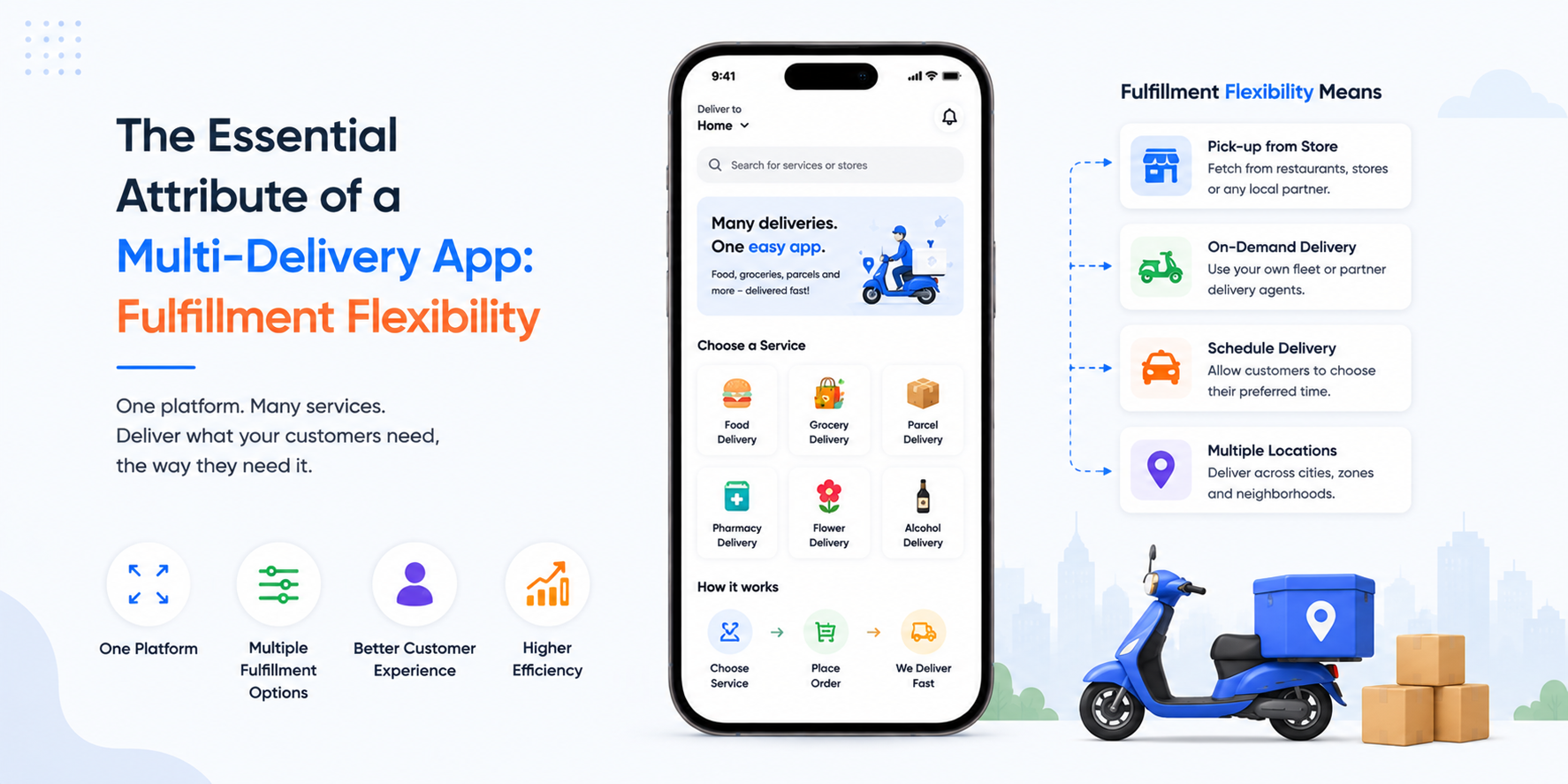
A multi-delivery business isn't successful simply because it offers multiple categories.
The real advantage comes from being able to handle different types of orders through one delivery infrastructure.
Food, groceries, flowers, pharmacy products, fuel, and other essentials don't follow the same ordering or fulfillment patterns. A scalable multi-delivery app therefore needs the flexibility to adapt its workflow to each business category without creating a separate platform for every service.
One Platform, Different Delivery Logic
A food order may require restaurant preparation time.
A grocery order may depend on real-time inventory.
A flower order may need scheduled delivery.
A pharmacy order may require additional verification.
A multi-delivery platform should be capable of accommodating these differences while maintaining a consistent customer experience.
This is where configurable workflows become essential.
Let Businesses Define How Orders Move
Instead of forcing every merchant into the same process, the platform can allow businesses to configure:
- Instant or scheduled orders
- Delivery time slots
- Service areas
- Product availability
- Order preparation status
- Delivery fees
- Cancellation rules
- Priority delivery options
This gives entrepreneurs the freedom to expand into new delivery categories without redesigning the entire application.
Make Delivery Capacity Work Across Categories
The delivery network is one of the most valuable assets in a multi-delivery business.
A single delivery partner network can potentially serve different categories depending on location, availability, vehicle type, and order requirements.
Smart dispatch can consider proximity and availability when assigning orders, while route optimization can help coordinate deliveries efficiently. SpotnEats' DoorDash-style platform includes automated dispatch, smart route optimization, real-time tracking, and multi-order handling capabilities.
That creates an opportunity to improve driver utilization across multiple revenue-generating services.
Keep Inventory and Availability Connected
Expanding into multiple delivery categories also increases operational complexity.
If a product is unavailable, customers shouldn't be able to order it.
Real-time inventory and availability management can allow merchants to update products, prices, and availability while administrators maintain visibility across the marketplace.
This becomes especially important when the same platform manages multiple merchants and product categories.
Turn One Delivery Network Into Multiple Revenue Channels
A flexible multi-delivery platform can support several monetization models:
Delivery fees — Charge based on distance, service type, or delivery priority.
Merchant commissions — Earn a percentage from completed orders.
Subscriptions — Offer customers reduced delivery fees and other benefits.
Sponsored listings — Allow merchants to promote their products.
Priority delivery — Charge additional fees for urgent fulfillment.
SpotnEats DoorDash clone supports delivery fees, restaurant commissions, subscriptions, surge pricing, and in-app advertising as potential revenue channels.
Expand Without Building Another App
This is perhaps the biggest strategic advantage.
An entrepreneur could start with food delivery, establish a customer and delivery network, and then introduce grocery, flowers, pharmacy, fuel, bakery, or other delivery services using the same underlying ecosystem. SpotnEats specifically positions its DoorDash clone as adaptable to multiple delivery models beyond food.
The business can therefore grow horizontally through new categories instead of repeatedly investing in separate applications.
Build a Flexible Multi-Delivery Platform With SpotnEats
SpotnEats provides a customizable DoorDash-style delivery platform with dedicated interfaces for customers, merchants, delivery partners, and administrators. Its infrastructure supports order management, payments, real-time tracking, dispatch, analytics, notifications, multi-order handling, and expansion into multiple delivery categories.
The essential attribute isn't simply having more services inside one app.
It's having an infrastructure flexible enough to make each service work differently while keeping customers, merchants, delivery partners, and administrators connected.
Build one delivery ecosystem that can adapt to the next service your market demands.

 English
 French
 Spanish
 Portuguese
 Deutsch
 Turkish
 Dutch
Dutch
 Italiano
 Russian
 Romaian
 Portuguese (Brazil)
 Greek
Greek
