


Resin Binder for Foundry Market Set to Hit USD 3,080 Million by 2034 at 5.5% CAGR
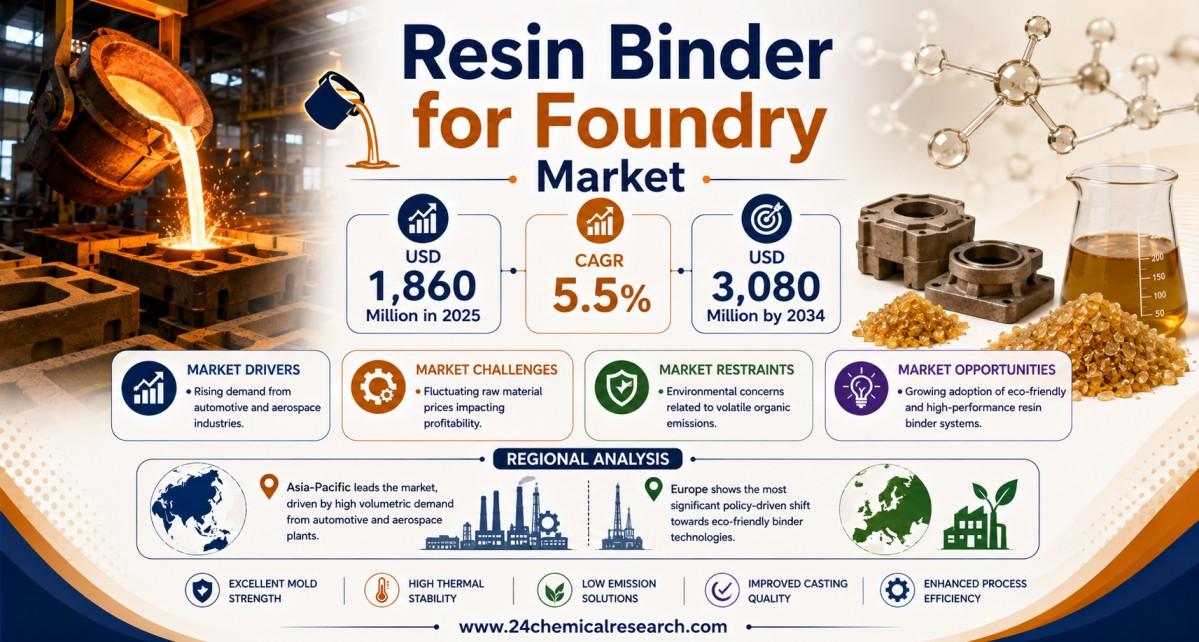
According to 24ChemicalResearch latest industry analysis, the global Resin Binder for Foundry market was valued at USD 1,860 Million in 2025 and is projected to reach USD 3,080 Million by 2034, growing at a compound annual growth rate (CAGR) of 5.5% during the forecast period. The market's expansion is fueled by integration with advanced casting technologies, cost and environmental efficiency, and the accelerating demand for low‑VOC binders.
View the complete report: https://www.24chemicalresearch.com/reports/305456/resin-binder-for-foundry-market
Resin binders, primarily furan, cold box, and alkali phenolic formulations, are engineered to bond sand grains into moulds and cores that endure high temperatures and mechanical loads. These binders deliver dimensional fidelity, thermal stability, and efficient shake‑out, enabling complex castings for automotive, heavy machinery and aerospace applications. In recent years, environmental regulations and the shift toward low‑VOC technologies have spurred the development of bio‑based and hybrid binders, reshaping product portfolios and competitive dynamics.
What Is Driving the Resin Binder for Foundry Market?
The market is primarily driven by integration with advanced casting technologies, cost and environmental efficiency, and the accelerating demand for low‑VOC binders.
Integration with Advanced Casting Technologies
Foundry operators increasingly adopt resin binders to complement high‑temperature steels and superalloys, enabling consistent tensile strength and reducing porosity in finished parts. The precision of resin rebonding allows longer burn‑times without compromising structural integrity, which translates into tighter cycle times and higher throughput for complex automotive and aerospace components. As engine block and turbine blade manufacturers push for lighter, more efficient geometries, the need for a binder that maintains dimensional fidelity under extreme temperatures becomes a practical necessity.
Cost and Environmental Efficiency
Across the globe, part manufacturers are mindful of a tighter cost envelope. Resin binders can be regenerated or blended to reduce material waste, cutting overall production expenses. In addition, many suppliers now offer low‑VOC formulations that help facilities meet tightening emission standards. Reduced solvent use not only aids compliance but also delivers a healthier work environment, factors that resonate with corporate sustainability agendas and procurement policies looking to mitigate long‑term operating risks.
Accelerating Demand for Low‑VOC Binders
Stringent regulations on volatile organic compound emissions have accelerated the adoption of low‑VOC binder formulations across the industry. Manufacturers now offer modified furan and phenolic resins that reduce solvent release by 30‑40 percent compared with legacy systems, meeting the latest EPA and EU directives. The decline in processor licensing costs, coupled with a steady rise in the procurement of precision‑casting components for electric‑vehicle powertrains, has pushed demand for these cleaner alternatives to represent roughly one‑third of total resin binder sales in 2026.
Market Segmentation Insights
The resin binder for foundry market is diverse, with segmentation by type, application, end user, curing process, and material composition revealing distinct growth drivers and competitive dynamics. Furan Resin continues to dominate the market, while Core Sand Casting remains the primary driver.
By Product Type
The market is segmented into Furan Resin, Cold Box Resin, Alkali Phenolic Resin, and Others. Furan Resin continues to dominate the market due to its exceptional thermal stability and cost effectiveness for intricate castings. Cold Box Resin is emerging as a strong competitor, offering faster cure times and lower emissions, while Alkali Phenolic delivers superior corrosion resistance for demanding applications. Industry focus remains on enhancing flexibility and performance across all binder typologies.
By Application
The primary application segments are Core Sand Casting, Mold Sand Casting, Refractories, and Others. Core Sand Casting remains the primary driver, driven by the need for precise and robust cores in complex structures. Mold Sand Casting also commands significant volume, especially in production lines focusing on high-output high-quality casts. Emerging refractories and specialty molding approaches are gradually increasing demand for binder solutions tailored to high-temperature or corrosive environments.
By End User
The market is segmented into Automotive Industry, Heavy Machinery & Equipment, Aerospace & Defense, and Others. The Automotive Industry maintains dominance as the most demanding customer, constantly pushing for lighter, stronger, and more complex cast components. Heavy Machinery & Equipment sectors value durability and high-temperature performance, whereas Aerospace & Defense demands the utmost precision and reliability. These end-user priorities shape trend lines toward advanced binder chemistry and process optimization.
By Curing Process
The market is segmented into No-Bake Process, Cold Box Process, Hot Box Process, and Others. The No-Bake Process enjoys widespread adoption for its simplicity and ability to handle large, heavy components, offering a consistent surface finish. Cold Box lends greater productivity and environmental benefits for high-volume core production, while Hot Box provides superior strength for demanding alloys. The selection is guided by output volume, quality demand, and environmental compliance.
By Material Composition
The market is segmented into Organic Binders, Inorganic Binders, Hybrid Binders, and Others. Organic Binders remain the core of the market, offering high binding strength and adaptability. Inorganic binders contribute primarily in specialized or environmental sections where emissions must be low. Hybrid formulations combine the advantages of both, addressing evolving demands for performance and sustainability while expanding the application of binder technology across the sector.
Regional Market Analysis
Asia‑Pacific remains the most prolific consumer of resin binders in the foundry sector, driven by high volumetric demand from automotive and aerospace plants. Europe shows the most significant policy‑driven shift towards eco‑friendly binder technologies.
Asia‑Pacific
Asia‑Pacific remains the most prolific consumer of resin binders in the foundry sector, courtesy of its vast established production base and rapidly digitised casting operations. The concentration of automotive manufacturing hubs in China, the vibration‑sensitive aerospace plants in Japan, and the lift‑mobile makers in South Korea generate a sustaining need for resilient binder chemistries. The area also enjoys compressed supply chains and technological opt‑ins for water‑based systems that reduce VOCs, enabling manufacturers to meet tightening environmental codes more comfortably. The interplay between production volume, local research, and the growing demand for component‑level precision makes the region a natural bellwether for global trends.
Europe
Europe's regulatory framework has hastened a transition toward low‑VOC binders across all foundry tiers. The REACH directive tightening formaldehyde exposure thresholds and the EU Green Deal's broader material‑sourcing mandates compel European foundries to adopt water‑based or phenolic‑urea blends that cut emissions while preserving mold strength. Firms in Germany, France, and Spain now conduct extensive field‑testing of bio‑based chemistries to validate part‑quality outcomes, thereby securing compliance certifications. The shift is not merely a compliance measure; it unlocks premium pricing streams and reduced liability risk. For suppliers, proximity to European R&D hubs lowers time‑to‑market for compliant formulations, and the region's well‑structured certification pathways provide a clear route for approval.
Report Summary
The global resin binder for foundry market is on a robust growth trajectory, propelled by a combination of integration with advanced casting technologies, cost and environmental efficiency, and the accelerating demand for low‑VOC binders. The rise of bio‑based resins, technology‑driven automation, and the shift to hybrid binding systems are expected to create substantial new avenues for growth.
Key Report Highlights:
-
The global Resin Binder for Foundry Market was valued at USD 1,860 Million in 2025 and is projected to reach USD 3,080 Million by 2034.
-
The market is expected to expand at a CAGR of 5.5% during the 2025–2034 forecast period.
-
Asia‑Pacific remains the leading regional market, driven by high volumetric demand from automotive and aerospace plants.
-
Core Sand Casting remains the primary driver, driven by the need for precise and robust cores in complex structures.
-
A major trend is the rise of bio‑based resins, with market share of bio‑based formulations rising to 12 percent in 2025, a 15 percent increase from 2023.
-
The competitive landscape includes major industry participants such as ASK Chemicals, HA‑International, and FOSECO, which together hold a leading share, alongside niche players like International Furan Chemicals, Jinan Shengquan, and Dynea.
-
The report provides comprehensive insights into market size, growth forecasts, emerging technologies, regional trends, competitive analysis, key growth opportunities, and strategic developments shaping the global Resin Binder for Foundry Market through 2034.
Frequently Asked Questions Resin Binder for Foundry Market
Q: What is the current size of the global Resin Binder for Foundry market?
A: According to 24ChemicalResearch, the global Resin Binder for Foundry market was valued at USD 1,860 Million in 2025 and is projected to reach USD 3,080 Million by 2034.
Q: Which region dominates the Resin Binder for Foundry market?
A: Asia‑Pacific is the leading regional market, driven by high volumetric demand from automotive and aerospace plants.
Q: What are the key growth drivers of the Resin Binder for Foundry market?
A: The primary growth drivers include Integration with Advanced Casting Technologies, Cost and Environmental Efficiency, and the Accelerating Demand for Low‑VOC Binders.
Q: Which segment leads the market by application?
A: Core Sand Casting remains the primary driver, driven by the need for precise and robust cores in complex structures.
Q: Who are the leading companies in this market?
A: The top companies include ASK Chemicals, HA‑International, and FOSECO, with other significant players including International Furan Chemicals, Jinan Shengquan, Dynea, Hindusthan Adhesive & Chemicals, and Quaker Houghton.
View the complete report: https://www.24chemicalresearch.com/reports/305456/resin-binder-for-foundry-market
Download the free sample report: https://www.24chemicalresearch.com/download-sample/305456/resin-binder-for-foundry-market
About 24ChemicalResearch
Founded in 2015, 24ChemicalResearch has established itself as a leading provider of chemical market intelligence, serving clients including over 30 Fortune 500 companies across North America, Europe, and Asia-Pacific. The company delivers data-driven insights through rigorous primary and secondary research methodologies.
Contact: +91 9169162030
Website: https://www.24chemicalresearch.com

 English
 Arabic
 French
 Spanish
 Portuguese
 Deutsch
 Turkish
 Dutch
Dutch
 Italiano
 Russian
 Romaian
 Greek
Greek
