


Confectionery Market Size to Reach USD 629.3 Billion by 2036, Driven by Chocolate Confectionery
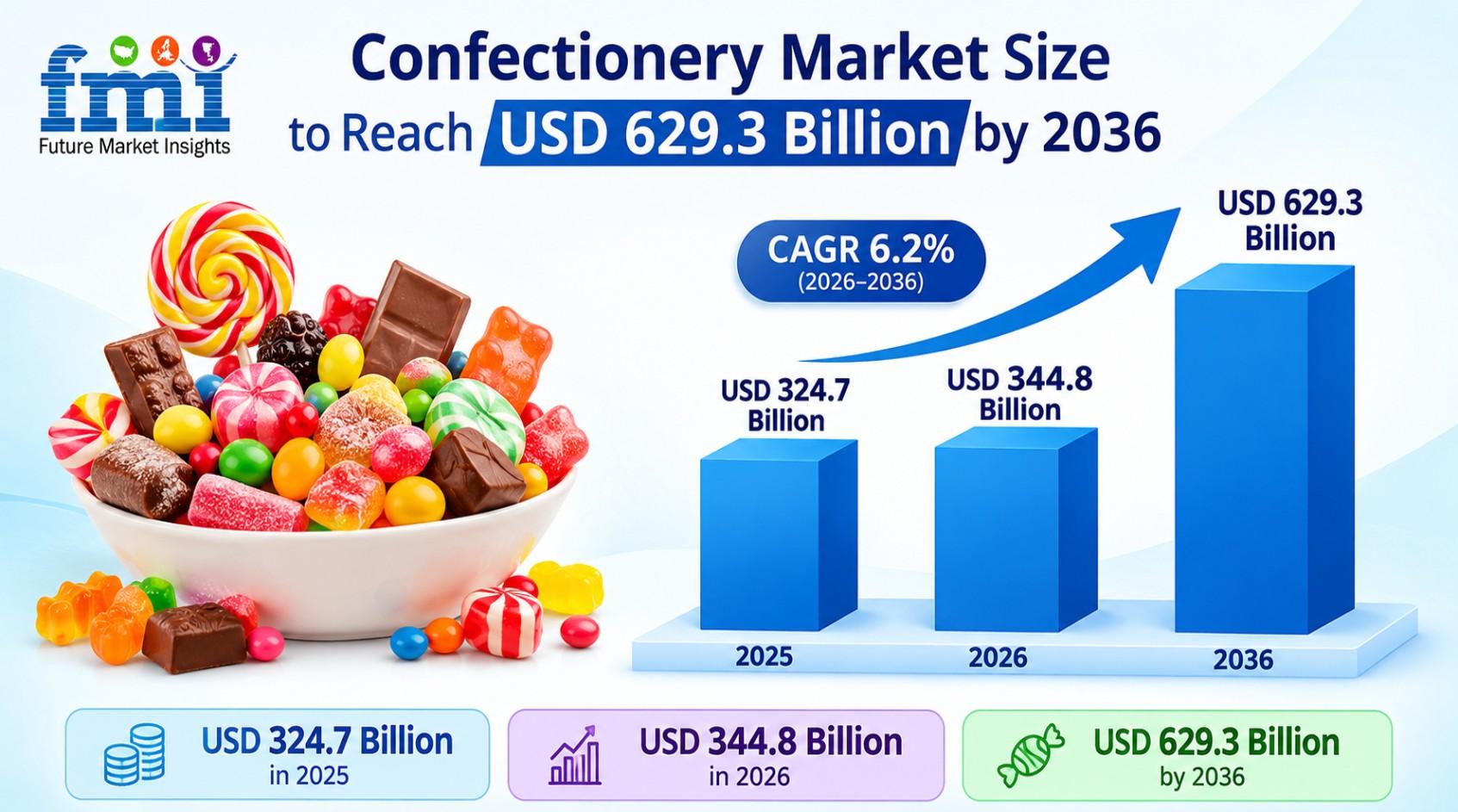
The global confectionery market was valued at USD 324.7 billion in 2025 and is estimated at USD 344.8 billion in 2026. The market is projected to reach USD 629.3 billion by 2036, expanding at a CAGR of 6.2% from 2026 to 2036. The market is expected to create an incremental opportunity of USD 284.5 billion during the forecast period.
Future Market Insights' analysis of the confectionery market provides investors, confectionery manufacturers, ingredient suppliers, retail category managers, and industry decision-makers with insights into market sizing, segment performance, country-level demand, competitive positioning, cocoa price dynamics, and opportunities across the global sweet treats and snack value chain.
Request Exclusive Sample (Top Performing Strategies (Next 10 years) :
https://www.futuremarketinsights.com/reports/sample/rep-gb-420
What is Confectionery Processing and Distribution?
Confectionery processing and distribution refers to the industrial formulation, cooking, molding, enrobing, and packaging of chocolate sweets, sugar candy, gum products, and novelty confectionery. These products including chocolate bars, molded blocks, fruit gummies, hard-boiled candies, and breath-freshening gums are distributed globally across supermarkets, hypermarkets, convenience stores, specialty outlets, and online retail channels for routine snacking, seasonal celebrations, and gifting.
The market is segmented by product type, flavor, application, end use, distribution channel, and ingredient type. Chocolate confectionery and sugar confectionery represent the principal product types, while fruits, chocolate, and mint lead flavor profiles. Everyday consumption and household pantry stocking anchor application and end-use demand, supported by cocoa-based and sugar-based ingredients distributed through large-format retail stores.
What is Driving the Confectionery Market?
The confectionery market is being supported by steady checkout impulse purchasing and everyday snacking routines across mass retail, alongside seasonal gifting and holiday assortment expansion that commands premium price points.
Emerging markets and formulation innovations are also becoming increasingly relevant. Rapid urbanization, modern grocery penetration, and small-pack affordability across high-growth markets like India and China coupled with consumer interest in low-sugar, portion-controlled, and fruit-forward gummies are sustaining global volume and value expansion.
Key Steps Required to Set Up a Confectionery Manufacturing Plant
1. Market Analysis
A confectionery manufacturing enterprise should begin with a detailed assessment of cocoa bean and sugar commodity pricing, regional flavor preferences (fruit vs. chocolate notes), target pack architecture (single-serve impulse vs. family sharing bags), modern retail distribution access, and competitive positioning.
The global confectionery market is projected to expand from USD 344.8 billion in 2026 to USD 629.3 billion by 2036, representing a 6.2% CAGR.
Key market analysis areas include:
- Product Type segmentation: Chocolate Confectionery, Sugar Confectionery, Gum Confectionery, Bakery Confectionery, and Frozen/Novelty Confectionery
- Flavor segmentation: Fruits (Strawberry, Citrus), Nuts, Chocolate, Vanilla, Coffee, and Mint/Peppermint
- Application segmentation: Everyday Consumption, Gifting, Celebrations and Events, Health and Wellness, and Foodservice/Hospitality
- End-Use & Channel analysis: Households, Retail Stores, Supermarkets/Hypermarkets, Convenience Stores, Online Retail, and Specialty Stores
- Ingredient Type analysis: Cocoa-Based Ingredients, Sugar-Based Ingredients, Natural Sweeteners, and Inclusions/Additives
2. Product Production: Product and Format Planning
A commercial confectionery processing facility needs to align its production lines with high-speed automated packaging for impulse treats as well as delicate molding lines for holiday assortments.
Key product categories covered by the market include:
- Molded chocolate bars, blocks, and filled pralines for everyday snacking and gifting
- Fruit-flavored gummy candies, jellies, and hard-boiled sweets with stable color and acidity profiles
- Chewing gums and breath-freshening mint tablets
- Reduced-sugar and clean-label confectionery lines using stevia or alternative natural sweeteners
Product planning can also be structured around:
- Automated continuous cooking, depositing, cooling tunnels, and high-speed flow-wrapping machinery
- Portion-controlled mini packs and resealable stand-up pouches for family sharing
- Eye-catching seasonal gift box designs tailored for holiday retail merchandising
3. Project Requirements and Cost Considerations
The economics of a confectionery manufacturing facility depend heavily on cocoa butter and sugar feedstock prices, automated wrapping efficiency, climate-controlled storage, and strict food safety compliance.
The market analysis identifies several areas that should be assessed before investment decisions are made:
- Long-term sourcing agreements for cocoa beans/mass, cocoa butter, sugar, and natural flavorings
- Industrial mixing, conching, tempering, depositing, and high-speed wrapping equipment
- Quality control laboratories for moisture control, Brix measurement, texture analysis, and allergen screening
- Climate-controlled warehousing and cold-chain/ambient distribution management to prevent melting and fat bloom
- Multi-channel retail distribution agreements and checkout point-of-sale display partnerships
- Food safety and quality management certifications (GMP, HACCP, ISO 22000, FSSC 22000)
4. Project Economics
Project economics for a confectionery plant should be evaluated against mass-market volume turnover, high-margin premium chocolate/gifting realization, operating expenditures, and raw cocoa commodity price volatility.
Key economic considerations include:
- Capital expenditure (CAPEX) for automated processing lines, molding machinery, and high-speed packaging systems
- Operating expenditure (OPEX) including ingredients, energy-intensive thermal processing, labor, and packaging materials
- Raw commodity price volatility tied to global cocoa grindings and agricultural crop yields
- Margin expansion through premium chocolate gifting boxes and clean-label diet candy tiers
- Distribution expenses across supermarkets, convenience networks, and digital e-commerce channels
- Payback assessment and sensitivity analysis against raw ingredient cost swings and pack weight adjustments
5. Legal and Regulatory Compliance
Confectionery manufacturers must comply with strict food safety regulations, added-sugar disclosure rules, and mandatory allergen labeling frameworks in each target destination.
Important areas include:
- Compliance with US FDA nutrition labeling mandates (e.g., added-sugar declarations) and European food safety standards
- Strict allergen cross-contamination controls and disclosures (dairy, tree nuts, peanuts, soy, wheat/gluten)
- Accurate labeling of chocolate identity standards (minimum cocoa butter and solids content)
- Good Manufacturing Practices (GMP) and HACCP quality assurance systems
- Chain-of-custody documentation for sustainable cocoa sourcing (Fairtrade, Rainforest Alliance)
Market Opportunities, Success Factors and Risks
The confectionery market offers significant opportunities through chocolate confectionery brand expansion, fruit-flavored gummy innovation, sugar-reduced candy formulations, impulse checkout placement, and rapid urban retail penetration across India and China.
Chocolate confectionery is expected to lead product types with a 42.0% share in 2026, while fruit flavors dominate flavor categories at 35.0%. Everyday consumption captures 46.0% of application demand, households represent 52.0% of end use, and supermarkets/hypermarkets anchor distribution with a 37.5% share.
Who Should Read This Report?
- Global confectionery manufacturers and regional sweet treats brand owners
- Cocoa ingredient processors, sugar refiners, and flavor houses
- Supermarket category buyers and convenience store retail procurement heads
- Investors assessing opportunities in packaged consumer goods, snack foods, and food ingredients
Get More Insights from the Full Research Report :
https://www.futuremarketinsights.com/reports/asean-confectionery-market
Frequently Asked Questions
1. What is the global confectionery market value in 2026?
The global confectionery market is estimated to reach USD 344.8 billion in 2026.
2. What will the confectionery market be worth by 2036?
The market is projected to reach USD 629.3 billion by 2036, creating an incremental opportunity of approximately USD 284.5 billion between 2026 and 2036.
3. What is the expected growth rate of the confectionery market?
The market is projected to expand at a CAGR of 6.2% from 2026 to 2036.
4. Which product type leads the confectionery market?
Chocolate confectionery is projected to account for 42.0% of the product segment in 2026, driven by wide shelf space allocation, molded bars, and seasonal gifting formats.
5. Which countries are showing the fastest growth?
India (7.8% CAGR) and China (7.5% CAGR) are forecast to lead national market expansion through 2036, driven by urban modern retail growth and branded snack pack adoption.
Explore In-Depth Food & Beverage Market Insights: https://www.futuremarketinsights.com/industry-analysis/food-and-beverage
FMI Custom Research: Strategic Intelligence for Confident Decision-Making
In today's rapidly evolving business environment, leadership teams need clear, actionable intelligence tailored to their strategic objectives. FMI's Custom Research solutions are designed around specific business questions, enabling executives to evaluate growth opportunities, validate investments, assess competitive dynamics, and reduce uncertainty before making critical decisions.
Key Executive Benefits
- Decision-Ready Insights: Research tailored to your specific business challenges, growth plans, and investment priorities.
- Reduced Strategic Risk: Validate market opportunities, customer demand, and competitive positioning before committing resources.
- Market Entry Confidence: Assess opportunity size, regulatory barriers, channel dynamics, and competitive landscapes with precision.
- Competitive Advantage: Gain proprietary intelligence unavailable through syndicated reports or internal datasets.
- Faster Growth Decisions: Accelerate expansion, product development, portfolio optimization, and investment planning.
- Primary Market Validation: Access real-world customer, buyer, and stakeholder insights that support high-confidence decision-making.
Business Impact
FMI helps organizations transform market complexity into strategic clarity, enabling leadership teams to identify growth opportunities faster, optimize resource allocation, strengthen competitive positioning, and make high-stakes business decisions with confidence.
To explore how FMI Custom Research can support your strategic priorities, connect with our team at - sales@futuremarketinsights.com
About Future Market Insights (FMI)
Future Market Insights (FMI) delivers actionable, decision-focused market intelligence that goes beyond traditional research reports. The company provides:
- In-depth pricing and cost benchmarking analysis
- Demand forecasting based on real industry inputs
- Procurement and buyer behavior insights
- Supply chain and trade flow intelligence
- Technology and application trend analysis across industries
FMI follows a robust bottom-up research methodology, combining insights from industry experts, procurement leaders, manufacturers, and technical professionals to ensure accurate and practical market intelligence.

 English
 Arabic
 French
 Spanish
 Portuguese
 Deutsch
 Turkish
 Dutch
Dutch
 Italiano
 Russian
 Romaian
 Portuguese (Brazil)
