


GLP-1 Meal Replacement Market Size to Reach USD 10.9 Billion by 2036, Driven by Ready-to-Drink Shakes
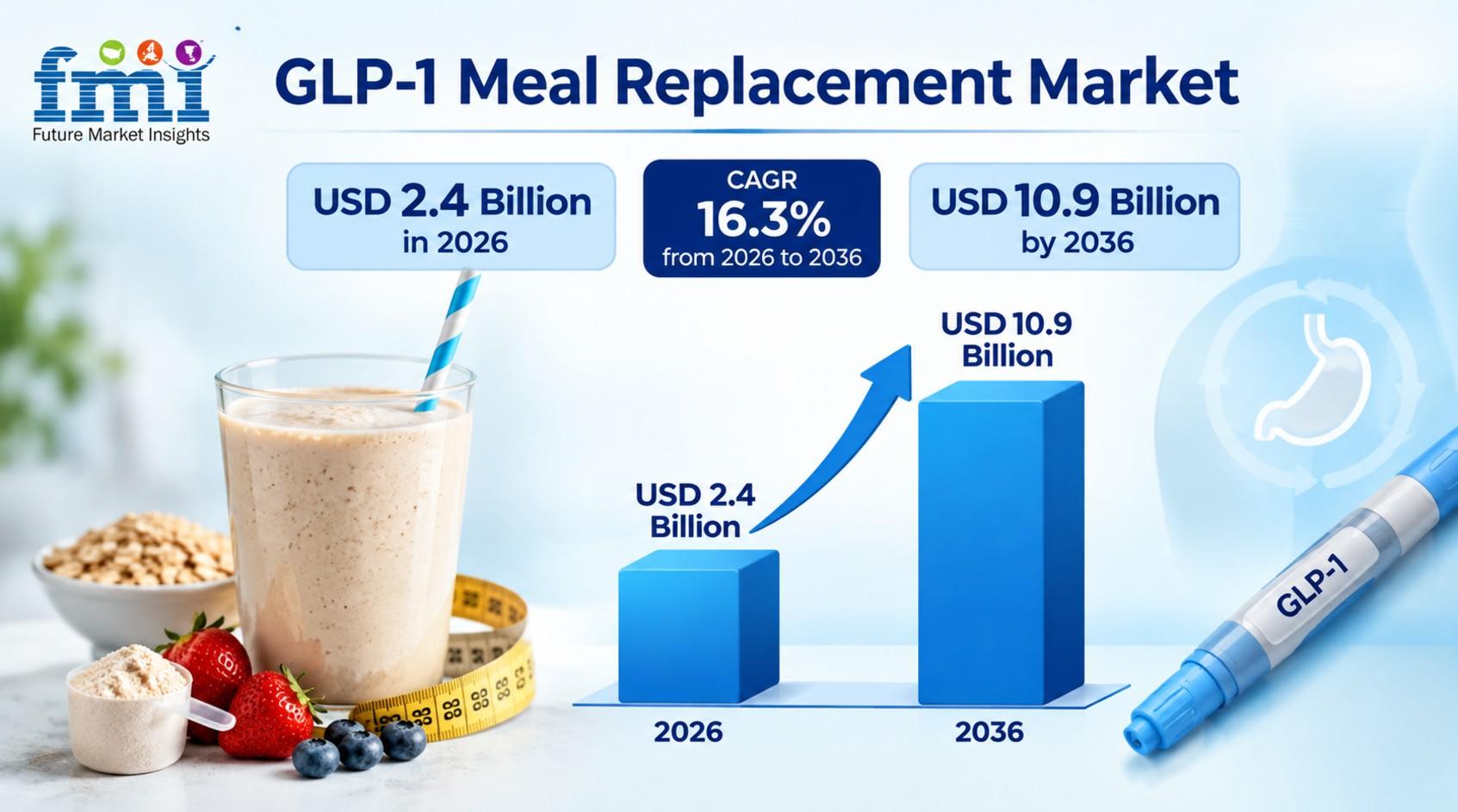
The global GLP-1 meal replacement market was valued at USD 2.4 billion in 2026. The market is projected to reach USD 10.9 billion by 2036, expanding at a CAGR of 16.3% from 2026 to 2036. The market is expected to create an incremental opportunity of USD 8.5 billion over the forecast period.
Future Market Insights' analysis of the GLP-1 meal replacement market provides investors, nutrition brand owners, clinical wellness operators, and industry decision-makers with insights into market sizing, segment performance, country-level demand, competitive positioning, formulation trends, and opportunities across the structured weight-management and reduced-appetite nutrition value chain.
Request Exclusive Sample (Top Performing Strategies (Next 10 years) :
https://www.futuremarketinsights.com/reports/sample/rep-gb-32989
What are GLP-1 Meal Replacements?
GLP-1 meal replacements refer to nutritionally formulated beverages, powders, bars, and savory formats positioned to replace or supplement meals for users taking GLP-1 receptor agonist medications or following similar appetite-reduced weight-management routines. These products are formulated to provide functional support around protein density, satiety support, portion control, digestive comfort, and easier daily nutrition when appetite drops.
The market is segmented by product type, nutritional focus, consumer stage, distribution channel, pack format, end use, and region. Ready-to-drink (RTD) shakes and powder meal replacements represent principal product categories, while high-protein, high-fiber, low-sugar, and digestive-support configurations anchor nutritional focuses. Active GLP-1 users and weight-maintenance users form the core consumer segments, distributed through pharmacies, supermarkets, DTC platforms, and wellness channels.
What is Driving the Market?
The GLP-1 meal replacement market is being supported by changes in eating behavior among users taking GLP-1 medications, who often consume smaller portions per sitting and require reliable nutrient density in easier-to-finish formats that minimize daily friction.
Emerging product innovations and major brand platforms are also becoming increasingly relevant. Leading nutrition players and suppliers such as Nestlé Health Science, Huel, BOOST, and ADM are actively rolling out purpose-built companion packs, shakes, and functional concepts explicitly tailored to GLP-1-linked intake behaviors.
Key Steps Required to Set Up a GLP-1 Meal Replacement Brand
1. Market Analysis
A GLP-1-supportive nutrition brand or product line should begin with a detailed assessment of reduced-appetite nutritional requirements (such as muscle preservation via high protein and GI tolerance support), preferred format ergonomics (RTD vs. small-portion powders), regulatory positioning, and channel distribution (pharmacy-adjacent vs. DTC).
The global GLP-1 meal replacement market is projected to expand from USD 2.4 billion in 2026 to USD 10.9 billion by 2036, representing a 16.3% CAGR.
Key market analysis areas include:
- Product Type segmentation: Ready-to-Drink Shakes, Powder Meal Replacements, High-Protein Nutrition Drinks, Soup and Savory Meal Replacements, and Bar-based Meal Replacements
- Nutritional Focus segmentation: High Protein, High Fiber, Low Sugar, Digestive Support, Micronutrient-Fortified, and Satiety-Support Formulations
- Consumer Stage segmentation: Active GLP-1 Users, Weight-Maintenance Users, GLP-1 Step-down Users, and General Weight-Management Consumers
- Distribution Channel analysis: Pharmacies and Health Stores, Supermarkets and Hypermarkets, Direct-to-Consumer (DTC), E-commerce Marketplaces, and Clinical/Wellness Channels
2. Product Production: Product and Format Planning
A structured nutrition manufacturing operation needs to align its production lines with immediate-use convenience formats as well as formulations that prioritize tolerance and nutrient concentration over high caloric volume.
Key product categories covered by the market include:
- Ready-to-drink (RTD) high-protein shakes optimized for effortless daily consumption when appetite is suppressed
- Nutrient-dense powder meal replacements offering lower cost per serving and flexible portion sizing
- Digestive-comfort and fiber-fortified nutrition drinks to address common gastrointestinal side effects
- Structured savory meal replacements and bar formats for variety in daily intake routines
Product planning can also be structured around:
- High bioavailability protein sources to support lean muscle mass preservation during rapid weight loss
- Balanced micronutrient profiles tailored to lower total daily caloric intake volumes
- Clean, non-aggressive marketing language emphasizing practical daily tolerance and nutritional continuity rather than exaggerated weight-loss claims
3. Project Requirements and Cost Considerations
The economics of launching a GLP-1-adjacent meal replacement brand depend heavily on ingredient formulation precision, clinical-adjacent nutrition validation, co-packing partnerships, and customer retention costs in DTC and retail channels.
The market analysis identifies several areas that should be assessed before investment decisions are made:
- Long-term sourcing agreements for high-grade proteins, prebiotic fibers, and vitamin/mineral premixes
- GMP-certified contract manufacturing facilities capable of aseptic liquid RTD bottling or dry powder blending
- Quality control laboratories for nutritional assay verification, shelf-life stability, and heavy metal screening
- Consumer education and trust-building frameworks to avoid category ambiguity and label skepticism
- Multi-channel distribution agreements spanning retail pharmacy shelves and e-commerce platforms
- Customer acquisition and retention strategies tailored to active wellness and weight-management users
4. Project Economics
Project economics for a GLP-1 meal replacement brand should be evaluated against mainstream diet shake margins, specialty clinical nutrition premiums, customer lifetime value (LTV), and marketing expenditure.
Key economic considerations include:
- Capital expenditure (CAPEX) for formulation development, initial inventory runs, and digital/retail brand marketing
- Operating expenditure (OPEX) including premium raw ingredients, co-packing fees, and logistics
- Price realization through functional positioning around tolerance, convenience, and muscle preservation
- Distribution expenses across pharmacy networks, grocery chains, and DTC shipping platforms
- Payback assessment and sensitivity analysis against repeat-use retention rates and regulatory scrutiny on weight-management claims
5. Legal and Regulatory Compliance
Brands operating in the GLP-1 supportive nutrition space must comply with strict dietary supplement or food labeling regulations, ensuring transparent structure/function claims without crossing into unauthorized medical or drug marketing.
Important areas include:
- Compliance with FDA or EFSA regulations governing food and meal replacement labeling standards
- Transparent nutritional disclosures (calories, protein quality, fiber content, and micronutrient profiles)
- Adherence to good manufacturing practices (GMP) for food and supplement safety
- Avoidance of unverified clinical claims or direct medical associations tied to specific prescription drugs
- Accurate allergen labeling and warning disclosures where applicable
Market Opportunities, Success Factors and Risks
The GLP-1 meal replacement market offers significant opportunities through high-protein RTD format dominance, pharmacy-adjacent retail placements, structured multi-pack bundling (such as companion packs), and expanding international demand across Europe and East Asia.
Ready-to-drink shakes are expected to lead product types with a 31.0% share in 2026, while high-protein formulations capture 34.0% of nutritional focus. Active GLP-1 users represent the primary consumer stage, and North America anchors the largest regional market value.
Who Should Read This Report?
- Nutritional supplement and functional beverage brand executives
- Food and ingredient technology companies developing supportive solutions
- Pharmacy retail buyers and grocery category managers
- Investors assessing opportunities in specialized nutrition, active aging, and weight-management health trends
Get More Insights from the Full Research Report : https://www.futuremarketinsights.com/reports/glp-1-meal-replacement-market
Frequently Asked Questions
1. How large is the global GLP-1 meal replacement market?
The global GLP-1 meal replacement market is estimated to be valued at USD 2.4 billion in 2026.
2. What will the GLP-1 meal replacement market be worth by 2036?
The market is projected to reach USD 10.9 billion by 2036, creating an incremental opportunity of approximately USD 8.5 billion over the forecast period.
3. What is the expected growth rate of the GLP-1 meal replacement market?
The market is projected to expand at a CAGR of 16.3% between 2026 and 2036.
4. Which product type leads market revenue?
Ready-to-drink (RTD) shakes are projected to account for 31.0% of market revenue in 2026, driven by immediate usability and simpler compliance with structured intake routines.
5. Which nutritional focus dominates demand?
High protein is the leading nutritional focus with a 34.0% share in 2026, as buyers place heavy weight on muscle preservation and nutrient density during reduced-appetite phases.
Explore In-Depth Food & Beverage Market Insights: https://www.futuremarketinsights.com/industry-analysis/food-and-beverage
FMI Custom Research: Strategic Intelligence for Confident Decision-Making
In today's rapidly evolving business environment, leadership teams need clear, actionable intelligence tailored to their strategic objectives. FMI's Custom Research solutions are designed around specific business questions, enabling executives to evaluate growth opportunities, validate investments, assess competitive dynamics, and reduce uncertainty before making critical decisions.
Key Executive Benefits
- Decision-Ready Insights: Research tailored to your specific business challenges, growth plans, and investment priorities.
- Reduced Strategic Risk: Validate market opportunities, customer demand, and competitive positioning before committing resources.
- Market Entry Confidence: Assess opportunity size, regulatory barriers, channel dynamics, and competitive landscapes with precision.
- Competitive Advantage: Gain proprietary intelligence unavailable through syndicated reports or internal datasets.
- Faster Growth Decisions: Accelerate expansion, product development, portfolio optimization, and investment planning.
- Primary Market Validation: Access real-world customer, buyer, and stakeholder insights that support high-confidence decision-making.
Business Impact
FMI helps organizations transform market complexity into strategic clarity, enabling leadership teams to identify growth opportunities faster, optimize resource allocation, strengthen competitive positioning, and make high-stakes business decisions with confidence.
To explore how FMI Custom Research can support your strategic priorities, connect with our team at - sales@futuremarketinsights.com
About Future Market Insights (FMI)
Future Market Insights (FMI) delivers actionable, decision-focused market intelligence that goes beyond traditional research reports. The company provides:
- In-depth pricing and cost benchmarking analysis
- Demand forecasting based on real industry inputs
- Procurement and buyer behavior insights
- Supply chain and trade flow intelligence
- Technology and application trend analysis across industries
FMI follows a robust bottom-up research methodology, combining insights from industry experts, procurement leaders, manufacturers, and technical professionals to ensure accurate and practical market intelligence.

 English
 Arabic
 French
 Spanish
 Portuguese
 Deutsch
 Turkish
 Italiano
 Russian
 Romaian
 Portuguese (Brazil)
 Greek
Greek
