


Shrimp Market Size to Reach USD 162.7 Billion by 2036, Driven by Canned Formats
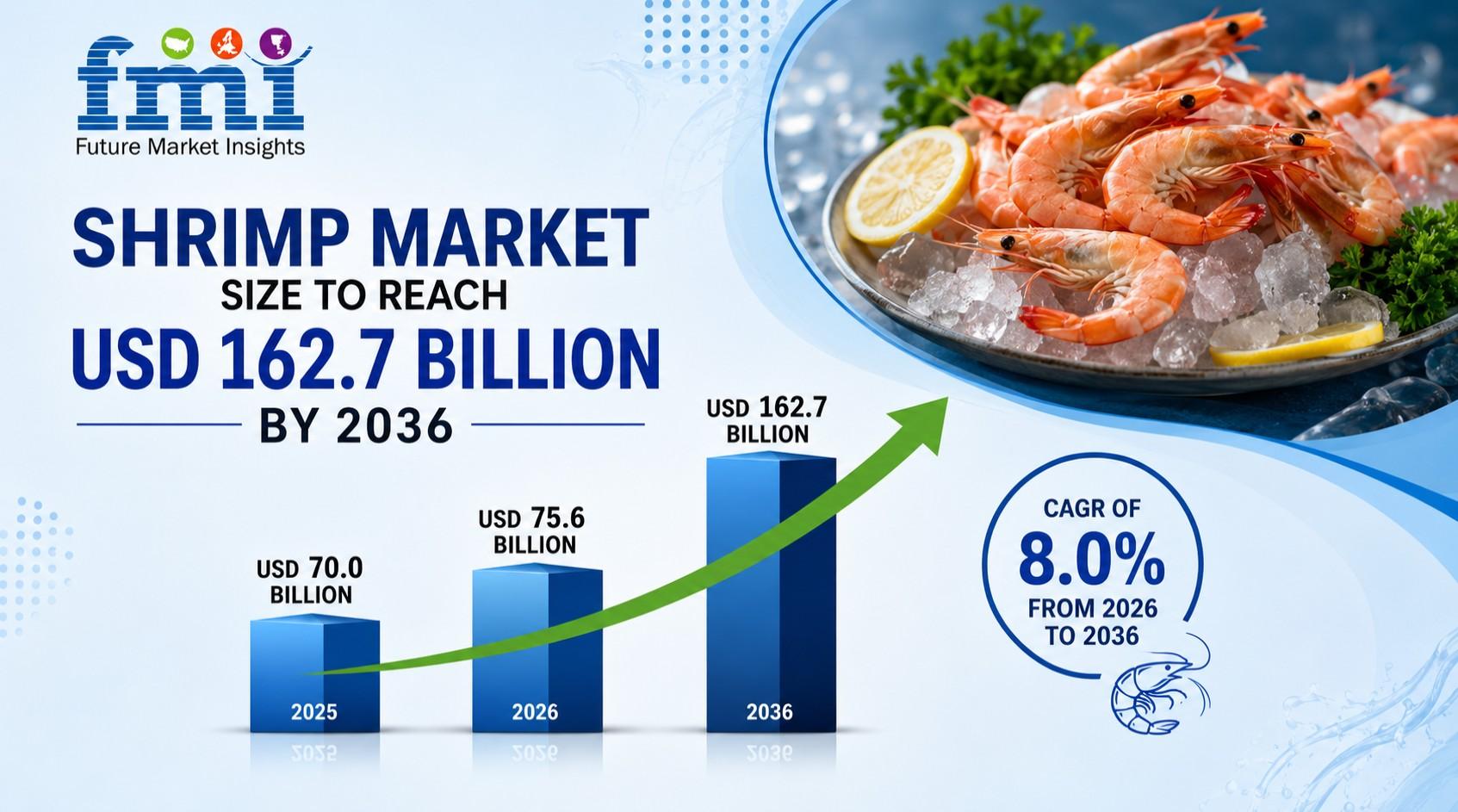
The global shrimp market was valued at USD 70.0 billion in 2025 and is estimated at USD 75.6 billion in 2026. The market is projected to reach USD 162.7 billion by 2036, expanding at a CAGR of 8.0% from 2026 to 2036. The market is expected to create an incremental opportunity of USD 87.1 billion during the forecast period.
Future Market Insights' analysis of the shrimp market provides investors, seafood processors, aquaculture operators, and industry decision-makers with insights into market sizing, segment performance, country-level demand, competitive positioning, trade flows, and opportunities across the global edible seafood value chain.
Request Exclusive Sample (Top Performing Strategies (Next 10 years) :
https://www.futuremarketinsights.com/reports/sample/rep-gb-1838
What is Shrimp Processing and Distribution?
Shrimp processing and distribution refers to the farming, harvesting, cleaning, cooking, peeling, canning, freezing, and commercial supply of farmed and wild shrimp for edible food applications. Available in various formats including canned, breaded, peeled, cooked peeled, shell-on, and frozen these products are distributed globally through retail grocery chains, foodservice operations, and direct processing channels.
The market is segmented by species, form, source, processing method, and application. Gulf shrimps and farmed whiteleg/giant tiger shrimps represent principal species categories, while canned and frozen formats dominate form classifications. Conventional and organic supply options anchor source categories, with direct processing leading methods and food applications capturing the vast majority of volume.
What is Driving the Shrimp Market?
The shrimp market is being supported by retailers and foodservice operators utilizing canned and frozen shrimp formats to reduce spoilage risks, extend shelf life, and provide convenient, quick-cook protein options for everyday meals.
Emerging import hubs and value-added processing are also becoming increasingly relevant. Export-oriented processors are shifting away from raw frozen blocks toward cooked, canned, and portioned value-added products to protect farm-level margins against global pricing volatility.
Key Steps Required to Set Up a Shrimp Processing Facility
1. Market Analysis
A shrimp processing and export plant should begin with a detailed assessment of raw material access from local aquaculture ponds or wild-capture fleets, cold-chain logistics capacity, value-added formatting capabilities (canned vs. frozen), and regulatory compliance for export destinations.
The global shrimp market is projected to expand from USD 75.6 billion in 2026 to USD 162.7 billion by 2036, representing an 8.0% CAGR.
Key market analysis areas include:
- Species segmentation: Gulf Shrimps, Farmed Whiteleg Shrimps, Giant Tiger Shrimps, Royal Red Shrimps, Blue Shrimps, and Ocean Shrimps
- Form segmentation: Canned, Breaded, Peeled, Cooked Peeled, Shell-On, and Frozen
- Source segmentation: Conventional and Organic
- Processing Method analysis: Direct Processing and Indirect Processing
- Application analysis: Food, Pharmaceuticals, Cosmetics, Industrial, and Biotechnology
2. Product Production: Product and Format Planning
A commercial shrimp processing plant needs to align its output lines with long shelf-life retail pantry formats as well as high-volume foodservice peeled packs.
Key product categories covered by the market include:
- Shelf-stable canned shrimp for convenient retail pantry stocking and zero-waste storage
- Individually quick-frozen (IQF) peeled and cooked shrimp for quick-service restaurants and home meal prep
- Breaded and value-added specialty shrimp lines for casual dining channels
- Raw shell-on and headless frozen blocks for industrial seafood distributors
Product planning can also be structured around:
- Direct processing lines to minimize transfer points, ensure lot traceability, and tighten quality control
- Residue testing and disease-free farm verification protocols (vital for meeting strict EU and US import rules)
- Eco-friendly and tamper-evident packaging formats tailored for export logistics
3. Project Requirements and Cost Considerations
The economics of a shrimp processing facility depend heavily on steady raw shrimp supply from farms, reliable cold-chain infrastructure, energy management for freezing/canning, and strict quality assurance.
The market analysis identifies several areas that should be assessed before investment decisions are made:
- Long-term sourcing agreements with local shrimp farmers and aquaculture cooperatives
- Industrial peeling, cooking, canning, and blast-freezing machinery
- Quality control laboratories for antibiotic residue screening, heavy metal testing, and microbial safety
- Traceability software for farm-to-pack documentation and seed-to-export record keeping
- Global cold-chain logistics integration (refrigerated trucking, port containerization)
- Compliance with export authority standards (such as MPEDA guidelines in India)
4. Project Economics
Project economics for a shrimp processing operation should be evaluated against raw material cost volatility, import market pricing pressure, operating expenditures, and value-added product mix premiums.
Key economic considerations include:
- Capital expenditure (CAPEX) for automated processing plants, freezing tunnels, and canning lines
- Operating expenditure (OPEX) including raw shrimp feedstock, energy utilities, water treatment, and labor
- Feed and farm input cost fluctuations impacting raw shrimp landed pricing
- Margin expansion through value-added cooked and canned formats versus raw commodity blocks
- Distribution expenses across international trade corridors (e.g., India/Ecuador to the US and China)
- Payback assessment and sensitivity analysis against disease outbreaks and global seafood price swings
5. Legal and Regulatory Compliance
Shrimp processors must comply with strict international food safety regulations, food import controls, and environmental/sustainability standards in each target market.
Important areas include:
- Compliance with US FDA and European Commission food import safety regulations
- Antibiotic residue testing and zero-tolerance policies for banned veterinary drugs
- Traceability documentation proving responsible farm practices and cold-chain integrity
- Good Manufacturing Practices (GMP) and HACCP food safety assurance systems
- Environmental compliance for wastewater discharge and aquaculture pond management
Market Opportunities, Success Factors and Risks
The shrimp market offers significant opportunities through canned seafood expansion, value-added ready-to-cook product development, traceability-led retail placements, and rapid export-processing growth in key supply origins like India.
Canned shrimp is expected to lead form segments with an 80.0% share in 2026, while Gulf shrimps dominate species demand at 53.0%. Conventional supply accounts for 86.0% of sources, direct processing leads methods at 62.0%, and food applications capture 82.0% of market volume.
Who Should Read This Report?
- Commercial shrimp processors and aquaculture farm executives
- Seafood importers, exporters, and cold-chain logistics providers
- Grocery retail category buyers and foodservice procurement directors
- Investors assessing opportunities in global seafood supply chains, marine proteins, and food processing technology
Get More Insights from the Full Research Report :
https://www.futuremarketinsights.com/reports/shrimp-market
Frequently Asked Questions
1. What is the global shrimp market value in 2026?
The global shrimp market is expected to reach USD 75.6 billion in 2026.
2. What will the shrimp market be worth by 2036?
The market is projected to reach USD 162.7 billion by 2036, creating an incremental opportunity of approximately USD 87.1 billion during the forecast period.
3. What is the expected growth rate of the shrimp market?
The market is projected to expand at a CAGR of 8.0% between 2026 and 2036.
4. Which form segment is expected to lead the market?
Canned shrimp is projected to account for an 80.0% share in 2026, driven by long shelf life, reduced household waste, and simplified retail inventory planning.
5. Which country is showing the fastest growth?
India is projected to record the fastest growth at a 10.2% CAGR through 2036, supported by massive processing scale and established global export relationships.
Explore More Related Studies Published by FMI Research
Date Syrup Market : https://www.futuremarketinsights.com/reports/date-syrup-market
Europe Postbiotic Pet Food Market : https://www.futuremarketinsights.com/reports/europe-postbiotic-pet-food-market
Explore In-Depth Food & Beverage Market Insights: https://www.futuremarketinsights.com/industry-analysis/food-and-beverage
FMI Custom Research: Strategic Intelligence for Confident Decision-Making
In today's rapidly evolving business environment, leadership teams need clear, actionable intelligence tailored to their strategic objectives. FMI's Custom Research solutions are designed around specific business questions, enabling executives to evaluate growth opportunities, validate investments, assess competitive dynamics, and reduce uncertainty before making critical decisions.
Key Executive Benefits
- Decision-Ready Insights: Research tailored to your specific business challenges, growth plans, and investment priorities.
- Reduced Strategic Risk: Validate market opportunities, customer demand, and competitive positioning before committing resources.
- Market Entry Confidence: Assess opportunity size, regulatory barriers, channel dynamics, and competitive landscapes with precision.
- Competitive Advantage: Gain proprietary intelligence unavailable through syndicated reports or internal datasets.
- Faster Growth Decisions: Accelerate expansion, product development, portfolio optimization, and investment planning.
- Primary Market Validation: Access real-world customer, buyer, and stakeholder insights that support high-confidence decision-making.
Business Impact
FMI helps organizations transform market complexity into strategic clarity, enabling leadership teams to identify growth opportunities faster, optimize resource allocation, strengthen competitive positioning, and make high-stakes business decisions with confidence.
To explore how FMI Custom Research can support your strategic priorities, connect with our team at - sales@futuremarketinsights.com
About Future Market Insights (FMI)
Future Market Insights (FMI) delivers actionable, decision-focused market intelligence that goes beyond traditional research reports. The company provides:
- In-depth pricing and cost benchmarking analysis
- Demand forecasting based on real industry inputs
- Procurement and buyer behavior insights
- Supply chain and trade flow intelligence
- Technology and application trend analysis across industries
FMI follows a robust bottom-up research methodology, combining insights from industry experts, procurement leaders, manufacturers, and technical professionals to ensure accurate and practical market intelligence.

 English
 Arabic
 French
 Portuguese
 Deutsch
 Turkish
 Dutch
Dutch
 Italiano
 Russian
 Romaian
 Portuguese (Brazil)
 Greek
Greek
