


Kundali Matching and Guna Milan
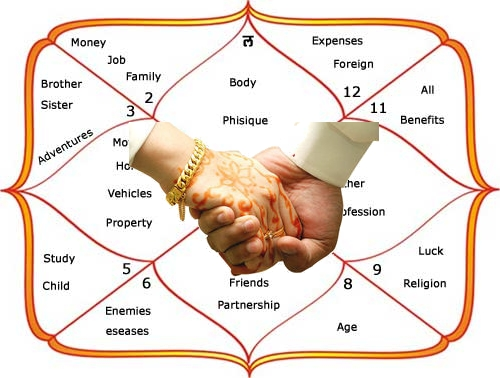
Kundali matching is a traditional Vedic astrology practice used to compare the birth charts of two individuals before marriage. It commonly includes Guna Milan through the Ashta Koota system and may also involve planetary, house, Rashi, and Nakshatra analysis. Accurate birth date, birth time, and birthplace are generally required to prepare the charts used for comparison. The traditional system assigns a maximum of 36 points, although a complete compatibility assessment can involve factors beyond this score. Online astrology calculators can provide useful preliminary calculations when correct information is entered. Astrology is a traditional belief system, and its interpretations are not scientifically established predictions of relationship outcomes.
What Is Kundali Matching and How Does It Work?
kundali matching is the traditional comparison of two birth charts according to principles of Vedic astrology. A Kundali, or birth chart, is prepared from an individual's date, time, and place of birth and traditionally represents planetary positions, zodiac signs, houses, and Nakshatras at that moment. In marriage compatibility assessment, the Moon's Rashi and Nakshatra are particularly important in the Ashta Koota method.
The process generally begins by entering the birth details of both individuals into an astrology calculation system. Their charts are then compared using Guna Milan and, depending on the approach, other Jyotish factors. Traditional analysis may include the seventh house, its lord, Venus, Jupiter, Moon, Navamsa, Dashas, and Manglik considerations. These factors can add context to the matching process, but they should be understood as traditional astrological interpretations rather than scientifically verified predictions.
What Is Guna Milan in Vedic Astrology?
guna milan is a traditional compatibility system within Vedic astrology that evaluates eight Kootas under the Ashta Koota framework. These categories are used to compare selected characteristics of two individuals and together provide a maximum of 36 points. The system is commonly associated with the Moon signs and Nakshatras of the prospective partners.
The traditional point allocation is:
-
Varna: 1 point
-
Vashya: 2 points
-
Tara: 3 points
-
Yoni: 4 points
-
Graha Maitri: 5 points
-
Gana: 6 points
-
Bhakoot: 7 points
-
Nadi: 8 points
Varna is traditionally associated with broad compatibility classifications, while Vashya concerns mutual influence. Tara is based on Nakshatra-related considerations, and Yoni is traditionally linked with behavioural and physical compatibility. Graha Maitri examines planetary friendship, Gana concerns temperament, Bhakoot evaluates Moon sign relationships, and Nadi receives the highest point value.
How Does Horoscope Kundali Matching Help With Marriage Compatibility?
horoscope kundali matching for marriage provides a traditional framework for comparing the astrological characteristics of two prospective partners. General horoscope matching may use broad information such as zodiac signs or Nakshatras, while personalised Kundali matching uses individual birth details to prepare and compare specific charts. This makes personalised matching more detailed than a general horoscope comparison.
Traditional Jyotish may also consider the seventh house and its lord, Venus, Jupiter, Moon, Navamsa, Dashas, and Manglik factors. For instance, the seventh house is traditionally associated with marriage and partnerships, while Venus and Jupiter may receive attention in marriage-related interpretations. These concepts belong to Jyotish traditions and are not scientifically established measures of relationship success. Couples should therefore consider communication, shared values, financial expectations, and family responsibilities alongside any astrological assessment.
What Are the 36 Gunas in Kundali Matching?
The 36 Gunas represent the maximum points available across the eight categories of Ashta Koota matching. The system assigns different weights to each category, with Nadi receiving 8 points and Bhakoot receiving 7 points. Gana receives 6 points, Graha Maitri 5, Yoni 4, Tara 3, Vashya 2, and Varna 1. Together, these values form the traditional 36-point framework.
In many traditional Kundali matching practices, 18 out of 36 is commonly treated as a minimum reference benchmark. However, this benchmark is not an absolute rule and is not scientifically validated. A score below 18 does not automatically mean a marriage will fail, while a score above 18 cannot guarantee a successful or happy relationship. Traditional practitioners may examine additional chart factors before interpreting the overall result.
How Is Kundali Matching Performed Using Drik Panchang?
drik panchang kundali matching involves using the Kundali and astrology calculation resources provided through the Drik Panchang platform. Drik Panchang is an astrology and Panchang reference platform offering tools and calculations based on traditional Hindu calendar and Jyotish concepts. Users generally enter the birth date, birth time, and birthplace of both individuals to generate relevant charts and compatibility information.
The result can be influenced by several technical settings. Birth time accuracy, birthplace, time zone, Ayanamsha, calculation method, chart system, and rounding or software settings can affect calculations. Different astrology tools may therefore produce different results even when the basic birth information appears similar. Users should verify their details and calculation settings before interpreting or comparing results. Online calculations represent traditional astrology methods and do not scientifically guarantee marriage success or failure.
What Is the Difference Between Kundali Matching and Guna Milan?
Kundali matching is the broader process of comparing two birth charts, whereas Guna Milan is a specific scoring method within the Ashta Koota system. Horoscope matching may be used as a general term for comparing astrological information, while birth chart compatibility can involve a wider examination of planets, houses, Rashis, Nakshatras, Navamsa, and Dashas.
This distinction is important because the 36-point Guna score does not represent every factor contained in two complete birth charts. For example, two couples could have similar Guna scores but different planetary placements or seventh-house conditions. A traditional practitioner may therefore examine the complete charts before forming an interpretation. Guna Milan is consequently best understood as one component of traditional Kundali matching rather than a complete substitute for chart analysis.
Which Factors Are Considered Beyond the Guna Milan Score?
Traditional Jyotish may examine several factors beyond Ashta Koota scoring. These can include planetary placements, the seventh house and its lord, Venus, Jupiter, Moon, Navamsa, Dashas, planetary aspects, and Manglik considerations. The importance assigned to each factor can vary according to the school of Jyotish or methodology being followed.
A complete relationship assessment also requires practical considerations that an astrological chart cannot adequately measure. Couples should discuss financial planning, career priorities, family expectations, household responsibilities, communication patterns, lifestyle preferences, personal boundaries, and long-term goals. A favourable traditional score cannot guarantee compatibility in these areas, and a lower score cannot prove that a relationship is unsuitable.
What Birth Details Are Required for Accurate Kundali Matching?
Accurate birth information is generally important for traditional Kundali calculations. The basic details required for both individuals are:
-
Date of birth
-
Birth time
-
Birthplace
The birth date establishes the basic astronomical reference, while birth time can affect the Ascendant and house positions. Birthplace is relevant to location-based calculations, and precise information may influence the resulting Rashi, Nakshatra, and other chart elements.
If the recorded birth time is uncertain, some parts of the resulting chart may also be uncertain. When comparing results from different online tools, users should check whether the same time zone, Ayanamsha, chart system, and calculation method have been applied. Verifying these details can help explain differences between generated results.
How Should Couples Interpret a Kundali Matching Result?
A Kundali matching result should be treated as a traditional reference rather than a final judgment about a relationship. For example, a couple receiving 27 out of 36 points should not assume that the score guarantees marital happiness. Likewise, a score of 16 does not establish that the relationship will fail. The number reflects the traditional Ashta Koota calculation and its specific rules.
Couples who follow astrology can use the result as one perspective while also discussing practical matters before marriage. Communication, financial expectations, career plans, family relationships, lifestyle preferences, personal values, and future responsibilities should be considered openly. Astrology may have cultural or spiritual significance for some people, but major marriage decisions should not be based solely on a Guna score or automated compatibility result.

 English
 Arabic
 French
 Spanish
 Portuguese
 Deutsch
 Dutch
Dutch
 Italiano
 Russian
 Romaian
 Portuguese (Brazil)
 Greek
Greek
