


How to Automate Sales Follow-Ups Without Losing the Personal Touch
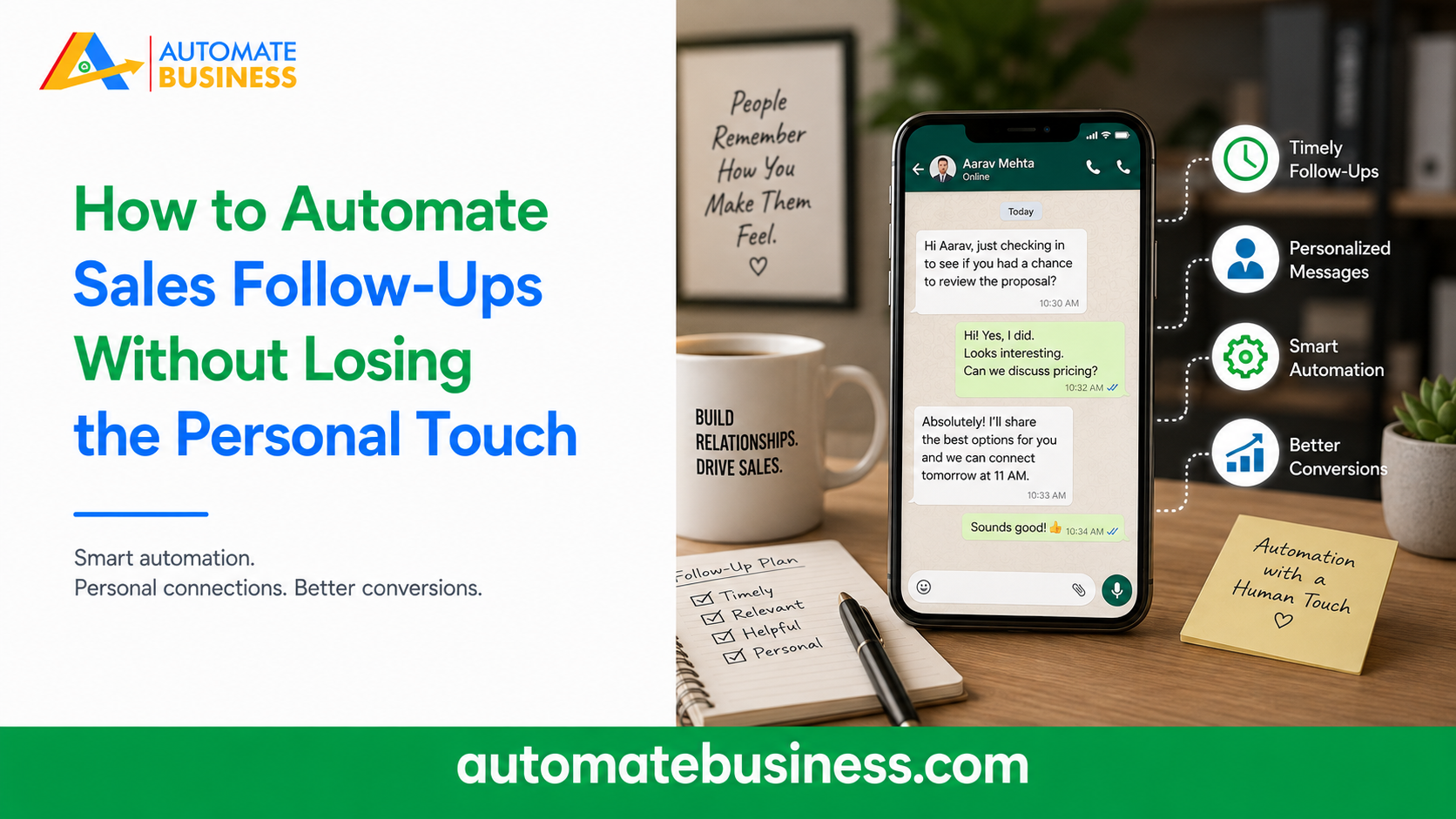
The moment a follow-up message feels like it was sent to a mailing list, the buyer stops feeling like a prospect and starts feeling like a number. In B2B sales, particularly across Indian manufacturing, trading, real estate, and service businesses, trust is the transaction before the transaction. Automation that kills that trust does not save time it costs deals. But automation that preserves or even deepens the sense of individual attention? That is the kind that scales a sales team without scaling headcount.
The Fear That Stops Most MSMEs From Automating Follow-Ups
When MSME owners first explore sales automation, the concern is almost always the same: “If we automate the follow-up, it will feel impersonal. Our clients will notice. It will hurt the relationship."
This fear is reasonable. Everyone has received a follow-up email that starts with “Dear [First Name]” or a WhatsApp message that is clearly a copy-paste from a template. These messages do not just fail to build trust they actively erode it. They signal that the sender did not bother to remember who they were talking to.
But the fear of impersonal automation is not a reason to avoid automation. It is a reason to do automation correctly. The difference between follow-up automation that feels robotic and follow-up automation that feels genuinely attentive is not whether a system is involved. It is whether the system uses the information it already has to make every message feel relevant, timely, and specific to the person receiving it.
Automate CRM is built to do exactly this. It automates the mechanical, time-sensitive parts of sales follow-up the timing, the triggering, the scheduling while using every piece of contextual data in the lead record to make each message feel as if it was written specifically for that person. The result is a sales team that responds faster, follows up more consistently, and builds better relationships than it could manage manually because the system handles the volume and the salesperson handles the human judgement.
Automation does not replace the personal touch. Done correctly, it creates the conditions for the personal touch to happen at the right moment, every time, for every lead.
Two Myths That Need Clearing Up First
Before mapping how to automate follow-ups with genuine personalization, two persistent myths about sales automation need to be addressed directly:
- MYTH: Automated messages are always impersonal.
TRUTH: A message is impersonal when it ignores context, not when it is sent by a system. An automated WhatsApp that says “Hi Rahul, following up on your IndiaMART enquiry for stainless steel fittings did you get a chance to review the spec we sent?” is more personal than a generic manual call that opens with “Hi, are you interested in our products?” Personalization is in the data used, not in the channel delivering it. - MYTH: If you automate follow-ups, salespeople become redundant.
TRUTH: Automation handles the mechanical work: sending the first message, scheduling the reminder, flagging the overdue task, and triggering the re-engagement sequence. Salespeople handle the work that actually closes deals: listening to the buyer’s specific requirement, navigating concerns about pricing or timeline, and building the kind of trust that makes a buyer choose you over a lower-priced competitor. Automation creates more time for salespeople to be human, not less.
5 Rules for Automating Follow-Ups That Still Feel Personal
The difference between automation that feels robotic and automation that feels attentive comes down to five principles. Each one is both a design rule for your sales process and a feature that Automate CRM implements directly.
- RULE 01 Use the Buyer’s Own Words Back to Them
Robotic: “Dear Customer, we are following up on your recent enquiry. Please let us know if you have any questions.”
Personal: “Hi Suresh, you asked about our 2-inch ball valve range for your Pune facility. We have sent the spec sheet — happy to arrange a call at your convenience.”
In Automate CRM: Every lead from IndiaMART, TradeIndia, or Facebook enters the pipeline with the original enquiry text as context. WhatsApp templates and AI email content draw from this data automatically so every first message references what the buyer actually asked about, not a generic product category. - RULE 02 Time Follow-Ups Around the Buyer’s Behavior, Not Your Schedule
Robotic: Monday morning blast to all pending leads regardless of when they last engaged.
Personal: A lead that opened the proposal email on Thursday at 4 PM receives a follow-up call reminder for Friday morning. A lead that went quiet for ten days receives a re-engagement message, not the same follow-up as an active prospect.
In Automate CRM: Stage-change automation and pipeline rules in Automate CRM trigger follow-up actions based on lead activity, not arbitrary calendar schedules. A proposal-stage lead triggers a 48-hour follow-up task from the moment the proposal is sent. A cold lead triggers a re-engagement sequence after a defined inactivity period. The timing responds to what the buyer has done. - RULE 03 Reference the Stage of the Conversation, Not Just the Lead’s Name
Robotic: “Hi [Name], just checking in on your enquiry.”
Personal: “Hi Priya, we spoke last Tuesday and you mentioned you needed delivery by the 15th. I wanted to confirm we can meet that timeline before you finalize.”
In Automate CRM: Automate CRM stores every call note, WhatsApp exchange, and stage movement in a chronological lead timeline. AI-generated follow-up emails and WhatsApp templates can reference the last logged interaction, the current pipeline stage, and any specific notes added by the salesperson making the message feel like a continuation of a real conversation, not the opening of a new one. - RULE 04 Let Automation Handle Timing, Not Tone
Robotic: Fully templated, zero-deviation messages sent at system-determined intervals regardless of context.
Personal: The system handles when to reach out. The salesperson decides the tone, adds a specific detail, or records a voice note before sending. Automation triggers the reminder and pre-fills the context. The human adds the warmth.
In Automate CRM: Automate CRM’s follow-up reminders surface the lead to the salesperson with full context already visible: the original enquiry, the last conversation, the stage, and the suggested next action. The salesperson can use an AI-generated draft as a starting point, personalize it in seconds, and send it. The system does the remembering. The salesperson does the relating. - RULE 05 Segment Before You Automate
Robotic: All leads receive the same follow-up sequence regardless of product interest, deal size, or engagement level.
Personal: A lead enquiring about a bulk order for industrial equipment receives a different sequence to a lead asking about a single unit for personal use. A highly engaged lead who has opened the proposal twice receives a different message to a cold lead who has not responded in three weeks.
In Automate CRM: Automate CRM supports multiple custom pipelines with independent automation rules for each segment. Source tags, custom fields, product categories, and lead scores allow different follow-up sequences to run simultaneously for different buyer profiles. The right message goes to the right person at the right stage, automatically.
Where Automation Ends and the Human Begins
One of the most important design decisions in a sales follow-up system is knowing which moments belong to automation and which belong to a person. Getting this boundary wrong in either direction is costly. Over-automating removes the human warmth that closes relationship-based deals. Under-automating reintroduces the forgetting and delays that automation was meant to solve.
Let Automation Own
- The first acknowledgement when a lead arrives the 90-second WhatsApp that confirms receipt.
- The scheduling of every follow-up task based on stage rules.
- The reminder that surfaces the lead to the salesperson before the deadline, not after.
- The escalation to the manager when a follow-up is missed.
- The re-engagement sequence for leads that have gone quiet.
- The payment link generation when a deal is ready to close.
Let the Salesperson Own
- The second and third conversations the ones where requirements, concerns, and trust are built.
- Any message where the buyer has raised a specific concern that needs a thoughtful, human response.
- The negotiation stage where tone, flexibility, and relationship judgement matter more than timing.
- The closing conversation where a buyer needs to feel that a person, not a system, is standing behind the product or service.
- Any re-engagement after a long silence where a brief, genuinely personal message outperforms any template.
This division of labor is the design principle behind effective sales automation. The system handles the volume, the timing, and the mechanical consistency. The salesperson handles the judgement, the empathy, and the relationship. Neither can do the other’s job well.
How Automate CRM Keeps Automation Personal at Every Stage
Automate CRM is built with this division in mind. Every automated feature in the platform is designed to serve the human conversation, not replace it. Here is how the platform keeps personalization at the center of automation:
- Your Own WABA — Not a Generic Shared Number
Every automated WhatsApp message in Automate CRM is sent from your own WhatsApp Business API credentials. Buyers see your company name and number, not a generic automation service. This single decision using your own WABA rather than a shared sender is the difference between a message that feels like outreach from your business and one that feels like a broadcast from an unknown automation platform. - AI Email Generation That Drafts From Lead Context
AI email content in Automate CRM is generated using the information already in the lead record: the buyer’s name, their product enquiry, their city, the current pipeline stage, and the last interaction note. The AI does not produce a generic template. It produces a first draft that reads as if the salesperson wrote it with full knowledge of the conversation history. The salesperson reviews it in seconds and sends it. Personalization at scale, without the per-message time cost. - Full Lead Timeline Visible at Every Follow-Up
When a follow-up reminder surfaces in Automate CRM, the salesperson does not just see a name and a phone number. They see the complete interaction history: the original IndiaMART enquiry, every call note, every WhatsApp exchange, every stage movement, and every document shared. The salesperson walks into every follow-up conversation with total context. No buyer ever has to repeat their requirement because the salesperson forgot what was discussed last week. - Custom Fields That Capture the Details That Make Personalization Possible
Effective personalization requires data beyond name and phone number. Automate CRM supports custom qualification fields per pipeline: product category, order size, delivery timeline, decision-maker name, previous supplier, and any other data point that makes a follow-up message feel specific rather than generic. The more context the system captures, the more personal the automation can be. - Stage-Change Templates That Sound Like the Next Step, Not a New Start
When a lead moves between pipeline stages in Automate CRM, the automated WhatsApp template triggered is specific to that stage transition. A lead moving to ‘Proposal Sent’ receives a message that references the proposal. A lead moving to ‘Negotiation’ receives a message that acknowledges the discussion is progressing. A lead re-entering the pipeline after going cold receives a message that acknowledges the time passed. Each template is written for the moment in the relationship, not for a generic touchpoint.
What MSMEs Report When Automation Is Done Right
- 45% higher lead-to-deal conversion — because follow-ups happen consistently, not when someone remembers.
- 2+ hours saved per salesperson daily — redirected from admin to actual conversations.
- First response in under 90 seconds for every new lead, from any source, at any hour.
- Zero leads missed from IndiaMART, TradeIndia, or Facebook — captured automatically from day one.
- “Our buyers often tell us they feel well looked after. They have no idea most of the coordination is automated.”
Is Your Follow-Up Automation Keeping the Personal Touch?
Run your current follow-up system against these six standards. If any are missing, the automation is either too generic or not happening at all:
- Every automated message references the buyer’s specific product or enquiry, not a generic greeting.
- Follow-up timing is based on lead activity and stage, not a fixed calendar schedule.
- Every salesperson has full interaction history visible before making a follow-up call.
- Different buyer segments receive different follow-up sequences, not the same template.
- The system handles timing and reminders; the salesperson handles tone and content.
- Automated messages come from your own branded business number, not a generic platform.
Automation without personalization is noise. Personalization without automation is burnout. The goal is both and with the right system, it is entirely achievable.
Automate the System. Keep the Relationship.
The best sales teams in 2026 are not choosing between automation and personalization. They have built systems where the two reinforce each other. The automation handles the parts that volume makes impossible to do manually: the immediate first response, the consistent reminder, the timely re-engagement. The salesperson handles the parts that only a human can do: the listening, the trust-building, and the closing.
Automate CRM gives Indian MSMEs both. Auto-capture from IndiaMART. Your own WABA for branded WhatsApp messages. AI-generated content that draws from lead context. Full interaction timelines for every follow-up. Pipeline-stage templates that feel like the next step, not a cold open. And a live dashboard that shows whether every lead is getting the attention it deserves.
Your buyers should feel remembered, not managed. The right CRM makes both happen at scale. Book a free personalized walkthrough and see Automate CRM’s personalization features running on your real lead sources, templates, and pipeline stages.

 English
 Arabic
 Spanish
 Portuguese
 Deutsch
 Turkish
 Dutch
Dutch
 Italiano
 Russian
 Romaian
 Portuguese (Brazil)
 Greek
Greek
