


How Healthcare App Development Services Are Transforming Modern Patient Care
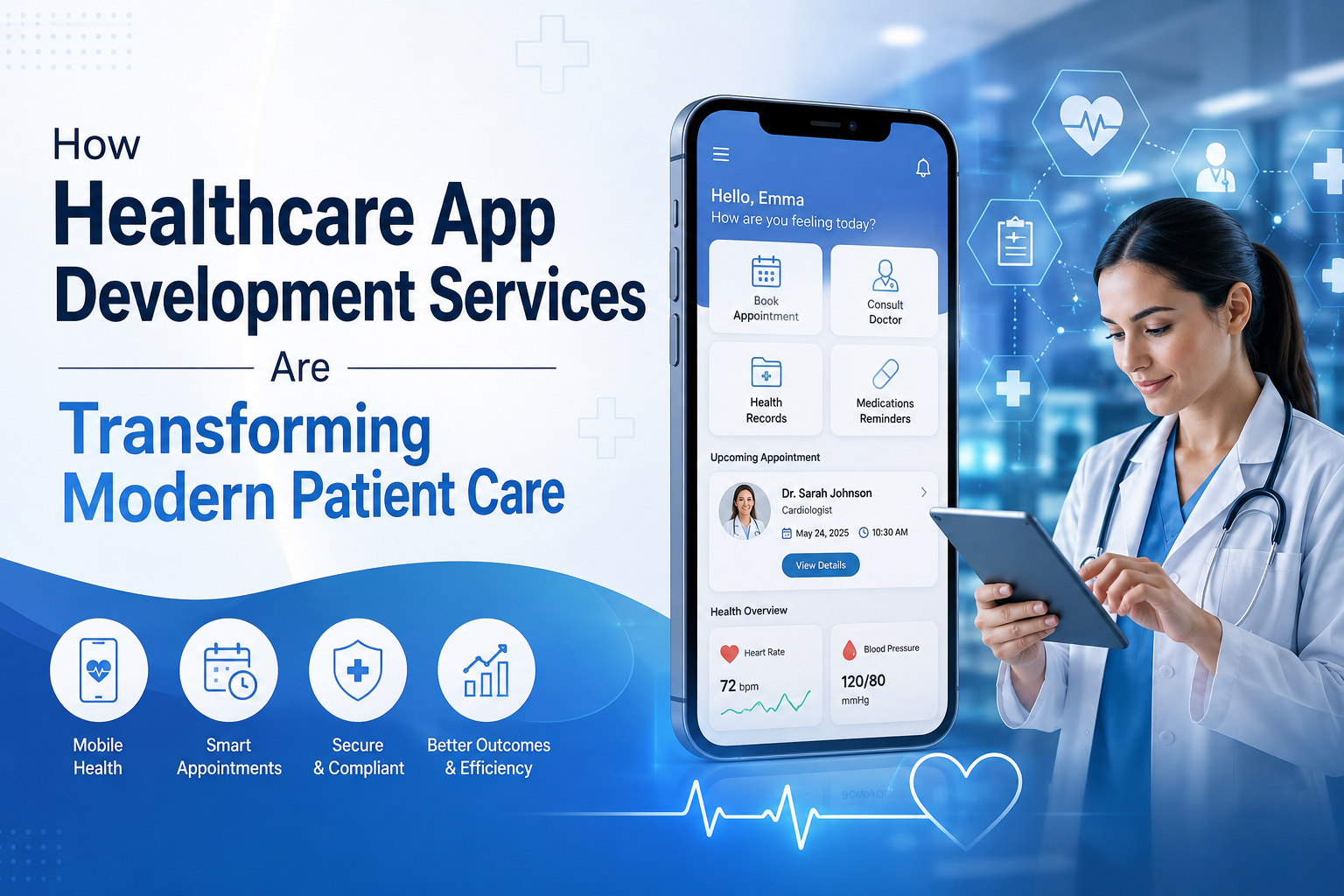
The healthcare industry is rapidly adopting digital technologies to make medical services more accessible, efficient, and patient-focused. Mobile applications have become an important part of this transformation, helping patients connect with healthcare providers, manage appointments, access health information, and receive care remotely.
Healthcare app development services enable hospitals, clinics, healthcare startups, and medical organizations to build customized digital solutions that address specific operational and patient needs. With the right combination of technology, security, and user experience, healthcare applications can improve communication while supporting more convenient healthcare delivery.
What Is Healthcare App Development?
Healthcare app development involves designing and building mobile or web applications for patients, doctors, hospitals, clinics, pharmacies, and other healthcare businesses. These applications can be developed for different purposes, including telemedicine, appointment management, health tracking, medication reminders, remote monitoring, and digital patient engagement.
Unlike conventional mobile applications, healthcare solutions must handle sensitive medical information and often need to integrate with existing healthcare systems. This makes security, compliance, scalability, and reliability important considerations throughout the development process.
A customized healthcare application can help organizations create a connected digital ecosystem where patients and healthcare professionals can interact more efficiently.
Essential Features of Healthcare Applications
The features included in a healthcare application depend on its purpose and target users. However, several functionalities are commonly used to create a complete digital healthcare experience.
1. Appointment Scheduling
Online appointment booking allows patients to view available doctors and schedule consultations through their smartphones. Automated reminders can help reduce missed appointments and improve scheduling efficiency.
2. Telemedicine and Video Consultation
Telemedicine features allow patients to communicate with healthcare professionals without visiting a physical facility. Secure video calls, audio consultations, and in-app messaging can support remote healthcare services.
3. Electronic Health Records
Integration with electronic health records can allow authorized users to access relevant patient information. Proper access controls are essential to ensure that sensitive information is available only to authorized individuals.
4. Digital Prescription Management
Healthcare applications can provide digital prescriptions and medication information. Patients can use the application to review prescribed medicines, dosage instructions, and refill reminders.
5. Health and Fitness Tracking
Applications can connect with smartphones, wearable devices, and other health-monitoring technologies to collect information such as activity levels, heart rate, sleep patterns, and other relevant metrics.
6. Secure Communication
Encrypted messaging can help patients communicate with doctors and healthcare staff. Notifications can also keep users informed about appointments, prescriptions, reports, and other important updates.
Role of Remote Patient Monitoring
One of the most valuable applications of healthcare technology is remote monitoring. Remote patient monitoring software development allows healthcare providers to collect health information from patients outside traditional clinical settings.
Connected devices can capture relevant health metrics and transmit information to healthcare platforms. Healthcare professionals can then review this information through dashboards and identify changes that may require attention.
For patients managing chronic conditions, remote monitoring can support ongoing engagement and reduce the need for unnecessary in-person visits. It can also help healthcare organizations build more connected care models.
Security and Compliance in Healthcare Apps
Security is one of the most important elements of healthcare application development because these platforms may process highly sensitive personal and medical information.
Healthcare applications should incorporate strong authentication, encryption, secure APIs, role-based access controls, secure data storage, and regular security testing. Developers should also consider applicable regulations based on the location, users, and type of healthcare service.
For example, organizations operating in the United States may need to consider HIPAA requirements, while applications handling users in Europe may need to address GDPR requirements. Compliance requirements should be evaluated during the planning and development stages rather than treated as an afterthought.
Benefits of Healthcare App Development Services
A well-designed healthcare application can benefit both healthcare providers and patients.
For patients, mobile healthcare solutions can provide convenient access to consultations, appointments, medical information, prescriptions, and health services. This can create a more flexible and user-friendly healthcare experience.
Healthcare providers can benefit from improved communication, automated workflows, centralized information, and better access to relevant patient data. Digital applications can also reduce repetitive administrative tasks and support more efficient resource management.
Healthcare businesses can use analytics and reporting tools to understand user engagement, operational activity, and service performance. These insights can support better decision-making and help organizations improve their digital healthcare strategies.
How AI Is Shaping Healthcare Applications
Artificial intelligence is introducing new possibilities for healthcare applications. AI-powered systems can assist with tasks such as appointment management, patient communication, data analysis, personalized recommendations, and virtual assistance.
AI chatbots can answer common patient questions and guide users toward relevant services. Predictive analytics can also help organizations identify patterns in healthcare data, although AI systems must be designed responsibly and used with appropriate human oversight.
The goal is not necessarily to replace healthcare professionals but to support them with technology that can automate repetitive tasks and provide useful information.
Choosing the Right Healthcare App Development Partner
Choosing a suitable development partner is important for building a reliable healthcare application. Businesses should evaluate a provider's experience, technical capabilities, security practices, integration expertise, and understanding of healthcare requirements.
Before development begins, organizations should clearly define their target users, business objectives, core features, integrations, budget, and scalability requirements. A strong development strategy should also include UI/UX design, testing, security assessments, deployment, and ongoing maintenance.
The application should be designed with usability in mind. Patients of different ages and technical abilities may use healthcare apps, so simple navigation, accessible interfaces, and clear communication are essential.
Future of Healthcare App Development
Healthcare applications are expected to become increasingly connected as technologies such as AI, cloud computing, wearable devices, IoT, and remote monitoring continue to evolve.
Future applications may provide more personalized experiences, intelligent health insights, automated administrative workflows, and stronger integration between patients, providers, devices, and healthcare systems.
Interoperability will also remain important. Healthcare organizations need digital platforms that can communicate with existing systems while maintaining strong security and privacy controls.
Conclusion
Digital healthcare is changing how patients access services and how healthcare organizations manage their operations. From telemedicine and appointment scheduling to remote monitoring, AI-powered assistance, and digital health records, healthcare applications can create more connected and convenient healthcare experiences.
Businesses looking to enter or expand in the digital healthcare market need solutions that balance functionality, security, compliance, scalability, and user experience. Teqnovos provides technology expertise for businesses seeking to build modern and scalable healthcare applications tailored to their specific requirements. With the right healthcare app development services, organizations can create digital solutions that support better

 English
 Arabic
 French
 Spanish
 Portuguese
 Deutsch
 Turkish
 Dutch
Dutch
 Italiano
 Russian
 Romaian
 Portuguese (Brazil)
